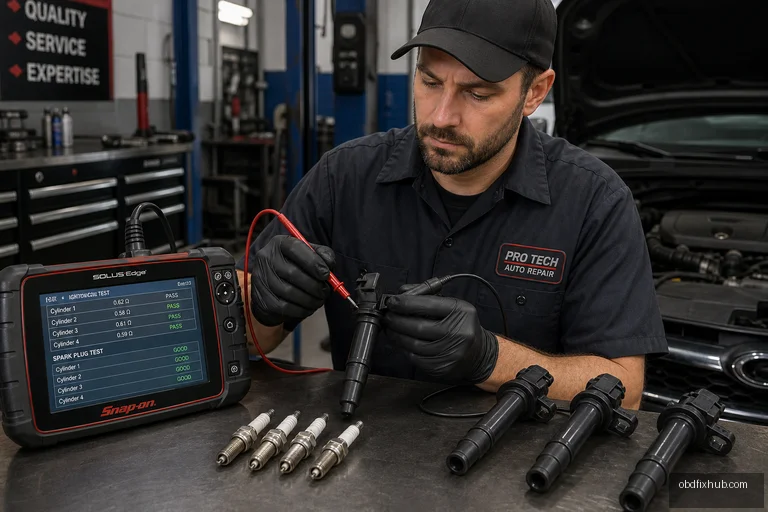
P034C Ion Sense System Performance: Meaning, Causes, Symptoms & Fix
P034C Ion Sense System Performance means the engine computer has detected an implausible or unreliable signal from the ignition system’s ion-sensing circuit. The fault is usually related to an ignition coil, spark plug, wiring, connector, poor ground, or—less commonly—the powertrain control module (PCM). Because the exact ion-sense design varies by vehicle, the correct repair starts with the manufacturer’s wiring diagram and diagnostic procedure rather than replacing parts at random.
Search intent for this code is primarily informational and diagnostic: you want to understand whether the vehicle is safe to drive, identify the likely cause, and decide what to test before spending money on repairs.
What Does P034C Ion Sense System Performance Mean?
Ion sensing is an ignition-monitoring technology used on certain engines to evaluate what happens inside the cylinder after the spark occurs. During combustion, the gases inside the cylinder become electrically conductive. The ignition system can detect this tiny ionization current through the spark plug and use it to assess combustion quality.
The PCM may use the signal to identify misfires, abnormal combustion, or ignition problems without relying only on crankshaft-speed fluctuations. When the ion-sense feedback is missing, too weak, excessively noisy, or inconsistent with engine operating conditions, the PCM stores P034C.
One important point: OBD code definitions can vary by manufacturer. On one vehicle, P034C may involve a dedicated ion-sensing ignition coil; on another, the system may be integrated into a coil pack or controlled through a specialized ignition module. Always verify the factory definition for the exact year, engine, and market.
Common Symptoms of P034C
The symptoms depend on whether the problem affects one cylinder or the entire ignition-monitoring system. A vehicle may run almost normally at light load but misfire when accelerating, climbing a hill, or starting in cold weather.
- Check Engine Light or flashing Malfunction Indicator Lamp
- Rough idle, hesitation, or engine stumble
- Hard starting or extended cranking
- Reduced power and poor throttle response
- Engine misfire codes such as P0300 or cylinder-specific P0301–P0308
- Higher fuel consumption
- Engine stalling, particularly during cold operation
- Failed emissions testing
A flashing Check Engine Light should be treated seriously. It commonly indicates an active misfire that can overheat and damage the catalytic converter. Avoid driving under heavy load until the fault has been diagnosed.
Most Likely Causes of P034C
1. Defective ion-sensing ignition coil or coil pack
The ignition coil is the first component to suspect when the fault is accompanied by a misfire. Internal coil insulation can break down when hot, while a weak secondary winding may produce an ignition event that looks normal at idle but fails under cylinder pressure. On systems with integrated ion sensing, the coil can create both a spark and an unreliable feedback signal.
2. Worn, contaminated, or incorrect spark plugs
Ion-sense systems are sensitive to the electrical behavior of the spark plug. Excessive gap, cracked porcelain, carbon fouling, oil contamination, or an incorrect plug type can distort the signal. A plug that is only slightly worn may still cause a performance code under load, so inspect the gap and plug specification rather than judging the plug by appearance alone.
3. Damaged wiring, terminals, or grounds
Open circuits, short circuits, chafed insulation, water intrusion, and loose terminals can interrupt the low-current ion-sense signal. Heat near the cylinder head and repeated engine movement are common causes of harness damage. A connector may look clean yet have a terminal that has lost tension and makes intermittent contact.
4. Battery or charging-system problems
Low system voltage can weaken ignition performance and make sensor feedback unreliable. Check battery voltage during cranking and charging voltage with the engine running. A failing alternator, poor engine ground strap, or corroded battery terminal can imitate an ignition-component failure.
5. Mechanical or fuel-related misfire
Low compression, a leaking valve, excessive carbon deposits, a vacuum leak, or an injector problem can alter combustion enough to trigger an ion-sense performance fault. This is why replacing a coil immediately is not always successful. If the ignition components test correctly, the cylinder still needs a mechanical and fuel-system evaluation.
6. PCM or ignition-control module fault
Module failure is possible but comparatively uncommon. It should be considered only after power, grounds, wiring, spark plugs, coils, and engine condition have been verified. Software updates or technical service bulletins may also apply on some vehicles.
How to Diagnose P034C Correctly
- Scan all stored and pending codes. Record freeze-frame data, engine temperature, RPM, load, battery voltage, and whether misfire counters identify a particular cylinder.
- Confirm the vehicle-specific code description. Use reliable service information for the exact engine. Do not assume the code has the same circuit layout on every brand.
- Inspect the ignition system. Look for cracked coils, oil in plug wells, damaged boots, incorrect plug gaps, carbon tracking, and moisture around connectors.
- Check the related coil or plug by substitution when appropriate. If the fault or misfire moves to another cylinder after exchanging identical components, the exchanged part becomes a strong suspect. Do not use this method when the manufacturer prohibits component swapping.
- Test power, ground, and signal circuits. A digital multimeter can find a dead supply or obvious open circuit, but an oscilloscope may be needed to identify an intermittent ion-sense waveform or electrical noise.
- Perform a voltage-drop test. Measure voltage drop across the engine ground and ignition grounds while cranking or running. A visually clean ground can still fail under load.
- Verify engine health. If ignition tests pass, perform compression or leak-down testing and check injector operation, fuel pressure, and intake leaks.
- Clear the code and road-test under the original conditions. Recheck pending codes and misfire data after the engine reaches the temperature and load shown in the freeze frame.
Do not probe an ignition secondary circuit casually. Coil output can exceed tens of thousands of volts, and the wrong test method can damage a meter or cause injury. Follow the manufacturer’s test points and use appropriate ignition-system equipment.
P034C Repair: What Usually Fixes It?
The repair depends on the failed component, but common fixes include installing the correct spark plugs, replacing a defective ignition coil or coil pack, repairing a damaged harness, tightening or replacing connector terminals, and restoring engine or ignition grounds. If oil or water is present in the plug well, correct the leak or sealing problem so the replacement parts do not fail again.
After repair, clear the diagnostic trouble codes and complete a proper verification drive. A successful repair should eliminate the original misfire, restore stable combustion feedback, and prevent the code from returning during similar temperature and load conditions.
A Practical Diagnostic Example
Suppose a vehicle logs P034C after a cold morning start and also stores P0302. The engine runs rough for several minutes, but the fault disappears when warm. Inspecting cylinder two may reveal moisture in the plug well or a cracked coil boot. Swapping the coil with cylinder four and seeing the misfire move to P0304 is stronger evidence than simply installing a new coil because the fault follows the component.
By contrast, if the misfire stays on cylinder two, test the plug, injector, compression, wiring, and connector tension. This approach prevents an unnecessary coil replacement when the real problem is a leaking injector, poor compression, or a damaged ion-sense wire.
Can You Drive With P034C?
Short-distance driving may be possible if the engine runs smoothly and the Check Engine Light is steady, but the vehicle should still be diagnosed promptly. Continued misfire can send unburned fuel into the catalytic converter and cause expensive damage. Stop driving and arrange repair if the light flashes, the engine shakes severely, power drops sharply, or the vehicle stalls.
Summary: The Best Next Step
P034C is an ignition-feedback performance code, not a diagnosis of one specific part. Start with the scan data, inspect the plugs and coils, verify power and grounds, and then test the ion-sense circuit using vehicle-specific information. If basic ignition checks pass, investigate fuel delivery, compression, and module software before condemning the PCM.
For the most efficient repair, record every related code and freeze-frame detail before clearing anything. That information often reveals whether P034C is the primary fault or a secondary result of a cylinder misfire.
Frequently Asked Questions
Is P034C the same as a camshaft sensor code?
No. P034C concerns ion-sensing ignition feedback on applications that use this technology. It should not be automatically confused with P0340-series camshaft position sensor codes.
Can bad spark plugs cause P034C?
Yes. Incorrect plug type, excessive gap, fouling, cracked ceramic, or contamination can change the spark and ionization signal enough to trigger the code.
Will replacing the ignition coil always fix P034C?
No. A coil is a common cause, but wiring, connectors, grounds, plugs, low compression, injector faults, and charging problems can produce similar symptoms. Confirm the failure with testing whenever possible.
Is P034C safe to ignore if the car still runs?
Ignoring it is risky, especially if the Check Engine Light flashes or the engine misfires. Continued misfire can damage the catalytic converter and may leave you with a no-start or stalling condition.
Do I need a specialist to diagnose P034C?
Basic inspections and plug or coil testing may be possible at home, but the ion-sense circuit can require a wiring diagram, oscilloscope, or manufacturer-specific scan data. A qualified technician is recommended when the fault is intermittent or returns after parts replacement.




