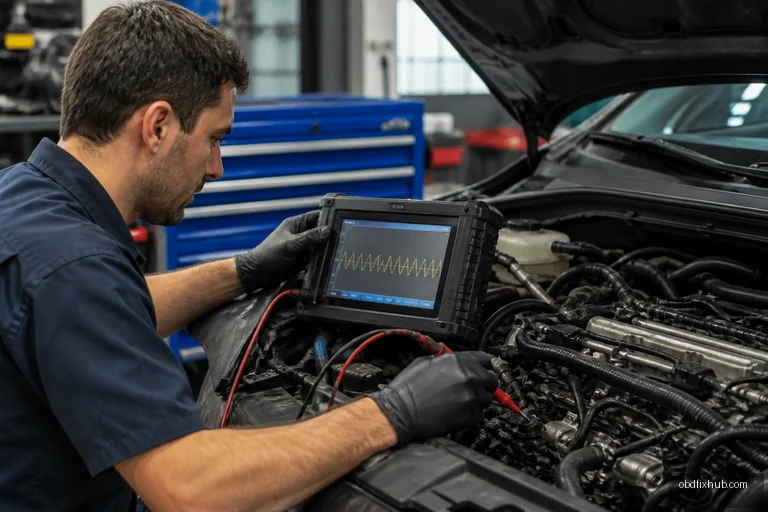
P0370 means the engine control module has detected a problem with the high-resolution timing reference signal A. In practical terms, the PCM is not receiving a clean, correctly timed pulse pattern from the crankshaft or related timing-reference circuit. The result can be anything from a check-engine light with no noticeable drivability issue to hard starting, stalling, misfires, or a complete no-start condition.
This is an information and diagnosis code, not a command to replace the crankshaft position sensor immediately. The exact signal source is manufacturer-specific, so the wiring diagram, service information, and related trouble codes matter before any parts are installed.
What Does P0370 Mean?
P0370 is a generic OBD-II description for Timing Reference High Resolution Signal A Malfunction. The engine computer uses a high-resolution timing signal to determine crankshaft speed and position with enough precision to control ignition timing, injector timing, variable valve timing, and misfire detection.
On many engines, this signal comes from a crankshaft position sensor reading a toothed reluctor wheel. On some applications, the timing reference may be generated through a camshaft sensor, distributor pickup, optical encoder, or a dedicated high-resolution timing circuit. That variation explains why the same P0370 code can require different tests on different vehicles.
Common Symptoms of P0370
The symptoms depend on whether the signal is intermittently distorted or completely missing. A vehicle that runs normally but stores P0370 may have a connector, shielding, or synchronization problem that appears only at certain engine speeds or temperatures.
- Illuminated check-engine light, sometimes with a flashing light during misfire events
- Extended cranking, hard starting, or a no-start condition
- Engine stalling when hot, during deceleration, or over bumps
- Rough running, hesitation, bucking, or reduced engine power
- Ignition misfires and poor fuel economy
- Erratic tachometer movement or loss of RPM data while cranking
- Additional crankshaft, camshaft, misfire, or synchronization codes
A useful workshop clue is the scan tool RPM reading during cranking. If the scanner shows zero RPM while the starter is turning the engine, the PCM may not be receiving a usable crank signal. However, a normal RPM value does not prove the waveform is correct; a signal can be present but electrically noisy, incorrectly shaped, or missing individual pulses.
Most Common Causes of the P0370 Code
1. Failing crankshaft or timing-reference sensor
Hall-effect and variable-reluctance sensors can fail with age, heat, vibration, or internal electronic damage. A sensor may work when cold and fail after the engine reaches operating temperature. This pattern is frequently misdiagnosed because the vehicle may restart after cooling down.
2. Damaged reluctor wheel or incorrect sensor air gap
A bent, cracked, loose, or damaged reluctor can create a missing or distorted pulse. Metal debris stuck to a magnetic sensor can also weaken the signal. On engines where the sensor position is adjustable, excessive air gap is a common cause of a weak waveform.
3. Wiring and connector faults
Open circuits, shorted signal wires, poor grounds, backed-out terminals, and corrosion inside the connector can all set P0370. Pay particular attention to wiring routed near ignition coils, alternators, starter cables, exhaust manifolds, and variable valve timing solenoids. Heat-damaged insulation may look acceptable until the harness is flexed.
4. Electrical interference or poor shielding
High-resolution timing signals are sensitive to electrical noise. Incorrectly routed aftermarket audio wiring, remote-start equipment, poor engine grounds, or a damaged shield can introduce interference that is visible on an oscilloscope but not detectable with a basic multimeter.
5. Timing or mechanical problems
A stretched or jumped timing chain, loose reluctor, damaged timing gear, or incorrect cam-to-crank alignment can produce a valid-looking sensor signal that occurs at the wrong time. If P0370 appears with cam/crank correlation codes, mechanical timing must be checked rather than treating the sensor as the only suspect.
6. PCM or timing-reference module failure
Control-module failure is possible, but it should be considered only after power, ground, wiring integrity, sensor type, and waveform quality have been verified. Replacing a PCM without proving the input circuit is a costly and unreliable diagnostic shortcut.
How to Diagnose P0370 Correctly
- Record all codes and freeze-frame data. Note engine speed, coolant temperature, battery voltage, and whether the code is pending, stored, or current. Related codes often reveal whether the fault is electrical or mechanical.
- Confirm the complaint. Check whether the engine cranks normally, whether the tachometer moves, and whether the fault occurs hot, cold, under load, or after vibration.
- Inspect the sensor and harness. Look for oil contamination, damaged insulation, loose mounting bolts, corrosion, and contact with moving or hot components. Repair the cause of a harness rub rather than simply taping the visible spot.
- Verify power, ground, and reference voltage. Use the manufacturer’s pinout. Do not assume every three-wire sensor uses the same wire arrangement; applying battery voltage to a signal terminal can damage the sensor or PCM.
- Test the signal with the correct tool. A multimeter can identify an open circuit or missing supply, but an oscilloscope is the preferred tool for examining pulse amplitude, frequency, dropouts, noise, and synchronization. Compare the crank and cam patterns with known-good waveforms when available.
- Check mechanical timing if needed. If the waveform is stable but the phase relationship is wrong, inspect timing marks, chain or belt condition, reluctor alignment, and sensor mounting.
- Clear the code and perform a verification drive. Monitor engine RPM, synchronization status, misfire counters, and the timing-reference signal while reproducing the original conditions.
P0370 Fixes That Usually Solve the Problem
The correct repair depends on the test result. Common successful repairs include replacing a failed crankshaft or timing-reference sensor, repairing a broken or corroded terminal, restoring a sensor ground, replacing heat-damaged wiring, correcting sensor air gap, securing a loose reluctor, or repairing a slipped timing chain.
When installing a new sensor, clean the mounting surface and confirm that the sensor is fully seated. Some sensors require a precise spacer or air gap, while others use a non-adjustable mounting design. A sensor installed at the wrong depth can produce the same code as a defective sensor.
After a repair, inspect live data during both cold and hot operation. A vehicle that starts easily immediately after the repair may still have an intermittent fault that returns only after heat soak. Where the manufacturer specifies it, perform a crankshaft position variation relearn using a capable scan tool.
Can You Drive With a P0370 Code?
Short-distance driving may be possible if the engine runs smoothly and the code is only pending, but continued use carries a real risk of stalling or refusing to restart. Avoid driving if the check-engine light is flashing, the engine is misfiring, the vehicle loses power, or the tachometer drops out unexpectedly.
If the vehicle stalls in traffic, the safety risk is more important than the cost of a diagnostic visit. Towing is the sensible option when the engine will not start or the timing signal disappears intermittently.
Key Takeaway
P0370 identifies a malfunction in a high-resolution engine timing signal, but it does not identify one guaranteed failed part. Start with the code context, inspect the harness and connectors, verify sensor power and ground, and use an oscilloscope when the fault is intermittent or difficult to reproduce. Correct diagnosis prevents unnecessary sensor, timing-chain, or PCM replacement.
Action step: Scan for companion codes and check the RPM signal during cranking before ordering parts. If P0370 returns after a sensor replacement, test the waveform and mechanical timing rather than installing another sensor.
Frequently Asked Questions About P0370
Is P0370 caused by a bad crankshaft position sensor?
It can be, but not always. The code may also result from damaged wiring, a poor ground, electrical interference, an incorrect sensor air gap, a damaged reluctor, or a mechanical timing problem. Testing the circuit and waveform is more reliable than replacing the sensor based on the code alone.
Will P0370 prevent my car from starting?
Yes, if the PCM cannot determine crankshaft position from the timing-reference signal. An intermittent fault may cause extended cranking or hot-start problems, while a complete signal loss can produce a no-start condition.
What is the fastest first check for P0370?
Check all stored and pending codes, then watch engine RPM on a scan tool while cranking. Follow that with a careful inspection of the sensor connector and harness, especially near heat sources and moving engine components.
Can low battery voltage set P0370?
Low voltage can create misleading sensor and communication faults, particularly during cranking. Test battery voltage and voltage drop across the engine grounds, but do not assume the battery is the root cause if the code returns with normal cranking voltage.




