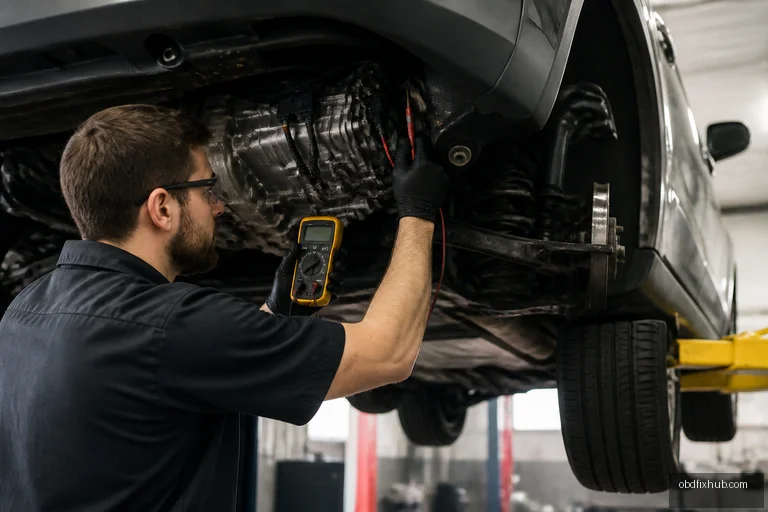
P0657 means the powertrain control module has detected a problem in the actuator supply voltage “A” circuit, usually an open circuit, missing voltage or an electrical fault affecting one or more electronically controlled components. The code does not identify a failed actuator by itself. A damaged wire, blown fuse, poor ground, corroded connector or internal control-module fault can produce exactly the same warning.
This is primarily an electrical diagnosis problem, not a reason to replace a transmission or a group of actuators immediately. The correct repair depends on which module set the code, what “A” supplies on that vehicle and whether the voltage disappears under load.
What Does P0657 Actuator Supply Voltage “A” Circuit/Open Mean?
Modern vehicles use a regulated power feed to operate solenoids, motors and other actuators. The engine or transmission control module monitors that feed and expects to see a usable voltage within a calibrated range. When the monitored circuit is open, severely low, shorted through another circuit or missing under certain conditions, the module stores P0657.
The letter “A” is not a universal name for one specific component. It is a manufacturer-defined circuit designation. On one vehicle it may feed transmission shift solenoids; on another, it may supply an emissions actuator, throttle-related device or a valve in an integrated control system. Always use the wiring diagram for the exact year, engine, transmission and market.
Common Symptoms of P0657
The symptoms depend on which actuators have lost their supply. Some vehicles drive almost normally while others enter a protective strategy within seconds of starting.
- Check Engine, transmission or powertrain warning light
- Harsh, delayed or incorrect gear changes
- Transmission stuck in one gear or limp mode
- Engine hesitation, stalling or difficult starting
- Reduced throttle response or limited engine power
- Non-working solenoids, valves or electronically controlled accessories
- Additional actuator, communication or low-voltage fault codes
A useful field clue is a cluster of unrelated actuator codes appearing at the same time. That pattern usually points toward a shared fuse, relay, ground or supply wire rather than several components failing independently.
What Causes the P0657 Code?
- Blown actuator supply fuse caused by an overloaded or shorted component
- Failed power relay or relay socket with heat damage
- Open, rubbed-through or broken wiring near the transmission or engine
- Water, oil or corrosion inside a connector
- Loose battery terminal, weak ground strap or low system voltage
- Shorted solenoid or actuator pulling the shared supply down
- Aftermarket wiring, remote-start equipment or an incorrect repair
- Rarely, a damaged PCM, TCM or integrated transmission controller
On vehicles exposed to road salt, inspect the underside harness before condemning a control module. A wire can look intact through its insulation yet be broken internally where the harness flexes beside a transmission mount.
How to Diagnose P0657 Correctly
A professional diagnosis starts with the complete fault-code record, not just the P0657 definition. Record freeze-frame data, battery voltage, engine temperature and whether the code is current or historic. Then check every module, because a transmission controller may report useful companion codes that a basic engine-code reader cannot display.
- Check battery and charging voltage. A fully charged battery is normally close to 12.6 volts with the engine off, while a running charging system is commonly around 13.5–14.8 volts. Use the vehicle’s specifications, especially on smart-charging systems.
- Inspect the relevant fuses and relays. Do not rely only on visual inspection. Test for voltage on both sides of the fuse with the circuit switched on. If a replacement fuse fails immediately, find the short instead of installing a larger fuse.
- Identify circuit “A” in the factory wiring diagram. Trace its power source, splice points, connectors and connected actuators. Generic code descriptions cannot tell you which wire to probe.
- Measure voltage at the actuator and module. A circuit may show battery voltage with no load but collapse when the actuator is connected. A test light or suitable load test often reveals a high-resistance connection that a digital meter misses.
- Perform voltage-drop testing. With the circuit operating, measure from battery positive to the actuator supply and from the actuator ground to battery negative. Excessive voltage drop identifies resistance in the cable, terminal, relay or ground path.
- Test the actuator before replacing the controller. Disconnect the suspected solenoid or motor and check resistance only against the manufacturer’s specification. An ohm reading alone cannot prove that an actuator works under load, but it can expose an obvious open or short.
- Clear the code and verify the repair. Drive through the conditions shown in the freeze-frame data, then rescan all modules. A repair is not confirmed simply because the warning light goes out after clearing codes.
Vehicle-Specific Meaning: Allison, Maruti, Range Rover and Honda CR-V
Allison transmission and P0657
If an Allison-equipped vehicle displays P0657, the fault may involve the transmission control system’s shared actuator power feed. Depending on the application, the code may be stored by the TCM, ECM or a body-integrated controller, and the scan tool may also show manufacturer-specific Allison or J1939 faults. Check the transmission harness, external connector, ignition feed, grounds and the supply to the shift solenoids before considering a valve body or TCM replacement.
Maruti Suzuki vehicles in India
On a Maruti vehicle, “actuator supply voltage A circuit open” indicates that the relevant control module cannot verify the expected supply to a manufacturer-defined actuator circuit. The exact component varies by model and engine; it might relate to an automated-manual transmission actuator, an emissions control device or another electronically operated system. Indian-market wiring, connector locations and fuse labels can differ from export models, so use the Maruti service manual and VIN-specific wiring diagram.
Range Rover
In a Range Rover, P0657 should be interpreted alongside the module that logged it. Low battery voltage, water intrusion, ground problems and network-related faults are common complications on vehicles with many electronic control units. Scan the ECM, TCM and body modules with a tool capable of Land Rover communication, then test the affected supply at the connector rather than assuming the transmission actuator is defective.
Honda CR-V
On a Honda CR-V, the code can indicate an open or abnormal power feed used by a PCM-controlled actuator circuit, but the exact application changes by generation, engine and transmission. Inspect the under-hood fuse box, PCM connectors, transmission harness and grounds. If P0657 appears with multiple low-voltage or solenoid codes, diagnose the common supply first; replacing one solenoid may not solve the root cause.
Can You Drive With P0657?
Short-distance driving may be possible if the vehicle has normal throttle response, stable shifting and no overheating or stalling. However, a vehicle in limp mode, one that cannot select gears, or one that stalls in traffic should be towed. Continuing to drive with incorrect transmission control can increase clutch wear, while an exposed short may damage a fuse, harness or control module.
Typical Repair Costs and Practical Advice
The least expensive repairs are often a fuse, terminal repair, ground correction or damaged wire. Costs rise when the harness is difficult to access or when a shorted solenoid has damaged a driver inside the controller. Ask the repairer for the measured supply voltage, voltage-drop results and the reason a module was condemned; “P0657 means the actuator is bad” is not a sufficient diagnosis.
Final Takeaway
P0657 identifies a problem with an actuator power-supply circuit, not a guaranteed failed part. Start with battery voltage, fuses, relays, grounds and connector condition, then follow the manufacturer’s circuit diagram and test the supply under load. If the code returns, use a capable scan tool to determine which module and actuator circuit are actually involved before authorizing expensive parts.
Frequently Asked Questions
What does the Allison transmission fault code P0657 mean?
It generally indicates a fault in the monitored actuator supply circuit used by the Allison transmission control system. Confirm the source module and inspect the shared power feed, transmission harness, connectors, grounds and related solenoid codes.
What does P0657 mean on a Maruti vehicle in India?
It means the control module detected an open or abnormal voltage condition in a manufacturer-defined actuator supply circuit. The affected actuator differs by model, so a Maruti-specific wiring diagram and scan procedure are required.
What does P0657 mean in a Range Rover?
It indicates an electrical problem with an actuator supply circuit monitored by one of the vehicle’s control modules. Low battery voltage, corrosion, water intrusion and wiring faults should be checked before replacing a transmission or control module.
What does P0657 mean on a Honda CR-V?
It indicates that the PCM has detected a missing, open or abnormal supply in a designated actuator circuit. Check the fuse box, PCM and transmission connectors, grounds and the circuit’s voltage under load using the correct model-year information.




