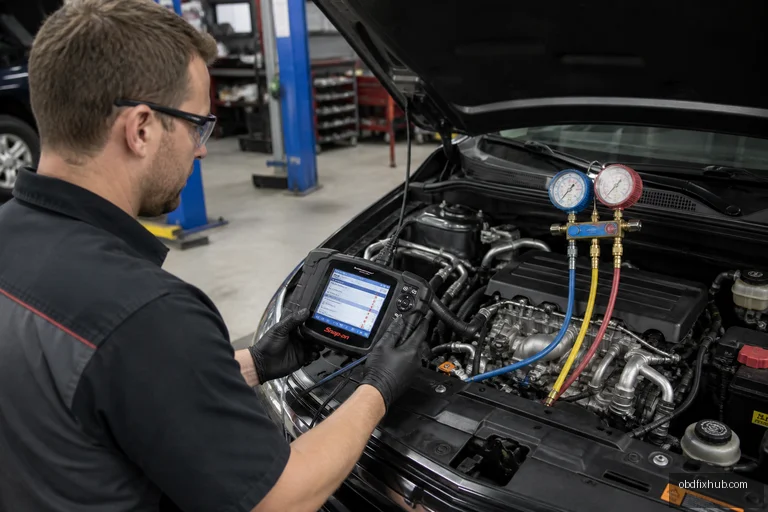
P06A0 means the engine or powertrain control module has detected a problem in the variable A/C compressor control circuit. The fault may involve the compressor control valve, wiring, connector, fuse, relay, pressure signal, or the compressor itself. A stored P06A0 does not automatically mean the compressor must be replaced; accurate circuit testing is the fastest way to avoid an expensive misdiagnosis.
What Does the OBD Code P06A0 Mean?
OBD-II code P06A0 is defined as “Variable A/C Compressor Control Circuit”. It is a powertrain-related diagnostic trouble code used on vehicles equipped with a variable-displacement air-conditioning compressor or electronically controlled compressor system.
Unlike a traditional compressor that is simply switched on and off with a magnetic clutch, a variable compressor can adjust its pumping capacity. The vehicle computer controls this capacity through an electronic solenoid or control valve. By changing the valve command, the system can regulate cabin temperature, reduce engine load, and improve fuel efficiency.
When the module sees an electrical value that does not match the expected command—such as an open circuit, short to ground, short to voltage, or an implausible feedback signal—it may set P06A0. The exact detection strategy varies by manufacturer, so the vehicle-specific service manual remains important.
Common Symptoms of P06A0
Some vehicles will still produce cool air with this code stored, while others will disable the A/C to protect the system. Typical symptoms include:
- Air conditioning that blows warm or only mildly cool air
- A/C that works intermittently, especially at idle or in heavy traffic
- The compressor running continuously or not engaging at all
- Rapid cycling, unusual compressor noise, or unstable vent temperature
- Reduced engine performance when the A/C is switched on
- An illuminated Check Engine Light, A/C warning, or climate-control fault
A useful real-world clue is the difference between an A/C system that is cold at highway speed but warm at idle and one that never cools at any speed. The first pattern can point toward low refrigerant charge, condenser airflow, or compressor capacity control. A system that never responds may have an electrical open circuit or a control module lockout.
Most Common Causes of the P06A0 Code
- Failed compressor control valve: The valve may be electrically open, shorted, mechanically stuck, or contaminated by compressor wear debris.
- Damaged wiring or connector: Wiring near the compressor is exposed to heat, vibration, oil, water, and road debris. A terminal can spread or corrode without looking severely damaged.
- Blown fuse or defective relay: A power supply fault can prevent the compressor control circuit from operating.
- Incorrect refrigerant charge: Low refrigerant, overcharging, or air in the system can create pressure readings that cause the module to inhibit compressor operation.
- Compressor internal failure: A seized, worn, or contaminated compressor can cause abnormal control behavior and may damage the replacement valve.
- Faulty pressure sensor or climate-control input: The control module may shut down the compressor if pressure information is implausible.
- Control module or software problem: This is less common than wiring, power, or component faults and should be considered only after basic tests pass.
How to Diagnose P06A0 Correctly
Do not begin by ordering a compressor. A professional diagnosis should establish whether the problem is electrical, mechanical, or related to refrigerant pressure.
1. Check for related codes and freeze-frame data
Scan every relevant module, not just the engine computer. Codes for A/C pressure, battery voltage, communication, fan operation, or clutch control can explain why P06A0 was set. Freeze-frame data can show whether the fault occurred at idle, under acceleration, during a high-pressure event, or immediately after startup.
2. Inspect power, ground, and the compressor connector
With the ignition off, inspect the connector for oil contamination, green corrosion, pushed-back terminals, broken locking tabs, or wires rubbing against the compressor housing. Check the A/C fuse and relay using a wiring diagram rather than relying only on visual inspection. A fuse that looks intact can still have voltage on one side only.
3. Test the control valve circuit
Measure the control valve resistance only according to the manufacturer’s specification. Some valves use a simple coil, while others are controlled by a pulse-width-modulated signal and may require a scope or bidirectional scan tool. A resistance reading that is technically present does not prove the valve can move or respond under operating conditions.
With a capable scan tool, command the A/C compressor or vary the compressor displacement command while monitoring refrigerant pressure, commanded duty cycle, actual feedback, and vent temperature. If the command changes but pressure and cooling do not respond, the valve or compressor may be mechanically faulty. If the command never reaches the compressor, concentrate on the wiring, power supply, module logic, or enable conditions.
4. Verify refrigerant pressure and condenser airflow
Use proper A/C gauges and follow the vehicle’s charging procedure. Do not add refrigerant simply because the air is warm. An overcharged system can produce high pressure and cause the module to disable the compressor, while an undercharged system can result in poor cooling and compressor protection shutdown.
Confirm that the radiator and condenser fans operate when commanded. A blocked condenser, failed fan, or excessive high-side pressure can imitate a compressor control fault. Refrigerant recovery and charging should be performed with approved equipment because venting refrigerant is unsafe and illegal in many locations.
What Does Ford Code P06A0 00 6C Mean?
On some Ford scan tools, the code may appear as P06A0:00-6C or P06A0 00 6C. The base code still refers to the variable A/C compressor control circuit, while the additional characters are Ford’s failure-type, status, or diagnostic information. Their precise interpretation can vary by model year, module, and scan-tool software.
For that reason, “00 6C” should not be treated as a universal replacement instruction. On a Ford Fusion, F-150, Escape, or another model, diagnosis may involve the compressor displacement solenoid, a dedicated A/C control circuit, pressure transducer data, the HVAC module, or the PCM. The correct next step is to use the factory wiring diagram and Ford pinpoint test for that vehicle’s engine and climate-control configuration.
Symptoms of a Bad A/C Compressor Control Valve
A failing control valve often causes inconsistent cooling rather than a completely dead A/C system. Common signs include cold air that becomes warm at idle, temperature changes when engine speed changes, compressor operation without adequate cooling, or pressure readings that do not respond normally to commanded displacement.
The valve may also stick after compressor wear contaminates the oil. In that situation, replacing only the valve can provide temporary relief but may fail again if metal debris remains in the compressor or refrigerant circuit. A technician should inspect the removed valve, compressor oil, and system condition before deciding whether a compressor replacement and system flush are necessary.
Symptoms of a Bad A/C Clutch Relay
A bad A/C clutch relay usually affects vehicles that use a conventional electromagnetic clutch. Symptoms can include a clutch that never clicks on, an A/C system that works intermittently, a compressor that remains engaged after the A/C is switched off, or a relay that becomes excessively hot. A blown fuse or repeated relay failure can indicate a shorted clutch coil or damaged wiring.
However, many modern variable-displacement compressors do not use a conventional clutch relay in the same way. Some have a continuously driven pulley and an electronic control valve instead. Therefore, replacing the clutch relay will not fix every P06A0 fault. First identify whether the vehicle has a clutch-controlled or variable-capacity compressor.
How Is P06A0 Fixed?
The repair depends on the confirmed failure:
- Repair chafed wiring, poor grounds, loose terminals, or corroded connectors.
- Replace a failed fuse or relay after finding the reason it failed.
- Replace the compressor control valve if the valve is separately serviceable and the compressor is otherwise healthy.
- Replace the pressure sensor when its signal is outside specification and wiring is sound.
- Repair or replace the compressor if it is seized, internally damaged, or contaminated.
- Recover, evacuate, leak-test, and recharge the A/C system using the specified refrigerant weight.
- Perform any required module software update, relearn, or A/C initialization after repair.
After the repair, clear the code and test the system under the conditions that originally triggered it. Check vent temperature, high- and low-side pressure, compressor command, fan operation, and code status during both idle and road testing. A code that returns immediately with the connector unplugged points in a different direction than one that returns only after several minutes of high-load operation.
Can You Drive With P06A0?
Usually, the vehicle can be driven if the engine runs normally and there are no overheating or belt-noise symptoms. The A/C may remain disabled, and continued operation with a noisy or failing compressor can spread debris through the system or damage the serpentine belt. Stop driving and investigate promptly if the compressor is seized, the belt is slipping, the relay is overheating, or the engine temperature rises.
Key Takeaway
P06A0 identifies a fault in the variable A/C compressor control circuit, not a guaranteed compressor failure. Start with related codes, wiring, power supply, pressure data, and the compressor control signal. Proper testing can distinguish a low-cost connector or valve repair from a compressor replacement—and prevents unnecessary parts swapping.
Frequently Asked Questions
What does the OBD code P06A0 mean?
P06A0 means the vehicle computer detected an electrical or operational problem in the variable A/C compressor control circuit. The fault may involve the control valve, wiring, relay, pressure inputs, or compressor.
What are the symptoms of a bad A/C compressor control valve?
Typical symptoms include intermittent cooling, warm air at idle, unstable vent temperature, abnormal compressor pressure response, and a P06A0 code. A stuck valve may cause the compressor to run without producing sufficient cooling.
What does Ford error code P06A0 00 6C mean?
It is a Ford-specific presentation of the P06A0 variable A/C compressor control fault. The added “00 6C” information must be interpreted with the exact Ford model, module, and factory diagnostic procedure.
What are the symptoms of a bad A/C clutch relay?
A failed clutch relay can cause no compressor engagement, intermittent A/C operation, a compressor that stays engaged, or a repeatedly blown fuse. This applies mainly to clutch-equipped systems; some variable compressors use an electronic control valve instead of a conventional relay-controlled clutch.




