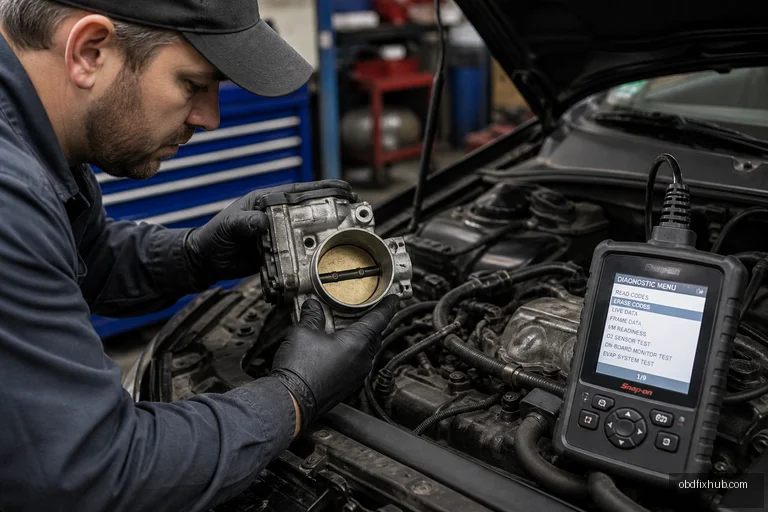
Search intent: informational. The P069F throttle actuator control lamp circuit code means the engine computer has detected a fault in the electrical circuit that controls the throttle actuator warning lamp. It does not automatically mean the throttle body is stuck or that the actuator motor has failed. In practice, the problem may be a damaged wire, poor connector, blown fuse, instrument-cluster fault, or a control-module communication issue—and the underlying throttle system must be tested before parts are replaced.
What Does P069F Mean?
P069F is a manufacturer-supported OBD-II diagnostic trouble code defined as Throttle Actuator Control Lamp Control Circuit. The throttle actuator control system uses electronic signals rather than a traditional mechanical cable to regulate the throttle plate. If the powertrain control module, or PCM, cannot correctly control or monitor the warning-lamp circuit, it stores P069F.
The lamp may be labeled ETC, Electronic Throttle Control, or appear as a lightning-bolt symbol, depending on the vehicle. Because manufacturers design this circuit differently, the exact test procedure and wiring layout must come from the vehicle-specific service manual. A code definition from a generic scanner is a useful starting point, not a complete diagnosis.
P069F Symptoms You May Notice
The most obvious symptom is an illuminated check-engine light or electronic-throttle warning indicator. Some vehicles drive normally because the fault is limited to the lamp-control circuit; others enter reduced-power mode if the PCM also detects an actual throttle-control problem.
- Check-engine light or ETC warning lamp illuminated
- Reduced engine power, limp mode, or limited throttle response
- Delayed acceleration or inconsistent engine speed
- Hard starting, stalling, or an engine that will not start
- Throttle warning light that stays on, fails to illuminate, or behaves intermittently
- Additional throttle-position, accelerator-pedal, or communication codes
A useful workshop clue is whether the vehicle has normal throttle response and only P069F. That pattern points more strongly toward the lamp circuit, wiring, cluster, or module output than toward a physically defective throttle plate.
Common Causes of the P069F Code
- Open, shorted, or corroded wiring in the throttle warning-lamp circuit
- Loose, water-damaged, or pushed-out terminals at the PCM, cluster, or related connector
- Blown fuse or poor power or ground supply
- Failed instrument cluster or warning-lamp driver
- PCM or throttle-control-module output fault
- Software calibration problem or a module that requires reprogramming
- Battery-voltage instability after a weak battery, jump-start, or charging-system problem
- An underlying electronic-throttle fault that has triggered the warning circuit
On vehicles exposed to road salt, inspect connectors near the engine bay and under-dash harnesses carefully. A terminal can look clean from the outside yet lose tension and create an intermittent open circuit when the engine moves on its mounts.
How to Diagnose P069F Correctly
- Record every stored code and freeze-frame value. Do not diagnose P069F in isolation. Codes for throttle position, accelerator-pedal position, CAN communication, or low voltage may identify the primary fault.
- Check battery and charging voltage. Low system voltage can create misleading electronic-throttle and lamp-circuit codes. Correct the power supply problem before testing modules.
- Verify the warning lamp operation. Use the scan tool’s output-control function if supported. Determine whether the lamp is commanded on but does not illuminate, or whether the module cannot command it at all.
- Inspect fuses, grounds, and connectors. Look for moisture, green corrosion, overheated terminals, aftermarket alarm wiring, and harness damage near the throttle body and PCM.
- Test circuit continuity and voltage under load. A simple continuity check can miss a high-resistance connection. Use a wiring diagram, back-probe the circuit, and perform a voltage-drop test while the lamp is commanded on.
- Check for technical service bulletins and software updates. Some vehicles need PCM, body-control-module, or instrument-cluster programming rather than a replacement part.
- Clear the code and confirm the repair. Road-test the vehicle through the conditions shown in the freeze-frame data, then rescan for pending and stored codes.
How to Fix P069F
The correct repair depends on the failed part. Repair damaged wiring with the proper automotive-grade wire and sealed terminals; do not twist wires together and cover them with ordinary household tape. Clean only approved electrical contacts, restore connector terminal tension, and repair water leaks that caused the corrosion.
If the warning lamp itself or its driver inside the instrument cluster has failed, the cluster may require professional repair, replacement, or configuration. If testing proves that the PCM cannot operate the circuit and power, ground, and wiring are good, module programming or replacement may be necessary. A replacement PCM normally requires immobilizer setup and vehicle-specific calibration.
Do not replace the throttle body simply because P069F contains the word throttle. A throttle body replacement is justified only when testing confirms a motor, position sensor, gear, or internal throttle fault. After throttle-body service, some vehicles require an electronic throttle relearn procedure using a scan tool.
What If the Throttle Actuator Control System Is Stuck Open?
P069F alone does not prove that the throttle actuator is stuck open. A stuck-open condition is usually associated with separate throttle-position or actuator-performance codes, symptoms such as unexpectedly high idle, poor engine braking, or an engine that does not respond correctly to the accelerator.
With the ignition off, inspect the throttle body for heavy carbon buildup, a damaged blade, broken return mechanism, or foreign material. Do not force an electronically controlled throttle plate aggressively by hand; the gears and position sensors can be damaged. Use live scan data to compare commanded throttle angle with actual angle, and follow the manufacturer’s cleaning and relearn procedure.
What Does Throttle Actuator Control Motor Circuit Open Mean?
A throttle actuator control motor circuit open means the electrical path to the throttle motor is interrupted. Possible causes include a broken wire, disconnected connector, failed motor winding, blown fuse, or a module that cannot provide the motor’s power or ground. This is different from P069F, which specifically concerns the warning-lamp control circuit.
Codes such as P2101, P2118, or manufacturer-specific throttle actuator codes are more likely when the motor circuit or throttle performance is the main problem. Always identify the exact code and vehicle before using a generic repair guide.
Where Is the Throttle Actuator Control Module Located?
There is no universal location. On many modern vehicles, the throttle actuator electronics are integrated into the throttle body, which is mounted between the air-intake tube and the intake manifold. On other vehicles, throttle-control functions are managed by the PCM or a separate engine-control module located in the engine bay, near the firewall, or inside the passenger compartment.
The instrument cluster or body-control module may control the warning-lamp side of the circuit. Use the wiring diagram and connector views for the specific year, make, engine, and transmission rather than searching for a component with the exact name shown by the scan tool.
Can You Drive With P069F?
If the vehicle has normal acceleration and only the check-engine light is on, a short trip to a repair facility may be reasonable. Do not continue driving if the vehicle is in reduced-power mode, stalls, surges, has unpredictable throttle response, or shows an electronic-throttle warning that flashes. Loss of throttle control can create a serious safety risk, especially when merging or crossing traffic.
Key Takeaway
P069F identifies a problem with the throttle actuator warning-lamp control circuit—not automatically a bad throttle body. Start with all stored codes, battery voltage, fuses, connector condition, wiring tests, and scan-tool output controls. Repair the confirmed circuit or module fault, then perform any required throttle or module relearn before returning the vehicle to service.
Frequently Asked Questions
What are the symptoms of a bad throttle actuator control module?
Possible symptoms include reduced power, poor throttle response, stalling, an ETC warning lamp, unusual idle, and related throttle-position or communication codes. However, these symptoms can also result from wiring, the throttle body, the accelerator pedal sensor, or low voltage.
Where is the throttle actuator control module located?
It may be integrated into the electronic throttle body, built into the PCM, or provided by a separate control module. The service manual for the exact vehicle is required to identify the correct component and connector.
How do I fix a throttle actuator control system stuck open?
Check for carbon buildup, mechanical damage, wiring faults, and mismatched commanded versus actual throttle angle. Clean or replace the throttle body only when testing supports it, and complete the manufacturer’s electronic throttle relearn procedure afterward.
What does throttle actuator control motor circuit open mean?
It means the electrical circuit supplying or monitoring the throttle motor is interrupted. Inspect the fuse, power and ground, connector terminals, harness, and motor resistance; this fault is distinct from the P069F warning-lamp circuit code.




