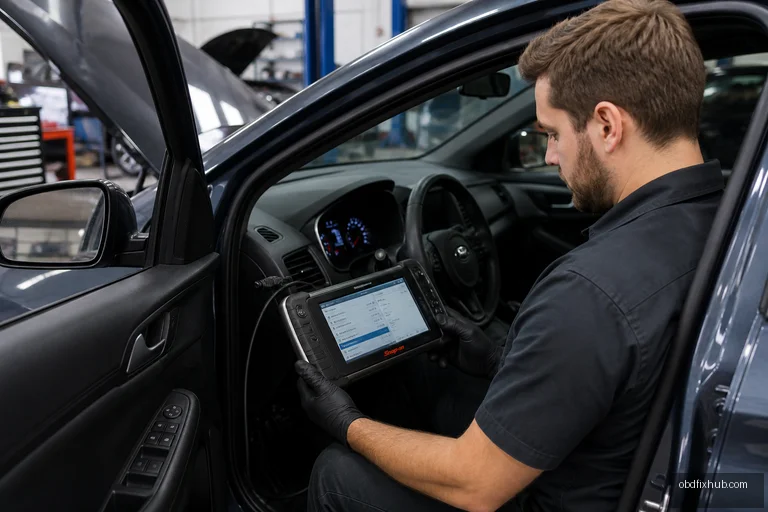
P0666 Control Module Internal Temperature Sensor Circuit: Meaning, Causes, Symptoms & Fix
P0666 means the powertrain, engine, or transmission control module has detected a problem in its internal temperature sensor circuit. The sensor is usually built into the PCM, ECM, or TCM and helps the module monitor its own operating temperature. In practice, P0666 is often caused by a module power or ground issue, excessive heat, moisture damage, an internal electronic fault, or a software problem—not by the engine coolant or intake air temperature sensor.
This is an informational, diagnostic search query: the correct repair depends heavily on the vehicle manufacturer, module design, and accompanying fault codes. Do not replace an expensive control module until its power supply, grounds, connectors, communication network, and software have been checked.
What Does the P0666 Code Mean?
P0666 is a generic OBD-II diagnostic trouble code defined as “PCM/ECM/TCM Internal Temperature Sensor A Circuit” or, on some scan tools, “Control Module Internal Temperature Sensor Circuit”. The exact wording varies between brands, but the basic meaning is the same: the control module is receiving an implausible signal from the temperature sensor used to monitor its internal electronics.
The sensor may be a thermistor mounted on the circuit board, a temperature-sensing integrated circuit, or part of a larger internal monitoring circuit. It is not necessarily a separate, externally replaceable component. That distinction matters because replacing the intake air temperature sensor, coolant temperature sensor, or fuel temperature sensor will not normally correct a true P0666 fault.
Common Symptoms of P0666
Some vehicles drive almost normally with P0666 stored, while others enter a reduced-power strategy. A control module that cannot trust its internal temperature reading may protect itself by changing engine, transmission, or charging behavior.
- Check Engine Light or service powertrain warning
- Intermittent no-start, hard starting, or stalling
- Reduced engine power or limp mode
- Harsh, delayed, or abnormal automatic transmission shifts
- Cooling fan operation at high speed or fans running after the engine is switched off
- Unstable idle, poor throttle response, or unusual fuel consumption
- Communication codes such as U-codes appearing with P0666
- A fault that appears only after the vehicle becomes hot
A particularly useful clue is temperature dependence. If the vehicle starts and drives correctly when cold but loses communication or enters limp mode after 20–40 minutes, heat-related module failure, a cracked solder joint, or a failing internal sensor becomes more likely. If the code appears immediately after battery work, suspect voltage instability, reverse polarity, poor grounds, or a disturbed connector before condemning the module.
What Causes P0666?
- Internal PCM, ECM, or TCM sensor failure: The sensor or its supporting circuit may have failed inside the module.
- Module overheating: Restricted airflow, a missing heat shield, nearby exhaust heat, or an incorrectly mounted module can raise internal temperature.
- Power or ground problems: Low battery voltage, corroded grounds, a loose fuse connection, or voltage spikes can create false internal-sensor readings.
- Water or corrosion intrusion: Windshield leaks, cowl drains, condensation, and engine-bay washing can damage module connectors or circuit boards.
- CAN network faults: A shorted communication wire or another module pulling the network down can produce misleading temperature and internal-performance codes.
- Software calibration error: A manufacturer may have issued a PCM update for an overly sensitive diagnostic threshold.
- Aftermarket electrical equipment: Remote starters, trackers, alarms, performance tuners, and poorly installed accessories can disturb module power or communication circuits.
How to Diagnose P0666 Correctly
A professional diagnosis begins with evidence, not parts replacement. The following process works well because it separates an actual internal module failure from a low-voltage or wiring problem that only looks like one.
1. Scan every module, not just the engine computer
Record all stored, pending, and history codes, along with freeze-frame data. Note the battery voltage, engine temperature, vehicle speed, and whether P0666 appeared alone or with communication, voltage, or overheating codes. A P0666 alongside several U-codes should immediately shift attention toward module power, grounds, and the CAN network.
2. Check battery voltage and charging performance
With the engine off after the vehicle has rested, a healthy battery is commonly near 12.6 volts. During cranking, voltage should generally remain above approximately 9.6 volts, although the precise specification depends on the vehicle. With the engine running, charging voltage is often around 13.5–14.8 volts. Use the manufacturer’s specification, especially on vehicles with intelligent charging systems.
Do not rely only on a static voltage reading. A loose battery terminal or damaged ground strap may pass a basic test and still create a voltage drop under load. Voltage-drop testing while cranking or operating electrical loads is more revealing than simply measuring resistance with the circuit disconnected.
3. Inspect the module, connector, and surrounding area
- Look for green or white corrosion on terminals.
- Check for pushed-back, spread, or water-stained connector pins.
- Inspect cowl drains, windshield seals, and carpet for moisture.
- Verify that the module is firmly mounted and has its intended cooling path.
- Look for aftermarket wiring spliced into ignition, ground, or CAN circuits.
4. Compare live data with reality
If the scan tool displays an internal module temperature PID, compare it with the ambient temperature after the vehicle has been parked overnight. A reading that is wildly unrealistic—such as an internal temperature of -40°F or over 250°F on a cool engine—suggests an open, shorted, or failed sensing circuit. A temperature that changes abruptly when the harness is moved points toward a connector or wiring issue.
5. Check technical service bulletins and software updates
Vehicle-specific service information is essential. Some manufacturers have known P0666 issues caused by calibration errors or module firmware. If a bulletin specifies a software update, programming must be completed with a stable power supply; a voltage interruption during programming can turn a manageable software issue into a non-communicating module.
How Is P0666 Fixed?
The repair depends on what the tests reveal. A loose ground, damaged connector, water leak, or CAN wiring fault may solve the problem without replacing the module. In other cases, the manufacturer may prescribe reprogramming, module replacement, or a professionally rebuilt control unit.
- Repair corroded terminals, damaged wiring, grounds, or power feeds.
- Repair water leaks and dry contaminated connectors before reconnecting them.
- Restore missing heat shields or correct an improperly mounted module.
- Install the latest approved software calibration when applicable.
- Replace or rebuild the PCM, ECM, or TCM if its internal sensor circuit has failed.
- Complete immobilizer pairing, configuration, and programming after module replacement.
Many control modules do not allow the internal temperature sensor to be replaced separately. Attempting to open a sealed module without the correct electronics expertise can cause permanent damage and may compromise water resistance. If replacement is necessary, confirm the part number, hardware version, calibration, immobilizer requirements, and transmission configuration before ordering a module.
Is It Safe to Drive With P0666?
Short-distance driving may be possible if the vehicle runs normally and the warning light is steady. However, driving should be limited if the vehicle stalls, loses power, shifts harshly, overheats electronically, or shows multiple communication faults. A control module that fails when hot can leave the vehicle unable to restart after stopping, even if it performed normally during the initial trip.
Do Not Confuse P0666 With Related Temperature Sensor Codes
What does the P0180 fuel temperature sensor circuit fault code mean?
P0180 refers to the fuel temperature sensor circuit, usually the sensor used to measure fuel temperature in or near the fuel system. It can be caused by a failed fuel temperature sensor, damaged wiring, a short, an open circuit, or an implausible signal. P0180 is different from P0666: P0180 concerns fuel temperature measurement, while P0666 concerns the control module’s own internal temperature monitoring circuit.
What are the symptoms of a bad intake manifold temperature sensor?
An intake manifold temperature sensor, often called an intake air temperature or IAT sensor, measures the temperature of air entering the engine. A faulty sensor may cause hard starting, rough idle, hesitation, poor acceleration, incorrect fuel mixture, reduced fuel economy, or a Check Engine Light. Some vehicles show an implausible fixed reading, such as -40°F or an unusually high temperature.
What does “intake air temperature sensor 1 circuit high” mean?
“Intake air temperature sensor 1 circuit high” generally means the engine computer sees a voltage higher than the expected range from IAT sensor 1. Depending on the circuit design, that commonly indicates an open signal wire, disconnected sensor, failed sensor, or poor ground. It is typically associated with P0113 or a manufacturer-specific equivalent, not P0666.
What are the symptoms of a bad temperature sensor in a car?
Symptoms vary by sensor. A bad coolant temperature sensor can cause hard starting, an incorrect fuel mixture, overheating warnings, or radiator fans that run continuously. A bad IAT sensor may cause hesitation and poor fuel economy, while a bad fuel temperature sensor may affect fuel calculations. A failed internal control-module temperature sensor can instead produce module communication problems, limp mode, intermittent stalling, or a P0666 code.
Frequently Asked Questions
Can a weak battery cause P0666?
Yes. Low cranking voltage, unstable charging voltage, or a poor ground can make the control module report an internal sensor fault. Test the electrical system before replacing the module.
Does clearing P0666 fix the problem?
Clearing the code only removes the stored record temporarily. If the fault is still present, the code will return—often after a specific temperature or operating condition is reached.
Can P0666 be caused by overheating?
Yes. Excessive heat around the module can produce a genuine internal-temperature problem or accelerate failure of the sensor and circuit board. Inspect heat shielding, mounting, and nearby exhaust components.
Will replacing the IAT sensor fix P0666?
Normally, no. The IAT sensor measures incoming engine air, whereas P0666 concerns a sensor inside the PCM, ECM, or TCM. Replace the IAT sensor only when its own test results or trouble code confirms it has failed.
Bottom Line
P0666 is a control-module internal temperature sensor circuit fault, not a general temperature-sensor code. Start with a complete scan, battery and ground tests, connector inspection, moisture checks, live-data comparison, and manufacturer service information. If the external circuits and software are verified, the control module itself may require professional repair, reprogramming, or replacement.




