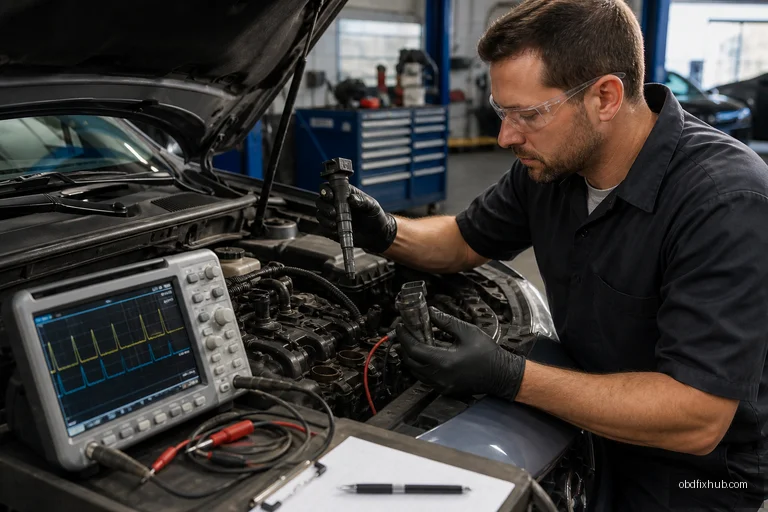
P06D1 means the vehicle’s powertrain control module (PCM) has detected poor or abnormal performance in the ignition coil control system. The fault may come from a weak coil, damaged wiring, low battery voltage, poor grounds, a software issue, or an internal PCM driver problem. Because this code can be caused by several different components, replacing the PCM immediately is one of the most expensive and common diagnostic mistakes.
What Does P06D1 Mean?
Diagnostic trouble code P06D1 is a generic OBD-II code described as Internal Control Module Ignition Coil Control Performance. It indicates that the control module is monitoring the ignition coil command or feedback signal and the result does not match the expected electrical or operating pattern.
On many modern engines, the PCM controls the ignition coils directly. The coil receives power, while the PCM switches the control side rapidly to create the magnetic field needed for a spark. If the PCM sees an incorrect voltage, current response, timing pattern, or self-test result, it can store P06D1.
The exact testing strategy varies by manufacturer. Some vehicles use individual coil drivers inside the PCM, while others use a separate ignition control module. Always check the factory service information for the specific engine before testing terminals or applying power to a control wire.
Common Symptoms of P06D1
The symptoms depend on whether the problem affects one ignition channel or the control system as a whole. A vehicle may run almost normally at first, then develop a misfire when the engine is hot or under load.
- Check Engine Light or flashing malfunction indicator lamp
- Hard starting, extended cranking, or a no-start condition
- Engine misfire, hesitation, or rough idle
- Loss of power during acceleration
- Engine stalling, especially after warming up
- Reduced fuel economy and increased exhaust emissions
- Related misfire codes such as P0300, P0301, or P0302
- Intermittent loss of spark that changes with temperature or vibration
A flashing Check Engine Light should be treated seriously. It usually indicates an active misfire that can overheat and damage the catalytic converter within a short drive.
What Causes the P06D1 Code?
1. Ignition coil or coil supply problems
A failing coil can draw abnormal current or produce an inconsistent response that the PCM interprets as a control-performance fault. Inspect the affected coil for oil contamination, cracks, carbon tracking, corrosion, and signs of overheating. Do not rely on resistance testing alone; many coils pass a static ohmmeter test but fail under load.
2. Damaged wiring or connectors
Open circuits, shorted control wires, loose terminals, water intrusion, and harness damage near the cylinder head are frequent causes. A wire may look intact but fail when the engine moves on its mounts. Gently wiggle-testing the harness while watching live misfire data can reveal an intermittent fault.
3. Low system voltage or poor grounds
A weak battery, failing alternator, corroded ground strap, or voltage drop in the ignition feed can create misleading control-module codes. During cranking, battery voltage should generally remain above approximately 9.6 volts, although the precise specification depends on the vehicle. Measure voltage at the coil and PCM ground under load rather than checking only battery voltage at rest.
4. Software or calibration problems
Some manufacturers release PCM software updates for false ignition-control or misfire detections. If the wiring and coils test correctly, check for technical service bulletins and applicable calibration updates before condemning hardware.
5. Internal PCM or ignition module failure
A failed ignition driver inside the PCM is possible, particularly after a shorted coil, incorrect jump-start, water intrusion, or aftermarket wiring modification. It should be considered only after power, grounds, coil current, control signals, and harness integrity have been verified.
How to Diagnose P06D1 Correctly
Start with the complete scan-tool report, not just the code shown on a basic reader. Record freeze-frame data, engine temperature, battery voltage, RPM, load, and every stored or pending code. A P06D1 accompanied by a cylinder-specific misfire code provides a much stronger diagnostic direction than P06D1 alone.
- Check the battery and charging system. Test cranking voltage and alternator output. Repair voltage or ground faults first.
- Inspect coils, plugs, connectors, and wiring. Look for oil in spark-plug wells, bent terminals, rubbed harnesses, and moisture.
- Swap the suspected coil. If a cylinder-specific misfire moves with the coil, the coil is likely defective. This test is useful, but it does not rule out a separate P06D1 circuit problem.
- Verify coil power and ground. A test light or voltage-drop test under operating conditions is more useful than a simple continuity check.
- Check the PCM control signal with the correct equipment. An oscilloscope can show whether the driver produces a clean, repeatable switching waveform. Never connect a test light or external power source to a PCM control wire unless the service procedure specifically permits it.
- Confirm the repair. Clear the codes, perform the required drive cycle, and check misfire counters and readiness monitors. A code that does not immediately return is not proof that the problem is permanently fixed.
One practical clue is temperature sensitivity. If the engine runs correctly when cold but loses spark after 15 to 30 minutes, use heat testing and a scope before replacing parts. An internal module fault can appear only when the PCM or ignition driver reaches operating temperature.
Can You Still Have Spark With a Bad Ignition Control Module?
Yes. A bad ignition control module or PCM ignition driver can still produce spark intermittently or on some cylinders. Internal failures are often channel-specific, temperature-dependent, or related to vibration, so the vehicle may start and run before suddenly misfiring or stalling.
A visible spark while the engine is cranking does not prove that the ignition system is healthy. The spark may be weak, incorrectly timed, or unable to fire the plug under cylinder compression. Testing with an adjustable spark tester, observing coil control with an oscilloscope, and checking misfire data provides more reliable evidence.
Is It Safe to Drive With P06D1?
Short trips may be possible if the engine runs smoothly and the Check Engine Light is steady, but driving should be limited until the cause is identified. Continued misfire can send unburned fuel into the catalytic converter, causing expensive overheating damage. Stop driving if the light flashes, the engine shakes, power drops sharply, or the vehicle stalls in traffic.
Avoid confusing P06D1 with P06B8. P06B8 is generally associated with an internal control module non-volatile memory performance problem, while P06D1 relates specifically to ignition coil control performance. Both can involve the PCM, but they require different diagnostic procedures and should not be treated as interchangeable codes.
How Much Does a P06D1 Repair Cost?
The repair price depends on the failed component and the vehicle design. A spark plug, coil, connector, or wiring repair is usually far less expensive than PCM replacement. If a PCM is required, programming, immobilizer pairing, labor, and possible core charges can substantially increase the total.
- Minor repair: connector, ground, wiring, or spark plug replacement
- Moderate repair: ignition coil or ignition control module replacement
- Major repair: PCM replacement followed by software programming and vehicle configuration
Ask for test results before approving a control-module replacement. A professional diagnosis should identify the failed circuit, show that power and grounds meet specification, and explain why the PCM is the remaining likely fault.
Final Takeaway
P06D1 is not a guaranteed PCM failure. It is a warning that the ignition coil control system is not behaving as expected, and the root cause may be as simple as low voltage, a damaged connector, or a weak coil. Diagnose the electrical supply and control waveform first, repair any active misfire promptly, and use manufacturer-specific service information before replacing an expensive module.
If the Check Engine Light is flashing or the engine is running badly, stop driving and have the vehicle tested. A correct circuit diagnosis is faster and cheaper than guessing with replacement parts.
Frequently Asked Questions
What are the symptoms of a bad ignition coil module?
Typical symptoms include hard starting, intermittent or constant misfire, rough idle, hesitation, stalling, reduced power, and a Check Engine Light. Some modules fail only when hot, so the vehicle may operate normally for the first few minutes.
Is it safe to drive with a P06B8 code?
P06B8 should not be ignored because it can indicate an internal control-module memory or performance problem. If the vehicle runs normally and the light is steady, drive only as far as necessary for diagnosis. A flashing light, stalling, or severe drivability issue means the vehicle should be towed.
How can I check if a control module is bad?
Verify battery voltage, power feeds, grounds, fuses, wiring, connectors, and ignition components first. Then compare the module’s control signal with the manufacturer’s waveform or voltage specification. A module should be replaced only after external causes have been ruled out.
Can a vehicle still have spark with a bad ignition control module?
Yes. A failing module may still produce spark on some cylinders or only work while cold. Spark must be tested under realistic conditions, because a weak or intermittent spark may disappear under compression or engine heat.




