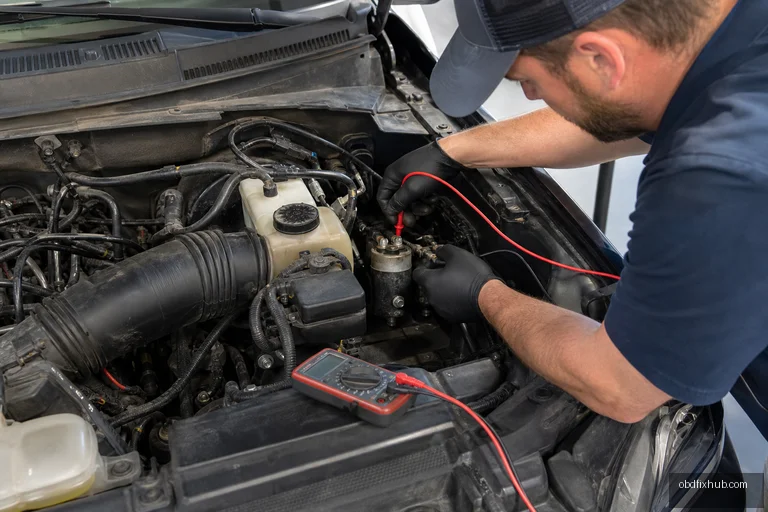
P06E9 Engine Starter Performance: Meaning, Causes, Symptoms & Fix
P06E9 Engine Starter Performance means the powertrain control module (PCM) detected that the engine starter system did not perform as expected. On a Ford F-150, this commonly causes an intermittent or complete no-crank condition, but the code does not automatically prove that the PCM is bad. A weak battery, poor ground, failing starter relay, damaged wiring, or a worn starter motor can all trigger the same fault.
This is an informational and diagnostic search query: most drivers want to understand the code and identify the correct repair before replacing expensive parts. The fastest route to an accurate fix is to test the complete starting circuit, rather than swapping the PCM based on the trouble code alone.
What Does the Engine Starter Performance Code P06E9 Mean?
P06E9 is a generic OBD-II powertrain code for an engine starter performance problem. The PCM monitors the starting request and the electrical response of the starter circuit. Depending on the vehicle configuration, it may compare the commanded starter operation with relay feedback, starter circuit voltage, and the engine speed signal expected during cranking.
If the PCM commands the starter but sees insufficient voltage, an unexpected relay state, or no meaningful engine rotation, it can store P06E9. In plain English, the vehicle was told to crank the engine, but the starting system did not respond correctly or consistently.
- No crank: The starter does not turn the engine at all.
- Intermittent crank: The engine starts sometimes and does nothing at other times.
- Slow crank: The starter turns, but much more slowly than normal.
- Starter circuit fault: The PCM detects a problem in the relay, solenoid, wiring, or control logic.
What Does Ford Fault Code P06E9 Mean?
On Ford vehicles, including the F-150, P06E9 generally points to a starter control or starter performance issue monitored by the PCM. The exact test strategy can vary with the engine, transmission, model year, and starting system design. That is why the code definition alone cannot identify whether the defective component is the battery, starter, relay, wiring, ignition switch, neutral safety input, or PCM.
A useful real-world clue is the behavior of the vehicle when the key or start button is used. A single click with dimming lights often suggests low battery voltage or high resistance in the main cables. A completely silent start request may indicate a control-side issue, such as a relay, park/neutral switch, brake-pedal input, immobilizer authorization, or a PCM-related fault.
Common Causes of P06E9
- Weak or discharged battery: A battery can show 12 volts at rest and still fail under starter load.
- Corroded battery terminals: A small amount of corrosion can create enough resistance to prevent reliable cranking.
- Bad engine or chassis ground: Loose ground straps are especially important because the starter returns high current through the engine block.
- Failing starter motor or solenoid: Worn brushes, internal dead spots, or excessive current draw can create an intermittent no-crank complaint.
- Defective starter relay: The relay may click but fail to pass adequate current, or its contacts may stick intermittently.
- Damaged control wiring: Rodent damage, rubbed insulation, water intrusion, and loose connector pins can interrupt the starter command.
- Transmission range or start authorization issue: A faulty park/neutral switch, clutch switch, brake switch, or immobilizer signal may block cranking.
- PCM software or internal fault: This is possible, but it should be considered only after power, ground, wiring, and starter operation have been verified.
P06E9 Symptoms to Watch For
The most common symptom is an intermittent no-crank/no-start condition. The engine may start normally after several attempts, then fail after the truck is parked briefly. Heat can make a worn starter solenoid more likely to fail, while cold weather can expose a weak battery or high-resistance cable connection.
- One click, repeated clicking, or no sound when starting
- Normal dash lights but no starter operation
- Slow engine cranking and low interior-light brightness
- A P06E9 code stored as current, pending, or history
- Additional low-voltage, relay, communication, or immobilizer codes
- A start that works after tapping the starter or waiting several minutes
Do not rely on the presence of a check-engine light. A starting fault may be stored without a dramatic warning on the dash, and a battery problem may create several unrelated codes after voltage drops during repeated start attempts.
How to Diagnose P06E9 Correctly
1. Check battery voltage and state of charge
Begin with a fully charged battery. A healthy resting battery is usually close to 12.6 volts, although temperature and battery condition affect the reading. During cranking, voltage should not collapse excessively; a professional battery load tester is more reliable than a simple open-circuit voltage check.
If the battery is low, charge and test it before clearing the code. Repeatedly attempting to start with a weak battery can create misleading PCM and communication faults.
2. Inspect terminals, cables, and grounds
Remove and clean both battery terminals, then inspect the positive cable, engine ground strap, chassis ground, and starter connections. Look for swollen cable insulation, green corrosion inside the cable, loose fasteners, or heat damage near the starter.
A voltage-drop test is more useful than visual inspection. While the engine is being cranked, measure between the battery positive post and the starter power terminal. Then measure between the battery negative post and the starter housing or engine block. Excessive voltage drop indicates resistance in the cable or connection; the exact acceptable value depends on the circuit, but a reading around 0.5 volts or more on the positive side deserves investigation, while the ground side should typically remain very low.
3. Test the starter relay and control signal
Use a wiring diagram for the specific F-150 engine and model year. Confirm that the relay receives battery power, a valid control signal, and a solid ground or return path when the vehicle is commanded to start. Do not assume a relay is good simply because it clicks; the contacts can fail under load.
Scan all modules, not just the PCM. Ford-specific data may show whether the PCM recognizes the key, brake pedal, transmission range, and starter request. Freeze-frame data can also reveal whether P06E9 occurred during low system voltage or a repeated failed start.
4. Evaluate the starter motor
If the starter receives proper power and a valid start command but does not crank, test its current draw and voltage at the solenoid. Excessive current with slow rotation suggests an internally worn or mechanically loaded starter. Very low current with no rotation can indicate an open solenoid, poor connection, or internal failure.
Do not use repeated tapping as a repair. If tapping the starter temporarily restores operation, it is a strong practical clue that the starter has worn internal components, but replacement should still be confirmed with electrical testing.
5. Consider the PCM only after circuit testing
A PCM becomes more suspicious when there are multiple unrelated symptoms, repeated loss of communication, missing output commands despite verified inputs, connector corrosion, water intrusion, or known software issues. A single P06E9 code by itself is not sufficient evidence for PCM replacement.
Before condemning the module, verify PCM power supplies and grounds under load, inspect connectors for pushed-out or oxidized pins, check relevant fuses, and confirm that the vehicle has the latest applicable software calibration. PCM replacement may also require programming, parameter reset procedures, and immobilizer configuration.
What Does P06E9 Mean on a 2018 F-150?
On a 2018 Ford F-150, P06E9 indicates that the PCM has detected starter performance outside its expected range. The likely causes remain a weak battery, cable or ground resistance, starter relay trouble, a failing starter, or a problem with the start authorization circuit. The model year does not make PCM replacement the default repair.
For a 2018 F-150 with an intermittent no-crank complaint, capture the failure while it is happening. Check battery voltage at rest and during the failed start, listen for relay and solenoid activity, and compare voltage at the battery with voltage at the starter. Testing only after the truck starts normally can miss a temperature-sensitive or vibration-sensitive fault.
What Are the Signs of a Failing Ford F-150 PCM?
A failing PCM is less common than a failing battery or starter. More convincing signs include several unrelated engine-control problems occurring together, intermittent communication loss with a scan tool, missing actuator commands despite correct inputs, unexplained recurring codes after wiring is proven good, or visible water and corrosion damage at the module or connector.
Symptoms such as a single no-crank event, dimming lights, or a P06E9 code with low battery voltage do not specifically identify a bad PCM. Replace or reprogram the PCM only after a technician proves that the module has correct power and grounds and fails to control the starter circuit as commanded.
Can You Drive With P06E9?
If the truck starts reliably, it may be possible to drive it to a repair facility, but the fault can become a complete no-start without warning. Avoid switching the engine off in a remote location until the problem has been diagnosed. If the starter cable is overheating, the battery is severely weak, or wiring is damaged, stop operating the vehicle and arrange a professional inspection.
Repair Costs and the Best Fix
The repair depends on the failed part. Cleaning a terminal or repairing a ground is relatively inexpensive, while a starter, relay, cable, or PCM can cost substantially more. Labor and programming requirements vary by engine and shop, so a proper electrical diagnosis is more valuable than an estimate based on the code alone.
The best fix is the one that restores reliable starter voltage and confirms that the PCM sees the expected starting response. After repairs, clear the code, perform several cold and hot start tests, and rescan all modules to confirm that P06E9 does not return.
Key Takeaway
P06E9 means the PCM detected abnormal engine starter performance; it does not automatically mean the PCM has failed. Start with the battery, voltage drop, grounds, relay, wiring, and starter, then investigate start authorization and PCM operation if those tests pass. If your F-150 has an intermittent no-crank condition, diagnose it while the failure is present rather than replacing parts based solely on the stored code.
Frequently Asked Questions
What does the engine starter performance code P06E9 mean?
It means the PCM detected that the starter system did not respond as expected during a starting request. Battery voltage, cables, grounds, relay operation, wiring, and the starter itself should be tested before blaming the PCM.
What does the Ford fault code P06E9 mean?
On Ford vehicles, P06E9 generally identifies a starter control or performance problem monitored by the PCM. The precise failed component depends on the vehicle configuration and test results.
What does P06E9 mean on a 2018 F-150?
It indicates that the 2018 F-150 detected abnormal starter performance. A weak battery, high-resistance ground, failing starter, relay fault, or wiring problem is usually more likely than a defective PCM.
What are the signs that a Ford F-150 PCM is failing?
Possible signs include repeated communication loss, multiple unrelated control-system faults, missing output commands with verified inputs, and confirmed PCM power and ground circuits that are good. P06E9 alone is not proof of PCM failure.




