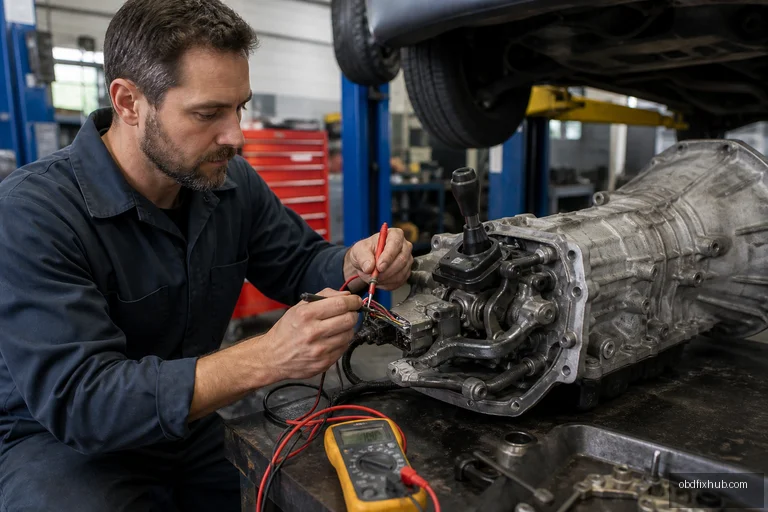
P081F Brake Transmission Shift Interlock Signal Correlation means the vehicle’s control module is receiving brake-pedal and transmission shift-interlock signals that do not agree. In practical terms, the car may not recognize that the brake is pressed, may refuse to shift out of Park, or may log the code even though the brake lights appear to work. Diagnosis should begin with live data and wiring tests—not by replacing the transmission.
What Does P081F Mean?
The brake transmission shift interlock system prevents the selector from leaving Park unless the brake pedal is applied. It normally uses a brake-pedal switch, shift-lock solenoid, transmission range information, and one or more control modules. The P081F code is set when these inputs do not correlate within the expected timing or electrical range.
The exact wording and monitoring strategy can vary between manufacturers. Some vehicles compare two circuits inside a brake switch, while others compare the brake input with the shift-lock actuator or transmission range signal. Always confirm the definition and wiring diagram for the specific year, make, model, engine, and transmission before ordering parts.
Common Symptoms of P081F
A vehicle with this fault can behave normally during a short drive, which makes the problem easy to dismiss. The interlock is primarily a starting and shifting safety system, so symptoms often appear when the driver first turns the key or presses the start button.
- Gear selector will not move from Park without using the manual shift-lock release.
- Brake lights stay on, fail to illuminate, or operate intermittently.
- Check Engine Light or transmission warning light is illuminated.
- Push-button start does not recognize the brake pedal.
- Starter operation is disabled or inconsistent.
- Shift-lock solenoid clicks repeatedly or makes no sound.
- The code returns after clearing, particularly when the brake pedal is pressed.
One useful real-world clue is a mismatch between the brake lights and scan-tool data. If the lamps work but the scan tool still shows “Brake Pedal Released,” the fault may be in a second switch contact, a shared ground, or the signal wire between the brake switch and module.
Most Likely Causes of P081F
- Defective or incorrectly adjusted brake-pedal position switch.
- Internal failure of a dual-circuit brake switch.
- Damaged, stretched, corroded, or partially disconnected wiring.
- Water intrusion near the driver-side footwell, fuse box, or shift assembly.
- Failed brake transmission shift interlock solenoid.
- Faulty transmission range sensor or implausible gear-position data.
- Blown fuse, poor ground, or low system voltage.
- Aftermarket remote-start, alarm, or shift-control equipment interfering with the circuit.
- Control-module software or communication failure.
A brake switch can fail in only one internal contact set. That is why a basic brake-light inspection is not enough. On many vehicles, one contact powers the lamps while another sends a low-current status signal to the body or powertrain control module.
How to Diagnose P081F Correctly
1. Check related codes and battery voltage
Scan every module, not just the engine computer. Codes involving the brake switch, transmission range sensor, CAN communication, starting system, or low voltage may identify the primary fault. Before deeper testing, verify a fully charged battery and clean battery and chassis grounds; unstable voltage can create contradictory interlock signals.
2. Test the brake switch and live data
With a capable scan tool, monitor brake-pedal status while slowly pressing and releasing the pedal. The signal should change at the same point every time and should not flicker. Compare the scan-tool status with the actual brake lamps. If the two disagree, test both switch circuits rather than replacing the switch based only on the code.
3. Inspect the shift-lock circuit
Listen for the solenoid when the ignition is on and the brake pedal is applied. Check whether the solenoid receives battery voltage and a proper ground under load. A circuit may show 12 volts with no load but collapse when the solenoid is connected because of a corroded terminal or broken wire strands inside the insulation.
4. Verify transmission range information
Move the selector through Park, Reverse, Neutral, and Drive while watching the range data. The displayed position should match the lever position without dropouts or overlapping states. If the module sees Park and another gear at the same time, inspect the range sensor, shift cable adjustment, connector, and transmission-side wiring.
5. Perform a wiggle and voltage-drop test
With the circuit monitored, gently move the harness around the brake pedal bracket, steering column, center console, and transmission connector. A changing signal points to a harness or terminal problem. Voltage-drop testing under load is more reliable than visual inspection alone and often exposes high resistance caused by moisture or loose pins.
P081F Repair Solutions
The correct repair depends on the failed input, but common solutions include replacing and properly adjusting the brake-pedal switch, repairing damaged wiring, cleaning or replacing corroded terminals, replacing the shift-lock solenoid, or correcting a misadjusted shift cable. If the transmission range sensor is faulty, the repair may involve adjustment, connector repair, or sensor replacement depending on the vehicle design.
After a repair, clear the code and perform several complete checks: confirm brake-light operation, verify the selector releases from Park only with the brake applied, check live brake and range data, and road-test the vehicle. Some models require a brake-switch, range-sensor, or transmission control module relearn procedure. Do not skip that step when the service information specifies it.
Can You Drive With P081F?
Short-distance driving may be possible if the vehicle shifts normally and the brake lights work, but the fault should not be ignored. A failed interlock input can leave the vehicle stuck in Park, prevent starting, or create a safety concern if the brake lamps are inoperative. If the selector requires the emergency manual release, or if the brake lights do not work, have the vehicle repaired before normal road use.
How to Avoid Misdiagnosis
- Do not assume a transmission failure simply because the code contains the word “transmission.”
- Do not replace the brake switch without checking adjustment and both signal circuits.
- Do not rely on a visual wiring inspection; test the circuit under load.
- Do not overlook aftermarket remote-start and alarm wiring.
- Confirm the vehicle-specific code definition before applying a generic repair procedure.
Summary
P081F indicates a disagreement between the brake input and the transmission shift-interlock system. The most efficient diagnosis combines scan-tool live data, brake-switch testing, shift-lock voltage checks, range-sensor verification, and voltage-drop testing. Repair the failed circuit, complete any required relearn, and verify that the selector and brake lights operate safely before returning the vehicle to service.
Frequently Asked Questions
Can a bad brake light switch cause P081F?
Yes. A dual-circuit brake switch can operate the brake lamps while its separate control signal fails, producing P081F and preventing the shifter from leaving Park.
Why is my car stuck in Park with P081F?
The shift-lock solenoid may not be receiving a valid brake-applied signal. Check the brake switch, fuse, wiring, solenoid power, and live-data status before using the manual override.
Is P081F a transmission problem?
Not necessarily. The fault commonly involves the brake switch, interlock wiring, solenoid, or range signal. A complete circuit diagnosis is required before condemning any transmission component.
Can low battery voltage trigger P081F?
Yes. Low voltage or poor grounds can cause modules to interpret brake and range signals incorrectly. Test battery voltage and charging performance before replacing electrical parts.




