P0A86 14-Volt Power Module Current Sensor Circuit: Meaning, Causes, Symptoms & Fix
If your scan tool reports P0A86 14-Volt Power Module Current Sensor Circuit, the vehicle has detected an electrical problem in the circuit that measures current through its 14-volt power module. The code does not automatically prove that the battery is bad. A failed sensor, damaged wiring, poor ground, charging-system fault, or a problem inside the power module can all trigger it.
This is primarily a diagnostic code, not a part-replacement instruction. Because the 14-volt system may support hybrid control modules, relays, and safety systems, an accurate diagnosis is more important than simply installing a new battery.
What Does P0A86 Mean?
P0A86 is a powertrain-related OBD-II fault code associated with the 14-volt power module current sensor circuit. In vehicles equipped with a hybrid or electronically controlled power system, the module monitors how much current flows into or out of the 14-volt electrical network. That information helps the vehicle manage charging, detect abnormal electrical loads, and protect sensitive control units.
The exact component name and location vary by manufacturer. On some vehicles, the current sensor is mounted near the auxiliary battery or integrated into a battery terminal assembly. On others, it is part of a DC-DC converter or a dedicated 14-volt power module. Always verify the wiring diagram and service information for the specific vehicle before testing or disconnecting anything.
Symptoms of P0A86
A vehicle can sometimes drive normally with this code stored, especially when the fault is intermittent. However, the symptoms may become more serious if the module can no longer determine whether the 14-volt battery is charging correctly.
- Check Engine, hybrid system, charging system, or powertrain warning light
- “Hybrid system malfunction” or “Check charging system” message
- Weak or repeatedly discharged 12/14-volt auxiliary battery
- Hard starting, delayed READY mode, or no-start condition
- Flickering lights or unstable electrical accessories
- Intermittent loss of power steering, climate control, or other electrical functions
- Multiple low-voltage communication codes stored in different modules
- Reduced vehicle performance or a protective limp-home strategy
One practical clue is a cluster of apparently unrelated communication codes. If several modules report low voltage at the same time, inspect the 14-volt battery, grounds, charging output, and current-sensor data before assuming that every module has failed.
What Causes the P0A86 Code?
The most common causes are electrical rather than mechanical. A sensor can report an implausible current value when its supply voltage or ground is unstable, even though the sensor itself is functional.
- Defective 14-volt power module current sensor
- Corroded, loose, or overheated battery terminal connection
- Open, shorted, or chafed sensor wiring
- Water intrusion in a connector near the battery or power module
- Weak auxiliary battery causing abnormal voltage behavior
- Incorrect charging voltage from the DC-DC converter
- Blown fuse or poor module power or ground connection
- Damaged 14-volt power module or internal sensor circuitry
- Recent battery replacement, jump-start, or wiring repair
- Software or calibration issue requiring a manufacturer update
What Are Common Current Sensor Problems?
Current sensors commonly fail because of corrosion, terminal tension problems, heat, vibration, or damage caused during battery service. A sensor may also become inaccurate without producing an obvious physical fault. For example, a sensor that reads zero amps with the vehicle operating, or shows a large current flow with all loads switched off, deserves further testing.
Another frequent problem is a poor connection at the sensor ground. This can create a false signal that changes when the vehicle moves, when the headlights are switched on, or when the battery cable is disturbed. In real-world diagnosis, watching the sensor data while gently moving the harness often reveals an intermittent open circuit that a static resistance test misses.
How to Diagnose P0A86 Correctly
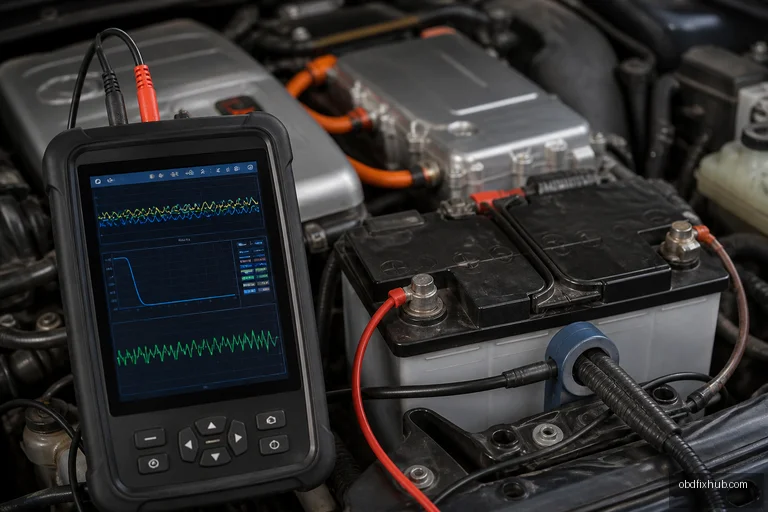
Use a scan tool capable of reading hybrid or manufacturer-specific data, not only generic engine codes. Record all codes and freeze-frame information first. Voltage-related faults should be diagnosed in the order below.
- Check the auxiliary battery. Measure its resting voltage after the vehicle has been switched off for several hours, then perform a proper load or conductance test. A battery that appears acceptable at rest can still collapse under load.
- Inspect the terminals and grounds. Look for white or green corrosion, loose fasteners, heat discoloration, and damaged ground straps. Voltage-drop testing under load is more useful than simply checking continuity.
- Confirm charging output. With the vehicle in the correct operating mode, compare the 14-volt system voltage with the manufacturer’s specification. Do not rely on a universal voltage number because charging strategies differ between vehicles.
- Compare current-sensor data with actual conditions. Turn known electrical loads on and off and watch whether the reported current changes logically. A fixed, reversed, or implausible value indicates a sensor, wiring, power, or data problem.
- Test the circuit at the connector. Verify reference voltage, ground quality, signal voltage, and continuity according to the wiring diagram. Never apply battery power to a sensor signal terminal unless the service procedure specifically permits it.
- Check for technical service bulletins. Some faults are caused by software logic or a known connector issue rather than a failed module.
How Is P0A86 Repaired?
The repair depends on the failed point. Cleaning and tightening a corroded terminal may solve the code, while a damaged harness requires proper splicing or harness replacement. If the current sensor is integrated into a battery terminal or power module, the complete assembly may need to be replaced rather than the sensor alone.
After the repair, clear the code and perform the manufacturer’s required initialization or current-sensor zero-point procedure. Some systems need a scan-tool relearn after battery or module replacement. Road-test the vehicle under the conditions shown in the original freeze-frame data, then rescan it to confirm that P0A86 has not returned.
Can You Drive With P0A86?
Short-distance driving may be possible when there are no warning messages, no starting problems, and the 14-volt system remains stable. Continuing to drive is risky if the battery is discharging, the vehicle will not enter READY mode reliably, or multiple hybrid and communication warnings are present. A loss of 14-volt power can disable important control systems and leave the vehicle unable to restart.
Do not probe orange high-voltage cables or open a hybrid battery while diagnosing this code. The 14-volt circuit may be accessible to a trained technician, but hybrid safety procedures still apply because the power module may be connected to high-voltage equipment.
Key Takeaway
P0A86 points to a fault in the 14-volt power module current-sensing circuit, not automatically to a bad battery. Begin with battery condition, terminals, grounds, charging output, and live sensor data. If the wiring and power supplies are correct, the current sensor or integrated power module may require replacement and initialization.
Best next step: obtain the vehicle’s exact year, make, model, and all stored codes, then follow its wiring diagram and voltage specifications. That approach prevents the common and expensive mistake of replacing the battery when the real fault is a connector, ground, or sensor circuit.
Frequently Asked Questions
What are the symptoms of a bad battery current sensor?
Typical symptoms include charging warnings, a repeatedly weak auxiliary battery, unstable electrical operation, delayed READY mode, multiple low-voltage codes, and inaccurate current readings on a scan tool. Some vehicles show no noticeable symptom until the battery becomes discharged.
Can a bad battery cause P0A86?
Yes. A weak or internally damaged 14-volt battery can create voltage behavior that the control module interprets as an implausible current-sensor signal. Battery testing and charging-system checks should therefore come before replacing the sensor.
Is P0A86 the same as a standard battery sensor fault?
Not necessarily. P0A86 specifically identifies the 14-volt power module current sensor circuit, and the sensor may be located in a power module, converter, terminal assembly, or battery-related harness depending on the vehicle.
Can I replace the current sensor myself?
Only if the vehicle’s service procedure identifies it as a separate, accessible component and you understand the electrical safety requirements. On many hybrid vehicles, the sensor is integrated into a larger assembly that requires initialization after installation.
Should I clear P0A86 after replacing the battery?
Clear the code only after checking the original cause and completing any required battery registration or sensor calibration. If the wiring, charging system, or current signal remains faulty, the code will return after clearing.




