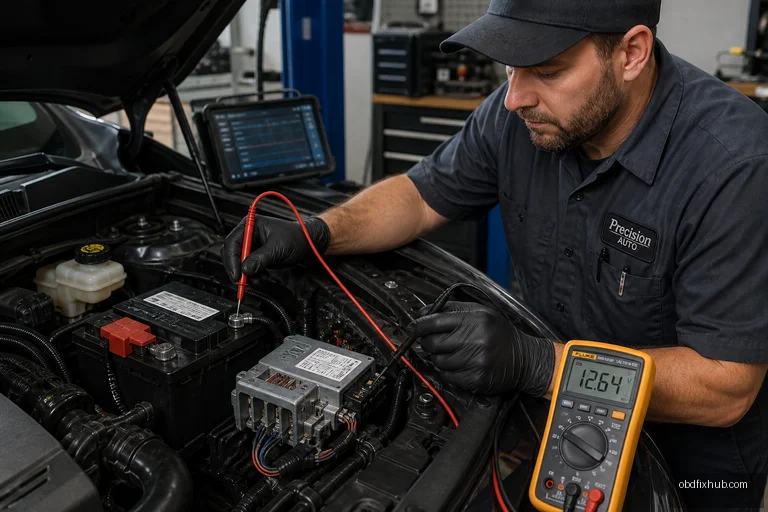
P0A8B 14-Volt Power Module System Voltage means the vehicle’s control system has detected an abnormal voltage condition in the 14-volt power supply circuit. The cause may be a weak 12-volt battery, poor ground, loose connection, charging-system fault, DC-DC converter problem, or a failing power module. The code does not automatically mean the power module must be replaced.
This is primarily an informational and diagnostic issue: the correct repair depends on whether system voltage is too low, too high, or unstable under load. On vehicles with start-stop or hybrid technology, a proper voltage test is far more useful than simply clearing the code.
What Does DTC P0A8B Mean?
P0A8B is a generic OBD-II power-system code associated with the 14-volt power module system voltage. The power module manages or distributes low-voltage electrical power to important vehicle systems, including control modules, sensors, communication networks, and sometimes the 12-volt battery charging circuit.
Although people often call this a “14-volt” system, the actual measured voltage will vary. A healthy conventional 12-volt battery may read around 12.4–12.8 volts with the engine off and approximately 13.5–14.8 volts while charging. Smart charging systems may deliberately reduce or raise voltage depending on battery temperature, state of charge, electrical load, and driving conditions.
In practical terms, P0A8B tells you that the vehicle saw voltage outside the expected range or detected a voltage signal that did not agree with other system measurements.
What Does the Mazda Trouble Code P0A8D Mean?
On many Mazda applications, P0A8D refers to 14-Volt Power Module System Voltage High. It indicates that the measured 14-volt system voltage was higher than the control module’s permitted limit. Mazda terminology and code descriptions can vary by model year, engine, and scan tool, so the factory service information should be used to confirm the exact definition.
P0A8D is not the same as P0A8B in every diagnostic database. P0A8B is commonly used as the base 14-volt power module system voltage fault, while P0A8D may identify a high-voltage condition. A basic code reader can display an incomplete description, so always record the full code, additional U-codes, battery codes, and freeze-frame data before beginning repairs.
Common Causes of P0A8B
- Weak or damaged 12-volt battery: An aging battery can collapse below the expected voltage during cranking or when the start-stop system restarts the engine.
- Loose or corroded battery terminals: A small amount of resistance at the positive terminal, negative terminal, or ground strap can create large voltage changes under load.
- Charging-system malfunction: A faulty alternator, voltage regulator, belt, or smart-charging control circuit can cause undercharging or overcharging.
- DC-DC converter fault: Hybrid and electrified vehicles commonly use a DC-DC converter to produce low-voltage power from the high-voltage battery.
- Faulty power module or voltage sensor: The module may incorrectly interpret system voltage because of an internal failure or a damaged sensing circuit.
- Wiring or ground problems: Chafed wires, water intrusion, loose connectors, and high-resistance grounds can produce intermittent voltage faults.
- Incorrect battery replacement: A battery with the wrong capacity or technology, or one that was not registered where required, can upset smart charging and battery-management calculations.
Symptoms You May Notice
P0A8B can appear with very few symptoms, particularly when the voltage fault is intermittent. However, a vehicle with a genuine power-supply problem may show several electrical warnings at once.
- Check Engine light or hybrid-system warning
- Start-stop system disabled
- Slow cranking or an intermittent no-start condition
- Battery warning light or charging-system message
- Flickering interior or exterior lights
- Infotainment, instrument-cluster, or driver-assistance resets
- Multiple unrelated communication codes, such as U-codes
- Reduced electrical functions or a vehicle entering fail-safe mode
An important diagnostic clue is the presence of many unrelated codes after a low-battery event. Several modules may log faults when voltage drops during starting, even though only the battery or ground connection is defective.
How to Diagnose P0A8B Correctly
1. Record all codes and freeze-frame data
Do not erase the code before noting when it set. Record battery voltage, engine speed, coolant temperature, vehicle speed, and whether the fault was current or stored. Scan all modules, not just the engine computer; a battery-management, charging, or body-control code may identify the root cause.
2. Inspect the battery and connections
Check both battery terminals, the body ground, engine ground strap, main fuses, and power-module connectors. Look for white or green corrosion, overheated terminals, loose fasteners, damaged insulation, or water inside connectors. A visual inspection often finds the fault before expensive components are tested.
3. Perform a battery test, not just a voltage check
A battery can show 12.6 volts at rest and still fail under load. Use a professional conductance tester or approved load tester, and compare the result with the battery’s rated cold-cranking capacity. If the battery has recently been discharged, fully charge it before testing; otherwise, a low state of charge may be mistaken for a failed battery.
4. Measure voltage under different conditions
- Measure voltage after the vehicle has been switched off long enough for the modules to go to sleep.
- Measure voltage during cranking. A sharp drop indicates a weak battery, poor connection, or excessive starter draw.
- Measure voltage with the engine running and electrical loads switched on.
- Compare voltage at the battery with voltage at the power module and relevant grounds.
The most useful measurement is often voltage drop. For example, if the battery negative terminal reads 14.2 volts but the power module ground reads 13.7 volts under load, the difference points toward a high-resistance ground path rather than a defective module.
5. Check the charging strategy and converter output
Do not condemn an alternator because the voltage is not constantly 14.4 volts. Smart charging can reduce output during certain conditions. Instead, follow the manufacturer’s charging test, check the control signal, inspect the drive belt, and compare scan-tool data with a quality multimeter. On hybrid vehicles, never probe high-voltage wiring unless you are trained and equipped for high-voltage service.
Repair Options for P0A8B
The repair should match the failed component. Common successful repairs include cleaning and tightening battery terminals, replacing a weak battery, repairing a ground strap, replacing a damaged fuse or connector, correcting a charging-control fault, or updating a control module with approved software.
If the vehicle uses a battery-management system, the new battery may need registration, initialization, or a battery-type configuration. Skipping that step can cause incorrect charging behavior and may make the original code return. If testing proves that the DC-DC converter or power module is defective, replacement and programming may be required; parts should not be replaced based on the code alone.
Can You Drive With P0A8B?
Short-distance driving may be possible if the vehicle starts normally, the charging warning is off, and voltage remains stable. However, continued driving is risky when the battery light is illuminated, the engine is hard to start, lights are flickering, or several systems are shutting down. A vehicle that is undercharging can stall after the battery is depleted, while overvoltage can damage electronic modules.
Stop driving and arrange professional diagnosis if you smell overheated wiring, see smoke, receive a high-voltage system warning, or notice rapidly rising voltage. Hybrid and start-stop systems should be handled according to the manufacturer’s safety procedures.
Practical Diagnostic Advice
- Use a multimeter with min/max capture when the fault is intermittent.
- Wiggle-test accessible wiring while monitoring voltage, but never disturb high-voltage cables.
- Compare scan-tool battery voltage with voltage measured directly at the battery; a consistent difference suggests wiring or ground resistance.
- Check whether the battery was replaced recently and whether the correct battery type was installed.
- Clear codes only after repairs, then perform a complete drive cycle and rescan every module.
Summary: The Best Fix for P0A8B
P0A8B identifies an abnormal 14-volt power-module system voltage, not a guaranteed power-module failure. Start with the 12-volt battery, terminal condition, grounds, fuses, and charging output, then move toward the converter or power module only after voltage-drop and control tests support that conclusion. For Mazda vehicles, remember that P0A8D generally points to a high 14-volt system voltage and should be verified against the vehicle-specific service information.
Next step: record every stored code, test the battery under load, measure voltage at multiple points, and repair the confirmed cause rather than replacing parts by guesswork.
Frequently Asked Questions
What does P0A8B mean on a car?
P0A8B means the vehicle detected an abnormal condition in the 14-volt power module system voltage. The fault may be caused by the battery, wiring, charging system, DC-DC converter, sensor, or power module.
What does the Mazda trouble code P0A8D mean?
P0A8D commonly means 14-Volt Power Module System Voltage High on Mazda applications. Confirm the exact description for the model and year because code definitions and diagnostic procedures can vary.
Can a bad battery cause P0A8B?
Yes. A weak battery, low state of charge, poor terminal connection, or excessive voltage drop during cranking can trigger P0A8B and several secondary communication codes.
Will disconnecting the battery fix P0A8B?
Disconnecting the battery may clear temporary symptoms, but it does not repair the cause. The code will usually return if the voltage problem remains, and disconnecting power can erase useful diagnostic information.
Is P0A8B expensive to repair?
The cost ranges widely. Cleaning a ground or replacing a battery is relatively inexpensive, while a DC-DC converter or programmed power module can be costly. Testing should come before parts replacement.




