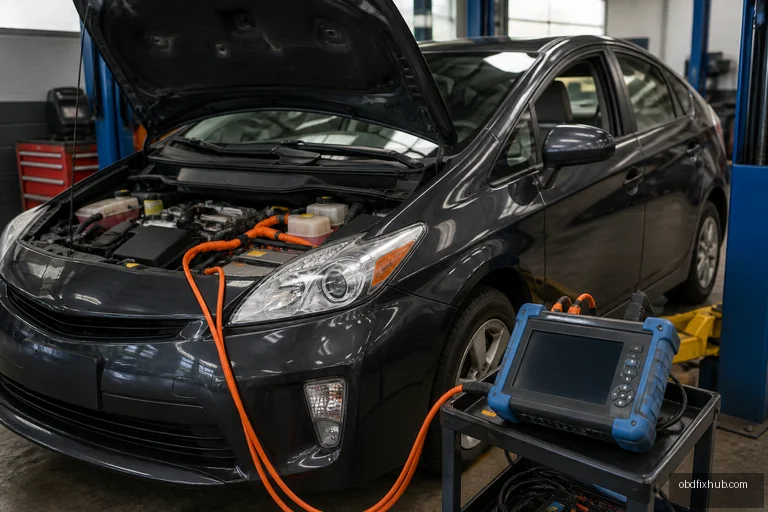
Search intent: Informational. Drivers searching for a P0AA6 hybrid battery voltage isolation fault usually want to know whether the car is safe, what caused the warning, and how expensive the repair might be. In plain English, P0AA6 means the high-voltage hybrid or EV system is detecting unwanted electrical leakage between the traction-battery circuit and the vehicle chassis. It is a safety-related fault, not a code that should be ignored or repeatedly cleared.
What Does Toyota P0AA6 Mean?
P0AA6 is the generic diagnostic trouble code for Hybrid/EV Battery Voltage System Isolation Fault. The high-voltage battery, inverter, motor-generators, air-conditioning compressor, onboard charger, and associated orange cables are designed to remain electrically isolated from the metal body of the vehicle.
The vehicle constantly checks this insulation. If the resistance between the high-voltage circuit and chassis falls below the permitted threshold, the hybrid control system stores P0AA6 and may shut down or limit the high-voltage system. Toyota vehicles often report additional information codes, such as INF 526 or INF 612. Those subcodes are extremely important because they can indicate when the fault appeared or which operating condition triggered it.
Why Is P0AA6 a Serious Code?
A hybrid battery can contain several hundred volts, even when the gasoline engine is switched off. A damaged isolation barrier can create a shock hazard, particularly if moisture, coolant, road salt, or damaged insulation provides a path to the body.
Do not remove the battery cover, disconnect orange cables, probe high-voltage terminals, or work on the inverter unless you are trained and equipped for hybrid high-voltage systems. Turning off the ignition does not make the battery harmless. The safest first step is a professional diagnosis, not a parts replacement.
Common Causes of a P0AA6 Isolation Fault
The code does not identify one specific failed component. It describes a measured electrical condition, so the diagnostic process must isolate each high-voltage branch.
- Water or coolant intrusion: Moisture inside the battery case, inverter, motor-generator, or electrical connectors can temporarily lower insulation resistance.
- Damaged orange high-voltage cables: Chafing, crushed insulation, corrosion, or rodent damage can allow leakage to the chassis.
- Failed electric air-conditioning compressor: An internal winding fault in the compressor is a well-known cause on some Toyota and Lexus hybrid models.
- Hybrid battery corrosion: Electrolyte leakage, condensation, busbar corrosion, or contamination around battery modules may create an isolation path.
- Inverter or transaxle failure: Internal insulation breakdown in motor-generator windings or power electronics can trigger P0AA6.
- Onboard charger or DC-DC converter problems: Plug-in hybrids and EVs can develop isolation faults in charging equipment that conventional hybrids do not have.
- Damaged battery cooling components: A leaking cooling circuit or conductive contamination near battery electronics may be the real source.
Symptoms You May Notice
Some vehicles store P0AA6 with no obvious drivability problem. Others display a red triangle, Check Hybrid System, Stop Safely, or a similar warning. The gasoline engine may continue to run while electric propulsion is disabled, producing poor fuel economy and unusual engine cycling.
- Hybrid system warning or check-engine light
- Reduced power or limp-home operation
- Inability to enter READY mode
- Loss of regenerative braking
- Battery cooling fan running more often than normal
- Warning appears after rain, washing, charging, or heavy humidity
- Repeated warning after the vehicle has been driven several miles
A warning that appears only after wet weather is a valuable clue. It often points toward moisture intrusion or contamination rather than immediately proving that the traction battery itself has failed.
How Professionals Diagnose P0AA6
A capable technician starts by scanning every relevant control module with a hybrid-capable scan tool. A basic code reader may show P0AA6 but fail to display Toyota-specific INF codes, freeze-frame data, battery temperatures, or isolation-resistance measurements.
- Record all codes and freeze-frame data. The operating conditions may show whether the fault appeared during charging, acceleration, regeneration, or air-conditioning use.
- Inspect the vehicle before clearing anything. Technicians look for water tracks, coolant residue, corrosion, damaged harnesses, rodent damage, and evidence of collision repairs.
- Measure isolation resistance with approved equipment. The high-voltage system is tested according to the manufacturer’s service procedure, not with an improvised meter test.
- Divide the circuit into sections. The battery, inverter, compressor, transaxle, charger, and cable assemblies are separated or tested individually to locate the leaking branch.
- Confirm the repair. After the suspected component is repaired, the system is retested under the conditions that originally triggered the code.
This approach matters because replacing a hybrid battery without testing the compressor or inverter can leave the original P0AA6 fault untouched. On the other hand, a low-cost connector repair can be missed if a shop assumes every isolation fault requires a complete battery.
How Much Does It Cost to Fix a Check Hybrid System?
There is no single price for a P0AA6 repair because the code can be caused by anything from a wet connector to a failed battery or inverter. Typical North American repair ranges are approximately:
- Diagnostic testing: $150–$400, depending on the vehicle and labor time
- Connector, wiring, or moisture repair: $200–$1,000
- Electric A/C compressor: $1,000–$3,000 installed
- Used or rebuilt hybrid battery: $1,000–$3,000 installed
- New OEM battery: $2,500–$6,000 or more
- Inverter, charger, or transaxle repair: $2,000–$6,000 or more
Prices vary significantly by model, battery size, labor rates, warranty coverage, and whether a new, rebuilt, or used part is selected. Ask the repair shop for the measured isolation value, the affected component, the diagnostic evidence, and the warranty terms before approving an expensive repair.
Can You Reset the Hybrid Battery System?
You can clear P0AA6 with a compatible scan tool after recording the codes, or a technician may disconnect the 12-volt battery on some vehicles. However, this is not a repair. If the leakage remains, the code will return—sometimes immediately and sometimes only after the system performs another self-test.
Disconnecting the 12-volt battery can also erase useful diagnostic data and may create additional initialization requirements. It will not reset a worn traction battery, dry out a wet connector, repair damaged insulation, or make an unsafe high-voltage system safe.
The only sensible reason to clear the code is after the cause has been repaired, or as part of a controlled diagnostic procedure. If the warning returns, stop treating it as a nuisance light.
What Should You Do When P0AA6 Appears?
- Reduce driving and avoid unnecessary high-speed or long-distance trips.
- Do not touch orange cables or open the high-voltage battery enclosure.
- Note whether the warning followed rain, washing, charging, or A/C operation.
- Have the vehicle scanned with a manufacturer-level hybrid diagnostic tool.
- Request the exact INF subcode and isolation-test results before authorizing parts.
If the vehicle displays a red stop warning, smells of burning insulation, shows visible fluid near high-voltage components, or refuses to enter READY mode, arrange towing rather than continuing to drive. A qualified hybrid specialist can determine whether the fault is a relatively simple wiring issue or a major high-voltage component failure.
Summary
P0AA6 means the hybrid or EV system has detected insufficient electrical isolation between a high-voltage circuit and the vehicle chassis. It can be caused by moisture, wiring damage, the A/C compressor, battery corrosion, an inverter, a transaxle, or charging hardware. Resetting the code may turn the light off briefly, but it cannot correct the underlying fault. The most economical repair is an accurate isolation test that identifies the failed branch before any battery or inverter is replaced.
Frequently Asked Questions
What does the Toyota P0AA6 hybrid battery voltage system isolation fault code mean?
It means Toyota’s monitoring system detected an unwanted electrical connection or low insulation resistance between the high-voltage hybrid circuit and the vehicle body. The battery is not automatically proven to be defective.
What does code P0AA6 mean on a Prius?
On a Prius, P0AA6 indicates a hybrid high-voltage isolation problem. The battery, inverter, electric A/C compressor, transaxle, cables, and connectors must be tested to locate the source.
How much does it cost to fix a Check Hybrid System warning?
Costs range from roughly $200 for a minor wiring or connector repair to more than $6,000 for major battery, inverter, charger, or transaxle work. A proper diagnostic test is necessary before estimating accurately.
How do I reset the hybrid battery system?
A compatible scan tool can clear the code, and some vehicles may lose the warning after the 12-volt battery is disconnected. Neither method repairs P0AA6, so the code normally returns if the isolation fault remains.
Can I drive with P0AA6?
Driving may be possible if the vehicle still operates normally, but it is not advisable to ignore the warning. Avoid long trips and seek professional diagnosis promptly, especially if power is reduced or a red stop warning appears.




