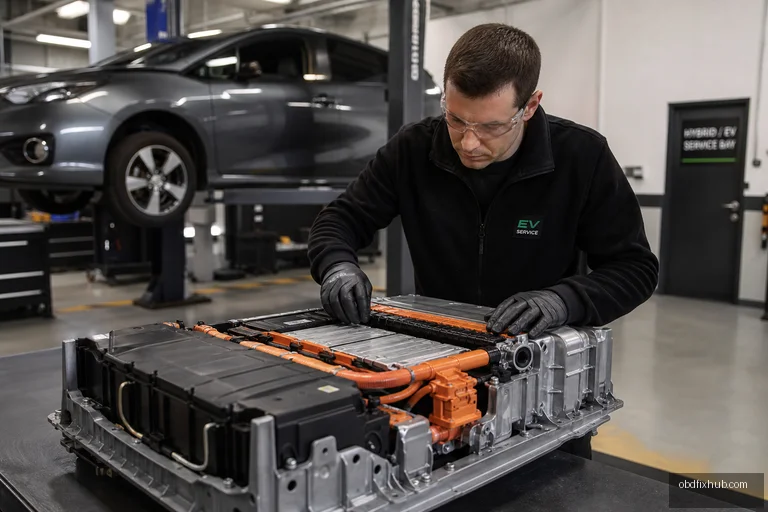
P0ABA Hybrid/EV Battery Pack Voltage Sense Circuit: Meaning, Causes, Symptoms & Fix
P0ABA is a hybrid or electric vehicle diagnostic trouble code indicating a problem in the battery pack voltage sense A circuit. The fault may come from a damaged sense wire, connector, fuse, battery monitoring sensor, or battery control module—not necessarily from a worn-out high-voltage battery. Accurate testing matters because replacing an expensive battery pack without proving the fault is a common and costly mistake.
What Does the P0ABA Code Mean?
P0ABA is a generic OBD-II code for Hybrid/EV Battery Pack Voltage Sense A Circuit. The battery energy control module continuously measures individual cell groups or battery blocks through low-current voltage-sensing wires. It uses these readings to calculate state of charge, detect imbalance, control charging, and protect the vehicle from overvoltage or undervoltage.
When the module sees an implausible signal, an open circuit, a short to ground or power, or a voltage reading outside the expected range, it can store P0ABA. The exact definition of the letter A and the affected circuit varies by manufacturer, so the vehicle-specific service manual and wiring diagram are essential.
In practical workshop diagnosis, P0ABA is often a circuit integrity problem rather than proof that every battery cell has failed. A scan tool may also show related codes for battery block voltage, battery sensor communication, isolation, or the battery ECU.
P0ABA Symptoms You May Notice
The vehicle may still start and drive normally when the code first appears. Hybrid systems often enter a protective strategy before the fault becomes severe, so a warning light should not be ignored simply because performance feels unchanged.
- Check Engine, Hybrid System, EV System, or battery warning light
- Reduced electric-motor assist or limited regenerative braking
- Engine running more frequently than usual
- Reduced fuel economy or shorter electric driving range
- Failure of READY mode or a no-start condition in more serious cases
- Cooling fan operating loudly or continuously
- Multiple battery voltage, communication, or isolation codes stored together
A useful clue is whether the code returns immediately after clearing. An immediate return with the ignition on usually points toward an electrical circuit fault. A code that appears only during charging, acceleration, or high battery temperature may require a live-data test and a careful inspection of battery block readings.
Common Causes of P0ABA
- Loose, corroded, bent, or contaminated battery sense connector terminals
- Broken voltage-sense wire inside or near the battery pack
- Damaged busbar or sensing harness caused by corrosion or battery electrolyte contamination
- Faulty battery voltage sensor or battery monitoring board
- Blown low-voltage fuse or an open power supply to the battery ECU
- Defective battery energy control module
- Water intrusion, rodent damage, or previous collision damage
- Genuine battery module deterioration creating abnormal block-voltage readings
On older hybrid vehicles, corrosion around the busbars is particularly important. Moisture and battery gases can create resistance at the sensing connection, producing a voltage reading that looks wrong even when the battery modules are not the original cause of the problem.
How a Professional Diagnoses the P0ABA Hybrid/EV Battery Pack Voltage Sense Circuit
High-voltage battery work is not a routine 12-volt electrical repair. A trained technician uses the manufacturer’s shutdown procedure, insulated tools, personal protective equipment, and a properly rated multimeter. Do not probe orange cables or open a battery pack without the correct training.
- Scan every control module. Record current, pending, and history codes before clearing anything. Codes in the battery ECU, inverter, engine ECU, and charging system can reveal whether P0ABA is primary or secondary.
- Check the 12-volt battery. Low auxiliary voltage can create misleading hybrid control-module faults. A healthy resting 12-volt battery is usually near 12.6 volts, although the manufacturer’s test procedure takes priority.
- Review live data. The technician compares battery block voltages, total pack voltage, temperatures, and state-of-charge values. One block that differs sharply from its neighbors under load is more suspicious than a small variation at rest.
- Inspect the low-voltage sensing circuit. With the high-voltage system safely disabled, the technician checks connectors, terminal tension, wiring continuity, shorts, and reference voltages according to the service manual.
- Test the battery monitoring components. If wiring and power supplies are correct, the battery sensor board or battery ECU may be at fault. Some manufacturers require replacement and programming rather than a simple plug-in repair.
- Clear codes and verify the repair. The vehicle should complete its readiness checks and be tested under the conditions that originally triggered the code.
A valuable diagnostic habit is to compare the fault code with freeze-frame data. If P0ABA was recorded at a normal battery temperature and low load, an open circuit or connector problem becomes more likely. If it appeared during heavy charging or acceleration, a weak module or intermittent connection may be involved.
P0ABA Fixes and Typical Repair Costs
The correct repair depends on the failed part. A loose connector may require cleaning, terminal repair, and corrosion prevention. A damaged sensing harness or busbar may need replacement. If the battery ECU or monitoring board has failed, programming or initialization may be required after installation.
- Diagnostic scan and inspection: commonly $100–$250, with dealer rates sometimes reaching $300 or more
- Connector, fuse, or wiring repair: approximately $150–$600 depending on access and corrosion
- Battery sensor board or ECU: often $400–$1,500 including labor and setup
- Refurbished or used battery assembly: roughly $1,000–$2,500, with warranty quality varying greatly
- New OEM hybrid battery: commonly $2,000–$5,000 or more depending on vehicle and labor
These are broad U.S. estimates, not a quote. Ask the repair shop whether the diagnostic fee is applied to the repair, whether the replacement battery is new or remanufactured, and what warranty covers both parts and labor.
What Does Hybrid Battery Pack Deterioration Mean?
Hybrid battery pack deterioration means the battery no longer stores or delivers energy as effectively as it did when new. The individual modules may develop increased internal resistance or lose capacity, causing voltage to drop more quickly under acceleration and rise more quickly during regeneration.
Deterioration is not identical to P0ABA. A degraded battery can trigger voltage-related codes, but P0ABA can also be caused by a broken sense wire or connector while the battery modules remain serviceable. Live data, load testing, and manufacturer-specific battery tests are needed to separate a circuit fault from true capacity loss.
What Does Toyota P0AA6 Mean?
Toyota P0AA6 generally means Hybrid Battery Voltage System Isolation Fault. It indicates that the high-voltage battery system is detecting unwanted electrical leakage between the high-voltage circuit and the vehicle chassis or ground.
P0AA6 is different from P0ABA. P0ABA concerns how battery voltage is sensed by the control system; P0AA6 concerns insulation and electrical isolation. Possible P0AA6 sources include a wet battery case, damaged orange cable, inverter, air-conditioning compressor, DC-DC converter, or internal battery leakage. Because isolation faults can expose dangerous high voltage, the vehicle should be inspected by a qualified hybrid technician rather than repeatedly driven or randomly reset.
How to Identify High-Voltage Components in a Hybrid Vehicle
Most manufacturers use orange-colored cables and connectors to identify high-voltage circuits. Common high-voltage components include the traction battery, inverter/converter, electric air-conditioning compressor, onboard charger, DC-DC converter, and high-voltage junction box.
- Look for orange cables, warning labels, and high-voltage symbols.
- Locate the service disconnect plug or service fuse, usually near the traction battery.
- Do not assume that removing the service plug makes the entire vehicle safe immediately; capacitors may retain charge.
- Never use a standard multimeter or insulated household tools on an unknown high-voltage circuit.
- Follow the exact manufacturer wait time and verification procedure after system shutdown.
The 12-volt battery may control relays, but it does not make the orange high-voltage system safe to handle. Identification is appropriate for awareness; testing or disassembly belongs to a technician trained in hybrid and EV safety.
Should You Keep Driving With P0ABA?
If the vehicle drives normally and only the Check Engine light is on, a short trip to a qualified repair facility may be reasonable. Avoid long journeys, towing, aggressive acceleration, and unnecessary charging until the fault is diagnosed. Stop driving and arrange professional assistance if the vehicle displays a red hybrid warning, refuses READY mode, smells of overheating, loses power, or shows an isolation-fault warning.
Key Takeaway
P0ABA identifies a problem with the battery pack’s voltage-sensing circuit, not an automatic verdict that the entire hybrid battery must be replaced. Start with a complete module scan, 12-volt battery check, live-data comparison, and safe wiring inspection. For Toyota P0AA6 or any suspected high-voltage isolation fault, use a qualified hybrid technician immediately.
Frequently Asked Questions
How much does a hybrid battery diagnostic cost?
A hybrid battery diagnostic commonly costs $100–$250 in the United States. Dealer pricing may be higher, especially when the inspection includes battery load testing, isolation testing, or a written repair estimate.
Can a weak 12-volt battery cause P0ABA?
Yes, low 12-volt voltage can create misleading communication and control-module codes. However, if P0ABA returns with a verified healthy 12-volt battery, the voltage-sense circuit and battery monitoring system need direct testing.
Does P0ABA always mean the hybrid battery is bad?
No. Damaged wiring, corroded terminals, a failed sensing board, or a battery ECU can all trigger P0ABA. Battery deterioration should be confirmed with live data and a manufacturer-approved capacity or load test.
Is P0AA6 the same as P0ABA?
No. P0AA6 is an isolation fault involving leakage from the high-voltage system to the vehicle body or ground. P0ABA is a battery voltage-sensing circuit fault. Both require careful diagnosis, but they point to different electrical problems.




