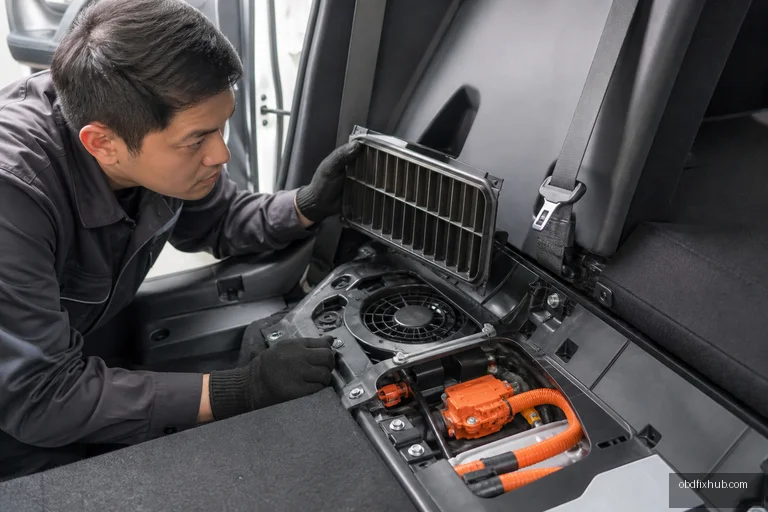
P0AD4 Hybrid/EV Battery Pack Airflow Insufficient means the vehicle has detected inadequate airflow through the high-voltage hybrid battery cooling system. The usual causes are a blocked battery air inlet, dirty filter or grille, failed cooling fan, restricted duct, faulty temperature sensor, or an electrical problem. It does not automatically mean the hybrid battery itself has failed, but continued overheating can accelerate battery deterioration.
This is primarily an informational diagnostic question: the correct repair depends on finding out why airflow is low rather than replacing expensive parts based on the code alone. A proper inspection should begin with the cooling path, fan operation, wiring, and live temperature data.
What Does P0AD4 Mean?
P0AD4 is a generic OBD-II powertrain code associated with the hybrid or electric vehicle battery pack air-flow system. In many hybrids, a dedicated electric blower pulls cabin air through an intake grille and forces it across the battery modules. The battery control system monitors fan performance, air movement, temperature sensors, or the temperature change expected during operation.
When the measured airflow is below the programmed threshold, the vehicle stores P0AD4. The exact monitoring strategy differs between Toyota, Lexus, Ford, Honda, Hyundai, Kia, and other manufacturers, so the factory service information remains important. Some vehicles may also store companion codes for battery temperature, fan speed, or battery performance.
P0AD4 Hybrid/EV Battery Pack Airflow Insufficient: Common Causes
- Blocked battery intake: Pet hair, dust, lint, luggage, seat covers, or a child’s clothing can obstruct the grille, often located near a rear seat or side trim panel.
- Dirty battery cooling filter: Some vehicles use a replaceable or cleanable filter. A neglected filter can reduce airflow enough to trigger the code, especially during hot weather.
- Restricted air duct: A disconnected, crushed, incorrectly installed, or debris-filled duct can prevent air from reaching the battery.
- Weak or failed cooling fan: The fan may be seized, noisy, intermittently stopping, or turning too slowly because of worn bearings, a failed motor, or an internal controller fault.
- Wiring or connector damage: Corrosion, loose terminals, rodent damage, and poor grounds can interrupt fan power or feedback signals.
- Incorrect temperature or airflow feedback: A defective thermistor, pressure sensor, fan speed signal, or battery control module can make normal airflow appear insufficient.
- Battery overheating or deterioration: A battery with abnormal internal resistance may generate more heat than expected. In that situation, P0AD4 can be a consequence of a deeper battery problem rather than the original fault.
Symptoms You May Notice
The most obvious symptom is a check-engine light or hybrid system warning. The vehicle may still drive normally at first because the battery control system protects the pack by limiting charge and discharge power. On a road test, however, the gasoline engine may run more often, electric assistance may feel weaker, and fuel economy may decline.
- Hybrid system warning or check-engine light
- Reduced electric-only driving or acceleration assist
- Cooling fan noise from the rear seat or luggage area
- Fan running at high speed more frequently than normal
- Engine staying on while stopped or during light acceleration
- Reduced fuel economy
- Warning messages such as Check Hybrid System
- Intermittent limp mode, especially after long climbs, heavy traffic, or hot weather
A fan that suddenly becomes very loud is not proof that it is working correctly. It may be compensating for a blocked intake, or it may be spinning without moving enough air because of damaged blades or a failing motor.
What Does Hybrid Battery Pack Deterioration Mean?
Hybrid battery pack deterioration means the battery modules no longer perform as evenly or efficiently as they did when new. Capacity gradually decreases, internal resistance rises, and differences between module voltage or temperature become more pronounced. The battery can still accept and deliver energy, but the control system must work harder to keep it within safe limits.
Deterioration is different from an airflow fault. A blocked vent may be inexpensive to correct and may leave the battery electrically healthy. Conversely, a severely aged battery can overheat even with a clean intake and fully functional fan. Scan data such as block voltage differences, state-of-charge swings, temperature variation, and resistance-related codes helps separate these conditions.
What Does It Mean When the Hybrid Battery Cooling System Is Low?
When someone says the hybrid battery cooling system is low, they may mean that airflow is low, not that the vehicle is low on liquid coolant. Most hybrid traction batteries use forced air, so there is no coolant reservoir to refill for the battery pack in the conventional sense.
Some plug-in hybrids and electric vehicles use liquid-cooled battery packs, but P0AD4 specifically points toward an air-flow system concern. Do not add coolant to an unrelated reservoir or assume a refrigerant recharge will solve this code. Confirm the vehicle’s cooling design and inspect the battery intake, fan, ducting, and sensors first.
How to Diagnose P0AD4 Correctly
- Scan all modules: Use a scanner capable of reading hybrid battery and body-control modules, not just generic engine codes. Record P0AD4 and every related code before clearing anything.
- Check the freeze-frame data: Note battery temperature, state of charge, vehicle speed, and operating conditions when the code was stored. A fault only during high heat points toward a different cause than one present at startup.
- Inspect the intake: Remove visible debris and check the grille, filter, seat area, duct, and fan housing. Do not use compressed air carelessly, because it can drive dust deeper into the pack.
- Command the fan on: With a professional scan tool, command several fan speeds and listen for smooth operation. A technician should verify actual fan response rather than relying only on sound.
- Test the circuit: Check power supply, ground, connector tension, control signals, and fan current draw. A fan that operates but draws excessive current may fail again soon.
- Compare live data: Review battery temperature sensors and module readings. One sensor showing an implausible value can produce a misleading airflow diagnosis.
- Inspect battery health: If airflow is normal, test battery voltage balance, state-of-charge stability, and internal resistance using manufacturer-approved procedures.
High-voltage battery packs can remain dangerous even when the vehicle is switched off. Do not remove the pack cover, disconnect orange high-voltage cables, or probe battery terminals without the correct training, insulated equipment, and manufacturer procedure.
How Much Does a Hybrid Battery Diagnostic Cost?
A basic code scan may cost approximately $30 to $100, although some parts stores offer limited scans at no charge. A proper hybrid battery and airflow diagnosis at an independent specialist commonly costs $100 to $250. Dealer pricing is often around $150 to $350 or more, depending on region, vehicle complexity, and whether battery live-data testing is included.
Ask exactly what the diagnostic fee covers. The useful service should include a full-module scan, freeze-frame review, cooling fan activation test, visual inspection, and a written explanation of the findings. A shop that reads P0AD4 and immediately recommends a complete battery replacement has not completed a meaningful diagnosis.
Repair Options and Typical Costs
- Cleaning or removing an obstruction: Often free to approximately $100, depending on access.
- Replacing a battery cooling filter: Commonly $30 to $150 including labor.
- Repairing wiring or connectors: Approximately $100 to $400, with extensive harness damage costing more.
- Replacing the cooling fan: Often $250 to $900 for parts and labor, depending on the model.
- Replacing a temperature sensor or duct: Usually $150 to $700 depending on battery access.
- Replacing the hybrid battery: Roughly $1,500 to $5,000 or more for a complete pack, with dealer-installed new batteries often at the higher end.
Prices vary substantially by model and location. A blocked intake is one of the least expensive hybrid warning-light repairs, which is why inspection should come before battery replacement.
Can You Drive With P0AD4?
Short, gentle driving may be possible if the vehicle has no red warning, overheating message, burning smell, severe loss of power, or unusual battery noise. Avoid towing, steep mountain routes, prolonged idling, and aggressive acceleration until the problem is diagnosed. If the hybrid warning flashes, the vehicle enters limp mode, or the cooling fan is silent despite rising temperature, stop driving and arrange professional service.
How to Prevent the Code From Returning
- Keep bags, clothing, pet hair, and child seats away from the battery intake grille.
- Clean or replace the battery filter according to the maintenance schedule.
- Ask for fan and intake inspection during routine hybrid service.
- Respond promptly to a continuously loud cooling fan or reduced fuel economy.
- Do not cover ventilation openings with aftermarket trim or cargo.
Bottom Line
P0AD4 indicates insufficient airflow through the hybrid or EV battery cooling system, not an automatic battery replacement verdict. Start with the intake, filter, duct, fan, wiring, and live sensor data. A qualified hybrid technician can usually identify whether the repair is a simple airflow service or evidence of genuine battery deterioration.
Frequently Asked Questions
What is the most common cause of P0AD4?
A blocked battery intake or dirty cooling filter is a common cause, especially in vehicles carrying pets or frequently used in dusty conditions. A failed fan and wiring fault must still be tested before confirming the repair.
What are the signs that a hybrid battery is weak?
Common signs include rapidly changing state of charge, reduced electric assistance, poor fuel economy, the engine running more frequently, battery warning codes, and large voltage or temperature differences between battery sections. These symptoms require scan-data confirmation.
Does P0AD4 mean I need a new hybrid battery?
No. P0AD4 can result from a blocked vent, dirty filter, failed fan, restricted duct, or sensor problem. Replace the battery only when electrical testing confirms deterioration or damaged modules.
Can low hybrid battery cooling be fixed by adding coolant?
Usually not. Many hybrid batteries use air cooling, and the problem is insufficient airflow rather than low fluid. A technician should verify whether the vehicle has air or liquid battery cooling before adding or servicing any fluid.
How much does a hybrid battery diagnostic cost?
Expect roughly $100 to $250 at many independent hybrid specialists and $150 to $350 or more at dealerships. Ask whether the price includes a full-module scan, fan activation test, visual inspection, and battery health measurements.




