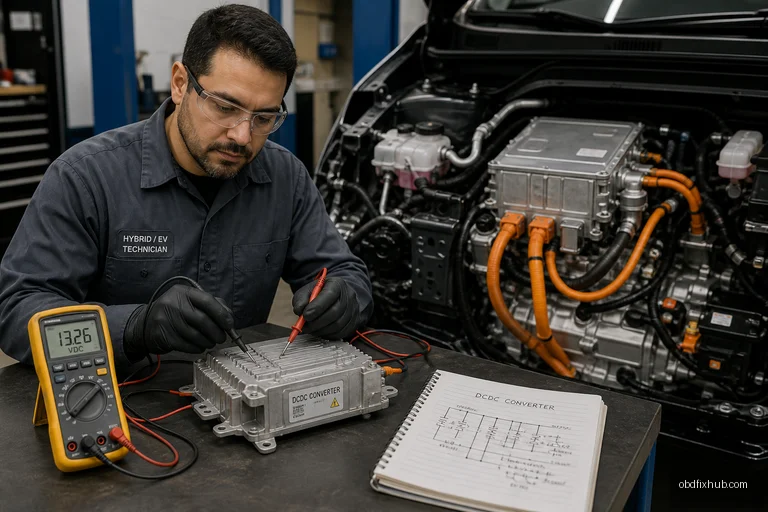
P0CA2 means the vehicle has detected a problem with the DC/DC converter’s step-down voltage performance. In a hybrid or electric vehicle, this converter reduces high-voltage battery power to the low-voltage system that runs the 12-volt battery, control modules, lighting, and accessories. The code does not automatically prove that the converter itself is defective; wiring, cooling, battery condition, software, and high-voltage safety interlocks can produce the same result.
What Does the P0CA2 Code Mean?
P0CA2 is a generic OBD-II powertrain code associated with DC/DC converter step-down voltage performance. The vehicle’s control system compares commanded converter output with the voltage it actually measures. If the output remains too low, too high, unstable, or outside the expected range for a defined period, it stores P0CA2.
The converter performs a role similar to an alternator in a conventional car, but it does not generate power from the engine. It uses energy from the high-voltage traction battery and supplies a controlled low-voltage output, commonly around the 12- to 14-volt range depending on the vehicle’s operating strategy.
Common Symptoms of P0CA2
Symptoms vary according to whether the converter has completely failed or is only dropping voltage under load. A vehicle may initially drive normally and then develop multiple unrelated-looking electrical warnings.
- Hybrid system, EV system, or powertrain warning message
- 12-volt battery warning or repeated low-battery condition
- Flickering lights, instrument-cluster resets, or accessory shutdown
- Multiple communication and undervoltage fault codes
- Vehicle entering reduced-power or fail-safe mode
- Failure to enter READY mode or difficulty restarting after a short stop
- Overheating smell, abnormal converter noise, or a converter cooling-fan fault
A useful diagnostic clue is timing. If P0CA2 appears after the vehicle sits, a weak 12-volt battery may be the original problem. If it appears during acceleration, heavy electrical load, or hot weather, converter thermal protection, high-voltage supply issues, or an internal power-stage fault deserve closer attention.
Why Does P0CA2 Occur?
1. Weak or damaged 12-volt battery
A failing auxiliary battery can pull converter output down and create misleading hybrid-system codes. A battery may show acceptable voltage at rest yet collapse during a load test. Test the battery after it has been fully charged and check voltage during vehicle wake-up, not only with the ignition switched off.
2. High resistance in power or ground circuits
Loose terminals, corroded ground points, damaged harnesses, and poorly repaired wiring can cause a voltage drop that the converter interprets as poor performance. A visual inspection is not enough. Voltage-drop testing under load is more reliable than measuring continuity with a multimeter.
3. Cooling or temperature-related failure
DC/DC converters generate heat and depend on coolant flow, a heat exchanger, airflow, or an electric cooling fan, depending on the vehicle. Blocked passages, low coolant, a failed pump, or a temperature sensor problem can force the converter to reduce output. P0CA2 that returns only after a long drive is particularly suspicious for thermal protection.
4. High-voltage battery or contactor problem
The converter cannot produce stable low-voltage power if the traction battery is not supplying the expected voltage. Open or high-resistance contactors, isolation faults, battery-management restrictions, and interlock problems may therefore set a converter performance code even when the converter is serviceable.
5. Internal converter failure
Failed switching transistors, capacitors, sensors, control boards, or internal connections can cause low, excessive, or pulsating output. Internal converter repair is normally a specialist task because the unit is connected to lethal high voltage and often requires vehicle-specific programming after replacement.
How to Diagnose P0CA2 Safely
Do not remove orange high-voltage connectors or open the converter housing unless you are trained and equipped for hybrid high-voltage work. Disconnecting the 12-volt battery does not make the traction-battery system safe. Follow the manufacturer’s service procedure, wear the specified personal protective equipment, and use an approved meter and scan tool.
- Record all codes and freeze-frame data. Diagnose battery, isolation, contactor, cooling, and communication codes before condemning the converter.
- Check the 12-volt battery. Measure resting voltage, perform a conductance or load test, and monitor voltage while the vehicle enters READY mode.
- Inspect connections. Check low-voltage plugs, grounds, fuses, service plugs, interlock circuits, and signs of moisture or heat damage.
- Verify converter input and output with live data. Compare commanded voltage, measured voltage, current, temperature, and enable status using a capable scan tool.
- Perform voltage-drop tests. Test positive and ground paths while the converter is operating under an appropriate electrical load.
- Check cooling performance. Confirm coolant level, pump operation, fan operation, temperature sensors, and relevant flow passages.
- Clear the code and road-test under the original conditions. A repair is not confirmed merely because the warning disappears after clearing codes.
How to Fix P0CA2
The correct repair depends on the failed part, not on the code label alone. A weak 12-volt battery should be replaced with the correct technology and capacity, then registered or initialized if the vehicle requires it. Corroded terminals and damaged grounds must be cleaned or repaired properly; tightening a loose connection without correcting terminal damage often leads to a repeat failure.
If the cooling system is responsible, repair the pump, fan, sensor, or coolant leak and remove trapped air according to the service procedure. If live data confirms an internal converter fault and its power, ground, enable, and cooling inputs are correct, the unit may need professional remanufacture or replacement. Some vehicles also require configuration, calibration, or software updates after installation.
Do not install a used converter solely because it is inexpensive. Compatibility can depend on model year, battery chemistry, software level, connector design, and immobilizer or hybrid-control programming. Verify the part number and required setup before purchasing a replacement.
How Do You Know If a DC/DC Converter Is Bad?
A converter is more likely to be defective when its input supply is correct, its grounds and control signals pass the manufacturer’s tests, the cooling system works, and its measured output fails to follow the commanded value under load. A low 12-volt reading by itself is not conclusive because a weak battery, poor ground, or disabled converter can create the same symptom.
One practical distinction is repeatability: if output voltage is correct with no load but falls sharply when headlights, blower, heated seats, or other loads are switched on, perform voltage-drop and current-capacity tests before replacing the converter. An oscilloscope or OEM live-data procedure may be needed to identify ripple or intermittent switching faults that a basic multimeter misses.
P0A08 and P0A09: How Are They Different from P0CA2?
P0A08 generally refers to a DC/DC converter status circuit problem. It points more toward the converter’s status signal, enable circuit, wiring, or communication path, although the exact wording can vary by manufacturer.
P0A09 is commonly defined as DC/DC converter performance. This is why both Ford and Toyota diagnostic systems may describe P0A09 as a converter performance fault. However, the test conditions, subcodes, repair procedures, and technical-service information are manufacturer-specific. P0A09 is not automatically the same fault as P0CA2, so use the vehicle’s factory service information rather than relying on a generic code list.
When Should You Stop Driving?
Stop driving and arrange professional diagnosis if the vehicle displays a high-voltage, hybrid-system, or “stop safely” message; loses READY mode; shows rapidly falling 12-volt voltage; smells overheated; or develops repeated electrical shutdowns. Continued operation can leave the vehicle stranded and may damage low-voltage control modules.
If the only symptom is a stored code with no warning light and the vehicle operates normally, schedule testing soon rather than repeatedly clearing the code. Intermittent converter faults are often easier to diagnose while the original freeze-frame conditions can still be reproduced.
Summary
P0CA2 identifies a DC/DC converter step-down voltage performance problem, but it is a starting point—not a verdict that the converter must be replaced. Begin with the 12-volt battery, wiring, grounds, high-voltage supply, cooling system, and live-data measurements. Because hybrid and EV systems contain dangerous high voltage, converter testing and replacement should be performed by a properly trained technician using the manufacturer’s procedures.
Frequently Asked Questions
How do I know if a DC/DC converter is bad?
Confirm that the converter has correct high-voltage input, power, ground, enable signals, and cooling. If its actual output remains outside the commanded range under load after those checks pass, the converter is a strong suspect.
How do I fix the P0A08 code?
Inspect the DC/DC converter status or enable circuit, fuses, connectors, grounds, and communication wiring. Test the 12-volt battery and converter inputs before replacing the unit, because P0A08 can be caused by an open circuit or control problem.
What does Ford DTC P0A09 mean?
Ford generally uses P0A09 for a DC/DC converter performance fault. Confirm the exact definition and test conditions in Ford service information, then check battery voltage, converter input and output, wiring, temperature, and cooling.
What does Toyota code P0A09 mean?
On many Toyota hybrid applications, P0A09 indicates DC/DC converter performance. The related INF or subcode is important because it can identify an electrical, temperature, battery, or converter-control condition.
Can I keep driving with P0CA2?
Driving is not recommended when the hybrid warning is active, the 12-volt voltage is falling, or the vehicle enters reduced power. The converter may stop charging the auxiliary battery and leave the vehicle unable to restart.




