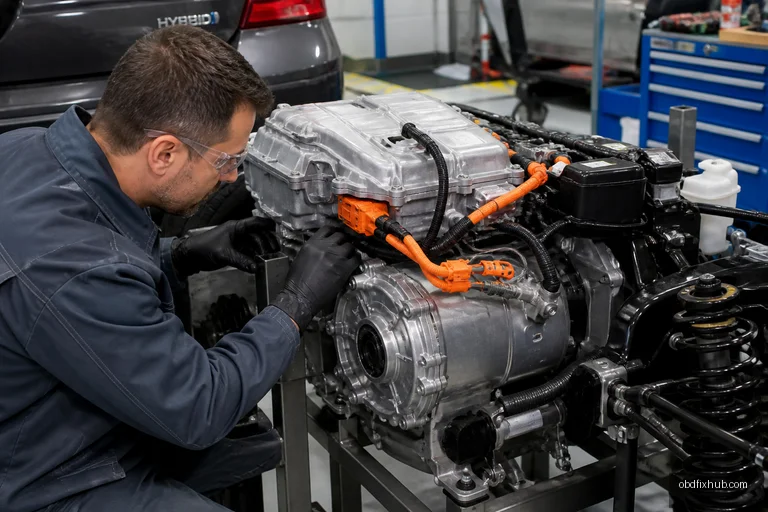
P0E71 Generator Torque Delivered Performance means the hybrid or electric powertrain has detected a mismatch between the torque the generator was commanded to produce and the torque it actually delivered. The fault may come from the motor-generator itself, its inverter, high-voltage wiring, sensors, software, or a weak battery—not necessarily from a mechanically damaged generator.
This is a performance-monitoring code, so replacing parts based on the code alone is a common and expensive mistake. A proper diagnosis compares commanded torque, measured torque, phase current, rotor position, battery voltage, and inverter temperature under controlled conditions.
What Does P0E71 Mean?
In a hybrid vehicle, the word “generator” can be misleading. The same electric machine may operate as a motor during acceleration and as a generator during regenerative braking or engine-assisted battery charging. P0E71 is set when the control system believes the generator torque output is outside the expected range for the operating conditions.
The powertrain control module or hybrid control module calculates expected torque from several inputs, including engine speed, motor speed, battery state of charge, inverter current, temperature, and rotor position. It then compares that estimate with feedback from current and position sensors. If the difference remains large enough for long enough, the module stores P0E71.
- “Torque commanded” is what the control module requests.
- “Torque delivered” is what the electrical and mechanical system actually produces.
- “Performance” indicates that the system may be functioning, but not accurately enough to meet the requested output.
Common Symptoms of P0E71
Symptoms vary by vehicle design and by the fault that caused the code. Some vehicles enter a reduced-power mode immediately, while others continue to drive normally until the hybrid battery is heavily loaded or regenerative braking is requested.
- Hybrid system warning, powertrain warning, or check-engine light
- Reduced acceleration or a “limited power” message
- Engine staying on more often than usual
- Reduced or disabled regenerative braking
- Unusual engine revving during acceleration or charging
- Rough transitions between electric drive and engine power
- Battery state-of-charge fluctuations that seem too rapid
- Inability to enter READY mode in severe cases
- Additional inverter, motor position, battery, or communication codes
A particularly useful clue is when P0E71 appears only during high-load events. For example, a vehicle may drive normally at low speed but set the code during a long hill climb, hard acceleration, or aggressive regenerative braking. That pattern often points toward current delivery, overheating, voltage drop, or an intermittent connection rather than a permanent mechanical failure.
Most Likely Causes of P0E71 Generator Torque Delivered Performance
1. Inverter or power electronics problems
The inverter converts high-voltage battery DC into the three-phase AC current required by the motor-generator. A failing power transistor, gate-driver circuit, current sensor, or internal solder connection can reduce torque output without immediately causing a complete inverter failure.
2. Motor-generator position feedback errors
The controller must know the rotor’s exact position to energize the motor phases correctly. A resolver, encoder, position sensor, wiring fault, or connector problem can make the control module calculate torque incorrectly. Position-related trouble codes often appear with P0E71 and should be diagnosed before condemning the motor-generator.
3. High-voltage battery limitations
A battery with excessive internal resistance, weak cells, low state of charge, or a temperature-related power restriction may be unable to supply or absorb the requested energy. In that situation, the generator may be capable of producing torque, but the battery and inverter system cannot accept the commanded power.
4. Damaged high-voltage cables or connections
Loose terminals, corrosion, water intrusion, insulation damage, or a partially seated inverter connector can create voltage drop under load. A visual inspection may look normal because the fault appears only when substantial current flows. Voltage and insulation checks must be performed with equipment rated for the vehicle’s high-voltage system.
5. Mechanical resistance or internal motor damage
Damaged bearings, rotor interference, gear reduction problems, or a seized mechanical component can prevent the generator from delivering the expected torque. Metallic debris in the motor housing, abnormal bearing noise, or a torque-related fault that follows a speed-dependent pattern makes a mechanical cause more likely.
6. Software, calibration, or communication faults
A control-module software issue, incorrect calibration, lost CAN communication, or a replaced module that has not been programmed correctly can produce a torque plausibility error. Check for technical service bulletins and confirm that all relevant modules communicate before replacing expensive hardware.
How to Diagnose P0E71 Correctly
Do not begin by clearing the code and replacing the hybrid battery. The most reliable diagnosis follows the data trail from the control request to the actual electrical and mechanical response.
- Record every stored and pending code. Use a scan tool that can access the hybrid control, battery, inverter, and motor-generator modules. The first code in the sequence is not always the root cause.
- Review freeze-frame data. Note vehicle speed, engine speed, battery state of charge, inverter temperature, motor speed, requested torque, and whether the vehicle was driving or regenerating when the code appeared.
- Check the 12-volt supply. Low auxiliary voltage can create misleading communication and actuator faults. Test voltage during startup and inspect the 12-volt battery terminals and grounds.
- Inspect connectors and cables. Look for moisture, terminal spread, damaged locking tabs, abrasion, corrosion, and signs of overheating. Do not disconnect high-voltage components without following the manufacturer’s shutdown procedure.
- Compare live data under load. A technician should compare generator torque command with calculated torque, phase current, DC bus voltage, rotor position, and motor speed. A large mismatch that appears at a repeatable load is more informative than a static resistance test.
- Check battery power capability. Review cell voltage spread, battery temperature, current limits, and internal resistance data. A battery may show acceptable voltage at rest but collapse under acceleration.
- Verify software and calibration. Confirm module part numbers, programming status, calibration updates, and CAN communication. A recently replaced inverter or battery module may require initialization or relearn procedures.
High-voltage systems can retain dangerous energy after the vehicle is switched off. Only trained personnel using insulated tools, appropriate personal protective equipment, and a verified zero-voltage procedure should open the inverter, battery, or motor-generator circuits. An ordinary multimeter and improvised probing are not safe substitutes for hybrid service equipment.
P0E71 Repair: What Usually Fixes It?
The correct repair depends on the failed part. If testing finds a loose connector or damaged harness, repairing the terminal or replacing the cable may solve the problem. If the inverter has an internal current-sensing or switching fault, it may require professional repair or replacement followed by programming and calibration.
Battery-related faults may require cell-level repair, a battery module replacement, or a complete remanufactured or new pack, depending on the vehicle manufacturer’s service policy. A motor-generator with bearing or winding damage generally requires replacement or specialist rebuilding. Software-related cases may be resolved with a control-module update, initialization, or a relearn procedure.
After repair, the code should not simply be erased. The system needs a complete verification drive that includes the operating condition that originally triggered the fault—such as acceleration, regenerative braking, or engine-generator charging—while monitoring live data for a renewed torque mismatch.
Can You Drive With P0E71?
Short-distance driving may be possible if the vehicle has no reduced-power warning, overheating message, burning smell, unusual noise, or loss of braking assistance. However, continued driving can leave the hybrid system in an unpredictable operating mode and may increase stress on the inverter or battery.
Stop driving and arrange professional recovery if the vehicle will not enter READY mode, displays “Stop Safely,” loses significant acceleration, overheats, produces smoke, or develops abnormal grinding or electrical odors. Do not attempt to bypass a hybrid warning by disconnecting the 12-volt battery.
Practical Diagnostic Example
Consider a hybrid that drives normally in city traffic but stores P0E71 after a long uphill acceleration. Freeze-frame data shows high inverter temperature, reduced DC bus voltage, and a battery current limit that drops sharply. In that case, the generator itself may be healthy; excessive battery resistance or inverter thermal protection is limiting available torque.
By contrast, if the battery voltage remains stable but generator phase current is uneven and rotor-position data becomes erratic at a specific speed, the investigation should focus on the resolver circuit, inverter current sensing, wiring, or the motor-generator windings. These two cases set the same basic code but require completely different repairs.
Key Takeaway
P0E71 indicates that the hybrid system’s generator torque output does not match what the control module expects. The cause may be electrical, mechanical, battery-related, thermal, communication-based, or software-related. The safest and least expensive path is to retrieve all module codes, study freeze-frame and live data, test the high-voltage system correctly, and verify the repair under the same load that triggered the fault.
Action step: If P0E71 is active, have a hybrid-qualified technician perform a system-level diagnosis before approving an inverter, battery, or motor-generator replacement.
Frequently Asked Questions
Is P0E71 a hybrid battery code?
Not directly. P0E71 concerns generator torque delivery, but a weak or restricted hybrid battery can cause the code by limiting the electrical power available to the generator system.
Can a low 12-volt battery cause P0E71?
Yes, low auxiliary voltage can disrupt module communication, sensor references, and actuator control. It should be tested first, although a healthy 12-volt battery does not rule out an inverter, battery, or motor-generator fault.
Will clearing P0E71 fix the problem?
No. Clearing the code only removes the stored warning temporarily. If the torque mismatch remains, the code will return, often during acceleration or regenerative braking.
How much does it cost to repair P0E71?
Cost varies widely. A connector or software update may be relatively inexpensive, while an inverter, hybrid battery, or motor-generator can cost substantially more. Accurate pricing requires testing because the code does not identify one specific failed component.
Can I diagnose P0E71 with a basic OBD2 scanner?
A basic scanner may read the code but usually cannot access the hybrid module’s torque, current, temperature, and battery-limit data. Professional hybrid-capable scan equipment is normally required for a reliable diagnosis.




