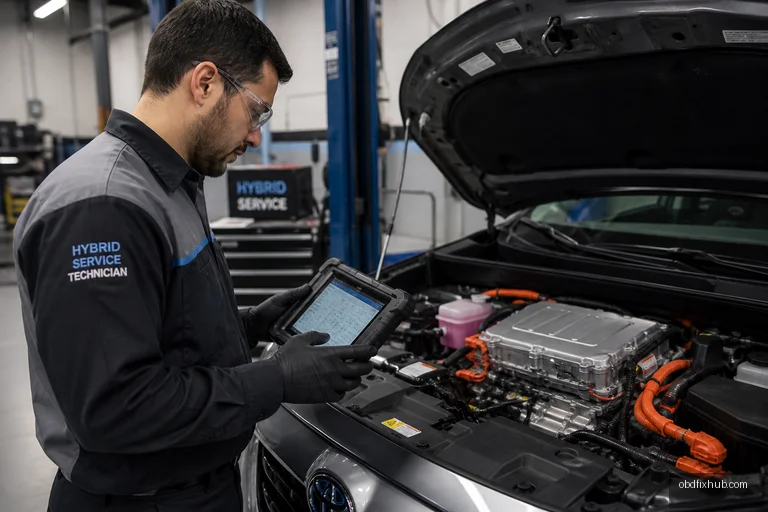
P0EED indicates a problem with the hybrid/EV battery system’s discharge circuit performance. In practical terms, the battery control system has detected that high-voltage energy is not being discharged as expected, or that the measured discharge behavior does not match the command. The fault may involve the battery pack, contactors, current sensor, wiring, inverter, software, or a weak 12-volt supply—not necessarily a failed hybrid battery.
This is an informational diagnostic code, not a part-replacement instruction. Because the system can contain several hundred volts even when the vehicle is switched off, high-voltage testing should be performed only by a qualified hybrid or EV technician with the correct insulated equipment.
What Does the P0EED Code Mean?
The P0EED hybrid/EV battery system discharge circuit code is generally set when the battery energy control system sees abnormal discharge performance. The exact wording and test conditions can vary by manufacturer, so the vehicle’s factory service information remains the final authority.
During normal operation, the battery management system monitors pack voltage, cell-group voltage, battery current, temperature, and high-voltage contactor status. When the vehicle requests power, the control module compares the requested current with the current actually measured. If the values remain outside the permitted range, it may store P0EED and limit propulsion or charging.
Common Symptoms of P0EED
A vehicle may store this code without immediately becoming undriveable. However, the symptoms can worsen if the underlying fault is ignored. Typical signs include:
- “Check Hybrid System,” “EV System Service,” or a similar warning message
- Reduced acceleration or a vehicle that enters limp-home mode
- The gasoline engine running more often than usual
- EV mode becoming unavailable or ending prematurely
- Unusual battery state-of-charge fluctuations
- Failure to enter READY mode
- Charging interruption on a plug-in hybrid or battery-electric vehicle
- Cooling fan operation that is louder or more frequent than normal
- Additional battery, inverter, isolation, or contactor-related trouble codes
Most Likely Causes of P0EED
1. Weak or imbalanced battery cells
A battery pack can still show a normal overall voltage while one cell group collapses under load. This is why a simple voltage check is not enough. A weak module may cause the battery management system to detect a discharge current or voltage response that is inconsistent with the requested output.
2. High-voltage contactor or precharge fault
Contactors connect the battery pack to the vehicle’s high-voltage bus. A contactor that is welded, slow to close, unable to close, or showing excessive resistance can interrupt proper energy delivery. A failed precharge circuit may also produce related codes before the vehicle permits full operation.
3. Current sensor or battery monitoring problem
The battery control unit relies on accurate current measurement. A biased Hall-effect sensor, damaged sensor wiring, poor connector contact, or an incorrect zero-current value can make a healthy battery appear to discharge incorrectly.
4. Damaged wiring, connectors, or corrosion
Moisture, rodent damage, overheated terminals, and corrosion can increase resistance in the high-voltage or low-voltage control circuits. Inspecting only the visible battery case can miss a problem in a connector near the inverter, service disconnect, battery junction box, or rear harness.
5. Inverter, DC-DC converter, or power electronics fault
The inverter controls the flow of electrical energy between the battery and the drive motor. A power electronics failure can cause abnormal current demand, poor regenerative braking, or a mismatch between commanded and measured battery discharge.
6. Low 12-volt battery voltage or software issues
A weak 12-volt battery can cause contactors and control modules to behave unpredictably, especially during startup. A control-module software update, calibration issue, or communication fault may also be involved. Always test the 12-volt system before condemning an expensive high-voltage component.
How to Diagnose P0EED Correctly
Professional diagnosis should follow a sequence rather than starting with a battery replacement. The most useful approach is:
- Record every code. Use a scan tool capable of accessing the battery energy control module, inverter, charger, and other EV-specific modules. The accompanying codes often identify whether the issue is electrical, thermal, insulation-related, or communication-related.
- Check freeze-frame data. Note battery state of charge, pack voltage, current, temperature, vehicle speed, and whether the code appeared during acceleration, regenerative braking, charging, or startup.
- Test the 12-volt battery. Measure it at rest and under load. Low voltage during READY-mode entry can create misleading high-voltage system faults.
- Compare live data under load. A technician should compare requested discharge current with actual current, cell-group voltage spread, pack voltage, and contactor feedback during a controlled test drive or manufacturer-approved service procedure.
- Inspect the circuit safely. With the high-voltage system properly disabled, inspect the service disconnect, connectors, busbars, current sensor, contactors, fuse, and relevant harnesses for heat damage, corrosion, loose terminals, or water intrusion.
- Verify the repair. Clear codes only after the fault is corrected, then perform the required initialization, road test, charging test, and a second scan. A code that does not return immediately is not proof that the problem is solved.
Do not use a conventional multimeter on exposed high-voltage terminals unless the vehicle manufacturer’s procedure specifically permits it and the technician is trained for that measurement. Insulation resistance testing, contactor testing, and battery-opening procedures require specialized equipment and personal protective equipment.
How Is a Hybrid System Malfunction Fixed?
The repair depends on the failed part. A loose low-voltage connector may require cleaning and terminal repair, while a degraded battery pack may need a professionally remanufactured or new battery. Other repairs can include replacing a current sensor, battery junction box, contactor, fuse, inverter, DC-DC converter, or damaged wiring.
Battery balancing or module replacement is not automatically a permanent repair. If several cell groups show high internal resistance, replacing one module may provide only temporary improvement because the remaining modules are also aged. A reputable shop should provide battery test results, cell-voltage spread under load, warranty details, and the source of the replacement pack.
How Much Does It Cost to Fix a Check Hybrid System?
Pricing varies widely by vehicle, region, and failed component. Typical U.S. ranges are:
- Diagnostic scan and high-voltage system testing: approximately $120–$300
- 12-volt battery or minor wiring repair: approximately $150–$600
- Contactor, fuse, sensor, or battery junction-box repair: approximately $500–$2,000
- Inverter or DC-DC converter replacement: approximately $1,500–$5,000 or more
- Hybrid battery replacement: approximately $1,500–$8,000 or more, depending on vehicle and battery type
These are planning figures, not a quote. A P0EED code alone cannot justify an $8,000 battery replacement. Ask the repair facility to identify the measured failure and explain why other causes were ruled out.
Can You Reset the EV or Hybrid Battery?
You can usually clear the diagnostic code with a compatible scan tool, but that does not reset or repair the battery. Disconnecting the 12-volt battery may erase some learned settings, trigger additional warnings, or make diagnosis harder; it will not restore a degraded high-voltage cell or repair a failed contactor.
After a legitimate repair, the technician may need to clear codes and perform a battery state-of-charge reset, contactor initialization, battery replacement registration, or other manufacturer-specific relearn procedure. These procedures should follow factory instructions. If P0EED returns after clearing, treat it as an active fault rather than repeatedly resetting it.
Can You Keep Driving With P0EED?
If the car displays a red warning, refuses READY mode, loses power, smells of overheated electronics, or shows signs of battery damage, stop driving and arrange professional recovery. If the vehicle remains driveable with a yellow warning, drive only as necessary to a qualified shop and avoid hard acceleration, steep climbs, and extended high-load operation.
Never open the traction battery, remove orange high-voltage cables, or attempt to bypass a contactor at home. A hybrid battery can remain hazardous even after the vehicle is turned off.
Key Takeaway
P0EED means the vehicle has detected abnormal hybrid/EV battery discharge-circuit performance. The root cause may be a weak cell group, contactor, sensor, wiring fault, inverter, software problem, or low 12-volt voltage. The fastest route to a reliable repair is a complete scan, freeze-frame review, live-data comparison, and high-voltage inspection by a trained technician—not a blind battery replacement or repeated reset.
Frequently Asked Questions
What is the most common cause of P0EED?
There is no single cause for every vehicle, but battery cell imbalance, contactor problems, current-sensor faults, wiring damage, and low 12-volt voltage are common possibilities. Manufacturer-specific codes stored alongside P0EED are essential for narrowing it down.
Does P0EED always mean the hybrid battery is bad?
No. The code identifies a discharge-performance problem, not a guaranteed battery-pack failure. A control circuit, contactor, sensor, inverter, connector, or software issue can produce the same symptom.
What are the signs that a hybrid battery is failing?
Frequent engine cycling, reduced EV range, rapid state-of-charge changes, weak acceleration, battery cooling fan noise, poor fuel economy, and hybrid-system warnings are common signs. Proper load testing is needed to confirm battery degradation.
How do I fix a check hybrid system warning?
Scan all vehicle modules, record the freeze-frame data, test the 12-volt battery, and have the high-voltage system evaluated by a qualified technician. Clearing the warning without finding the cause is only temporary.
Can a hybrid battery be repaired instead of replaced?
Some packs can be professionally reconditioned or repaired, but the long-term result depends on the condition of the remaining cell groups and the quality of testing. Compare warranty coverage and documented test results before choosing a repair option.




