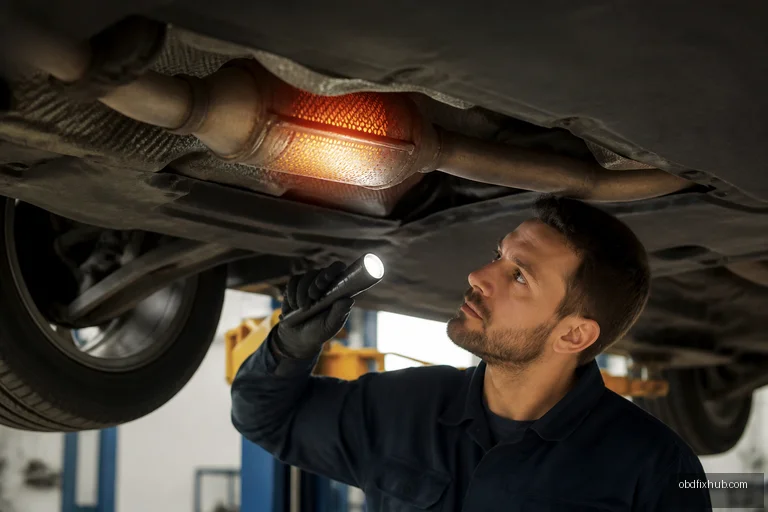
P200E Catalyst System Over Temperature: Meaning, Causes, Symptoms & Fix
P200E Catalyst System Over Temperature means the engine computer has detected an excessively high temperature in the catalytic converter system on Bank 1. The usual cause is not the catalytic converter itself; an engine misfire, rich fuel mixture, ignition fault, leaking injector, or incorrect temperature-sensor reading may be sending excessive heat into the converter. Continued driving can damage the catalyst and, in severe cases, create a fire risk.
What Does the P200E Code Mean?
P200E is a generic OBD-II diagnostic trouble code defined as Catalyst System Over Temperature Bank 1. “Bank 1” is the side of the engine containing cylinder number one. On an inline four-cylinder engine there is usually only one bank, while V6 and V8 engines have two banks.
The powertrain control module (PCM) calculates catalyst temperature using oxygen-sensor data, exhaust-gas-temperature sensors, fuel-trim information, engine load, and operating time. If the calculated or measured temperature rises beyond a calibrated limit, it stores P200E and may switch on the check engine light.
This code is a warning about abnormal exhaust heat, not a direct instruction to replace the catalytic converter. A converter can be the victim of an upstream problem rather than the original failure.
Is It Safe to Drive With P200E?
Short-distance driving to a repair shop may be possible if the vehicle runs smoothly and there is no flashing check engine light, smoke, burning smell, or visible heat from underneath. Avoid towing, high-speed driving, steep hills, and heavy acceleration because these conditions increase exhaust temperature quickly.
Stop driving and switch off the engine if the check engine light is flashing, the engine is misfiring badly, the floor or carpet becomes unusually hot, or you see glowing red exhaust components. A severely overheated catalytic converter can melt internally and may ignite nearby plastic, insulation, or dry grass.
Common Causes of the P200E Catalyst System Over Temperature Code
- Engine misfire: Unburned fuel enters the exhaust and burns inside the catalytic converter, producing extreme heat. Worn spark plugs, failing ignition coils, damaged plug wires, or low compression can all cause this.
- Rich air-fuel mixture: Too much fuel leaves the engine partially unburned. A leaking injector, excessive fuel pressure, faulty mass airflow sensor, or incorrect coolant-temperature reading may be responsible.
- Incorrect oxygen-sensor feedback: A biased upstream O2 or air-fuel-ratio sensor can make the PCM command an unnecessarily rich mixture.
- Exhaust-gas-temperature sensor fault: A sensor with an open circuit, short, damaged wiring, or implausible reading can falsely report an overheating condition.
- Restricted catalytic converter: A melted or collapsed substrate creates backpressure. The restriction raises exhaust temperature and can cause additional drivability problems.
- Engine timing or valve-control problems: Incorrect cam timing, variable valve timing faults, or a timing-chain problem can cause incomplete combustion and elevated exhaust heat.
- Calibration or software issue: Some vehicles may require a PCM software update, especially if the code appears without misfires or abnormal fuel trims.
Symptoms You May Notice
P200E does not always produce obvious symptoms. In some cases, the driver sees only a check engine light. When the underlying fault is severe, the symptoms usually point toward the cause.
- Flashing or steady check engine light
- Rough idle, hesitation, or engine misfire
- Loss of power, especially under load
- Strong raw-fuel or sulfur-like exhaust odor
- Excessive fuel consumption
- Rattling from a damaged catalytic converter
- Unusually hot floor, exhaust tunnel, or catalytic-converter housing
- Reduced maximum speed when the converter becomes restricted
How to Diagnose P200E Properly
A professional diagnosis starts with the complete fault-code picture, not with the P200E code alone. Other codes such as P0300–P0308 misfire codes, fuel-trim codes, oxygen-sensor codes, or temperature-sensor faults often reveal the real cause.
- Scan all modules and record freeze-frame data. Note engine speed, load, coolant temperature, fuel trims, and vehicle speed when the code was set. This shows whether the event occurred during a cold start, highway cruise, or heavy acceleration.
- Check for active misfires. Use the scan tool’s misfire counters and inspect spark plugs, coils, injectors, and compression. Do not condemn the converter while the engine is still misfiring.
- Evaluate fuel-trim readings. Large negative short- and long-term fuel trims suggest a rich condition. Large positive trims may indicate a vacuum leak or weak fuel delivery, which can also disturb catalyst-temperature calculations.
- Inspect the exhaust and wiring. Look for melted sensor insulation, loose connectors, exhaust leaks near oxygen sensors, and heat damage to nearby components.
- Test temperature and oxygen sensors. Compare live data with a known-good scan pattern and verify sensor power, ground, signal, and resistance where applicable. Never rely only on a visual inspection.
- Check exhaust backpressure if power is low. A pressure test before the catalytic converter can identify a restricted catalyst. Vacuum behavior during a loaded test can also support a restriction diagnosis.
- Check for technical service bulletins. Manufacturer-specific updates, revised sensors, and known wiring repairs can prevent unnecessary parts replacement.
One useful workshop clue is the difference between a genuine overheating event and a false temperature report. If the vehicle has normal fuel trims, no misfire counters, no excessive heat, and an implausible temperature reading, the sensor circuit deserves priority. If the catalyst is physically glowing and the engine is misfiring, the sensor may be accurately reporting the damage rather than causing it.
How to Fix P200E
The correct repair depends on the test results. Common fixes include replacing defective spark plugs or ignition coils, repairing injector problems, correcting fuel pressure, replacing a failed oxygen or exhaust-temperature sensor, repairing damaged wiring, or updating the PCM software.
If the catalytic converter has melted, broken apart, or become restricted, it must be replaced after the engine problem is corrected. Installing a new converter without fixing the misfire or rich condition usually destroys the replacement quickly. Use a converter that meets the vehicle’s emissions requirements; an inexpensive universal unit may not provide the correct oxygen-storage capacity or durability.
After the repair, clear the code only after recording diagnostic data. Complete the manufacturer’s drive cycle, monitor fuel trims and misfire counters, and confirm that the catalyst monitor runs without returning P200E. A code that stays away during a short idle test may return during highway load, so the final verification should include the conditions that originally triggered it.
What Not to Do
- Do not replace the catalytic converter solely because P200E is stored.
- Do not continue driving for weeks with a flashing check engine light.
- Do not remove or bypass oxygen and temperature sensors.
- Do not use catalyst-cleaning additives as a substitute for repairing a misfire or leaking injector.
- Do not test a hot catalytic converter by touching it; use an infrared thermometer and appropriate safety equipment.
How Much Does a P200E Repair Cost?
Costs vary widely because the code can originate from a simple wiring fault or from a failed catalytic converter. A damaged connector or ignition component is generally far less expensive than a restricted converter. Diagnosis is especially valuable here: replacing a converter before correcting an over-fueling problem can turn one repair into two.
Parts pricing also depends on engine size, emissions certification, vehicle location, and whether the vehicle uses one or multiple catalytic converters. Ask the repair shop to identify the test that supports the recommended part, not just the stored code.
Frequently Asked Questions About P200E
Can a bad oxygen sensor cause P200E?
Yes. A faulty upstream oxygen or air-fuel-ratio sensor can command an overly rich mixture or produce misleading catalyst data. The sensor should be tested through live data and circuit checks before replacement.
Does P200E always mean the catalytic converter is bad?
No. Misfires, leaking injectors, fuel-control faults, exhaust-temperature sensors, wiring, and PCM software can all trigger the code. The converter may be functioning correctly or may have been damaged by another fault.
Can low-quality fuel cause this code?
Poor fuel can contribute to rough running or deposits, but it is rarely the sole explanation for a confirmed over-temperature code. Check misfires, fuel trims, injector operation, and sensor data before blaming the fuel.
Will clearing P200E fix the problem?
Clearing the code only erases the stored information and turns off the warning temporarily. If the underlying temperature or combustion problem remains, the PCM will detect it again after the relevant monitor runs.
Bottom Line
P200E means Bank 1 catalyst temperature has exceeded a safe calibrated limit, but the code does not identify the failed component by itself. Treat it as an urgent diagnostic warning: check for misfires and rich-running conditions first, inspect sensor data and wiring, test for exhaust restriction, and replace the catalytic converter only when evidence confirms it is damaged. If the engine is misfiring or the exhaust is visibly glowing, stop driving and arrange a professional inspection.




