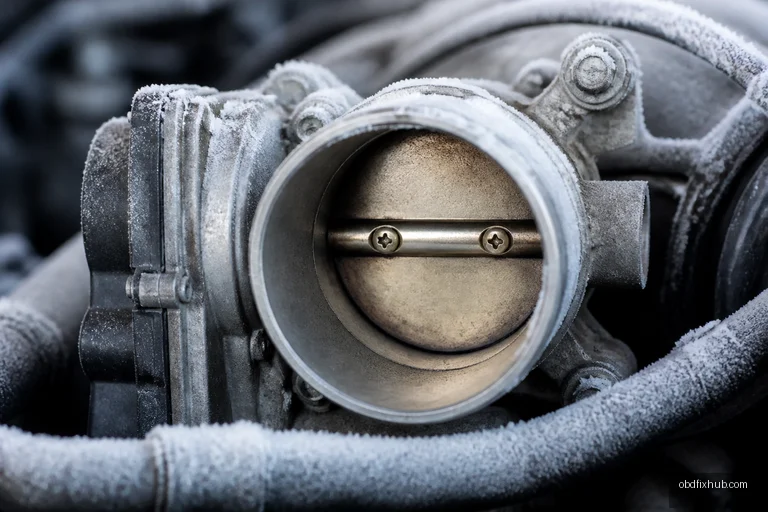
P2072 means the engine computer has detected an ice blockage or restricted movement in the throttle actuator control system. It often appears in very cold, damp conditions, but a dirty throttle body, moisture in the intake, a failing actuator, wiring damage, or an incorrect air-control reading can produce the same code. Do not automatically replace the throttle body: the correct repair depends on proving whether the restriction is genuinely ice, contamination, or an electrical fault.
What Does the P2072 Code Mean?
P2072 is an OBD-II diagnostic trouble code defined as Throttle Actuator Control System – Ice Blockage. The powertrain control module, or PCM, monitors the commanded throttle position against the actual position reported by the throttle body. If the blade does not move as expected, especially during cold-start or airflow-control conditions, the PCM may interpret the problem as ice blockage.
Modern vehicles use an electronic throttle control system rather than a traditional cable alone. The accelerator pedal sends a position request to the PCM, and the PCM controls a motor inside the throttle body. Position sensors then confirm whether the throttle blade reached the requested angle. A small amount of ice or sticky carbon can be enough to make those readings disagree.
Common Symptoms of P2072
The symptoms vary by vehicle and by how severely the throttle is restricted. Some drivers notice the problem only after an overnight freeze, while others experience reduced power every time the engine is started.
- Check Engine Light or reduced-power warning
- Hesitation when pressing the accelerator
- Rough idle, stalling, or difficulty starting
- Limited engine speed or limp-home mode
- Throttle response that feels delayed or inconsistent
- Unexpectedly high or low idle speed
- Higher fuel consumption caused by incorrect airflow control
- Additional throttle-position or accelerator-pedal codes
A particularly useful clue is the weather pattern. If the vehicle runs normally after warming in a heated garage but sets P2072 after a cold, wet night, moisture-related icing becomes more likely. If the fault occurs in warm, dry weather as well, inspect the throttle body, connector, wiring, and sensor data before blaming ice.
What Causes a P2072 Throttle Actuator Control System Ice Blockage?
1. Moisture freezing at the throttle blade
Humid air can condense inside the intake tract. When temperatures fall below freezing, that moisture may form a thin ring of ice around the throttle plate or shaft. The engine may start, but the actuator motor cannot move the blade quickly enough or cannot achieve the requested position.
2. Carbon and oil deposits
Crankcase ventilation vapors carry oil mist into the intake. Over time, oil combines with dust and combustion by-products, creating a sticky deposit around the throttle bore. In freezing weather, that residue can hold moisture and behave like an ice blockage even when no large piece of ice is visible.
3. Restricted or damaged intake ducting
A collapsed air duct, blocked air filter, damaged resonator, or improperly installed intake tube can change airflow enough to confuse the throttle-control strategy. Check for water entry points as well; a missing splash shield or poorly sealed intake can make icing far more likely.
4. Electrical or actuator faults
The throttle motor, dual throttle-position sensors, wiring, and connector terminals are all possible failure points. Corrosion, low battery voltage, a loose ground, or a damaged harness may prevent the actuator from responding even though the throttle body is mechanically clean.
5. Software or calibration issues
Some vehicles have manufacturer technical service bulletins involving throttle icing, cold-weather calibration, intake design, or PCM software. A dealer-level scan tool can reveal whether an updated calibration is available. Vehicle-specific service information matters because the same code can have different diagnostic procedures across brands.
How to Diagnose P2072 Correctly
Start with a complete scan, not just the displayed P2072 code. Record freeze-frame data such as coolant temperature, intake-air temperature, engine speed, battery voltage, and throttle position when the code was stored. Those details can distinguish a cold-start icing event from a permanent actuator failure.
- Check for related codes. Codes involving throttle position, accelerator-pedal position, airflow, or low voltage may identify the primary fault.
- Inspect the intake. Look for water, ice, a blocked air filter, a loose boot, or an air duct that has collapsed internally.
- Examine the throttle body. With the ignition off and following the manufacturer’s procedure, inspect the bore for carbon and abnormal blade binding. Do not force an electronic throttle plate aggressively; its gears and sensors can be damaged.
- Test live data. Compare commanded throttle angle with both actual position-sensor signals while operating the actuator with a professional scan tool.
- Test power, ground, and wiring. A voltage-drop test under load is more useful than simply checking continuity with a multimeter.
- Check technical bulletins and updates. If the mechanical and electrical checks pass, a PCM software update or a known cold-weather repair may be required.
Never spray general-purpose lubricant into the throttle body or flood the electronics with cleaner. Use throttle-body cleaner on a suitable cloth, protect the connector, and follow the vehicle manufacturer’s cleaning and relearn instructions.
How to Fix P2072
If inspection confirms ice, move the vehicle to a warm, dry environment and allow the intake and throttle body to thaw naturally. Do not use an open flame or high-temperature heat gun near plastic intake components, fuel vapors, or wiring. After thawing, remove the underlying moisture source and inspect the throttle bore for deposits.
A contaminated throttle body may need careful cleaning followed by an electronic throttle relearn. Some vehicles perform this procedure automatically after a specified ignition cycle; others require a scan tool. If the actuator motor or position sensors fail testing, replacing the complete throttle body is usually more reliable than attempting to repair its sealed internal components.
Also repair any damaged intake duct, replace a severely restricted air filter, clean corroded terminals, restore battery voltage, or update the PCM when the manufacturer specifies it. Clear the code only after the repair, then complete a cold-start and road test while monitoring throttle-position data.
Can You Drive With a Bad Throttle Actuator?
Driving with a throttle actuator fault is not recommended unless the vehicle is being moved a very short distance to a safe repair location. The PCM may limit power, hold the engine at an unusual idle, or enter limp mode without warning. A vehicle that hesitates in traffic or stalls at intersections creates a safety risk.
If the accelerator does not respond normally, the engine stalls, the reduced-power warning is active, or multiple throttle and pedal codes are present, arrange a tow. Do not rely on the fact that the vehicle still starts; electronic throttle failures can become more severe as temperature and moisture change.
How Much Does It Cost to Fix P2072?
Repair pricing depends heavily on the vehicle and the confirmed cause. A basic diagnosis commonly costs about $80–$180, although dealer rates and difficult access can increase that figure. Cleaning and performing a throttle relearn may cost approximately $120–$300.
- Intake hose, clamp, or air-filter repair: roughly $50–$250
- Wiring or connector repair: approximately $100–$400
- PCM software update: about $100–$250, sometimes covered by a service campaign
- Throttle body replacement: commonly $400–$1,200 installed
These are planning ranges, not a quote. Ask the shop to separate diagnostic labor, parts, programming, and throttle relearn charges. A scan report showing actuator test results is far more valuable than an estimate that simply lists a throttle body because P2072 was present.
P2072 vs. P2172: Do Not Mix These Codes Up
Drivers sometimes search for P2172 after seeing a similar-looking code. P2172 is generally associated with a throttle actuator control system that is responding too quickly, while P2072 specifically refers to suspected ice blockage. The exact manufacturer description can vary, so always verify the code with a quality scanner and vehicle-specific service information.
The repair approach is different: P2172 may require checking throttle response, sensor plausibility, wiring, and PCM strategy, whereas P2072 places greater emphasis on intake moisture, freezing conditions, and physical restriction. Replacing parts based on a code-number resemblance can waste money.
Practical Prevention Tips
- Keep the air filter housing correctly sealed and fully latched.
- Replace cracked intake boots and missing splash shields.
- Inspect the crankcase ventilation system if oil deposits return quickly.
- Maintain a healthy battery, particularly before severe winter weather.
- Have repeated cold-weather faults checked for manufacturer updates or bulletins.
- Do not ignore intermittent throttle hesitation just because the light later turns off.
Final Takeaway
P2072 does not automatically mean the throttle body is defective. It indicates that the electronic throttle system detected restricted or implausible movement, with ice or moisture identified as a likely explanation. Confirm the conditions in the freeze-frame data, inspect the intake and throttle body, test the electrical system, and perform the required relearn after cleaning or replacement. If throttle response is unreliable, stop driving and have the vehicle diagnosed safely.
Frequently Asked Questions
Can I drive with a P2072 code?
Only for a short distance to a safe repair location if throttle response remains completely normal. Do not drive if the vehicle is in limp mode, stalls, hesitates, or shows a reduced-power warning.
How can I fix the P2172 code?
First confirm that the code is actually P2172, not P2072. Diagnose the throttle actuator response, position sensors, wiring, power supply, and PCM data using vehicle-specific service information. The repair may involve cleaning, wiring repair, software updating, or throttle-body replacement.
How much does a throttle actuator repair cost?
Cleaning may cost around $120–$300, while complete throttle-body replacement often ranges from $400–$1,200 installed. A proper diagnosis should come before approving replacement.
How do you fix the throttle actuator control system?
Find and correct the restriction or control fault: thaw and dry the intake, clean approved deposits, repair air leaks or wiring, restore battery voltage, update the PCM if required, and complete the throttle relearn procedure.




