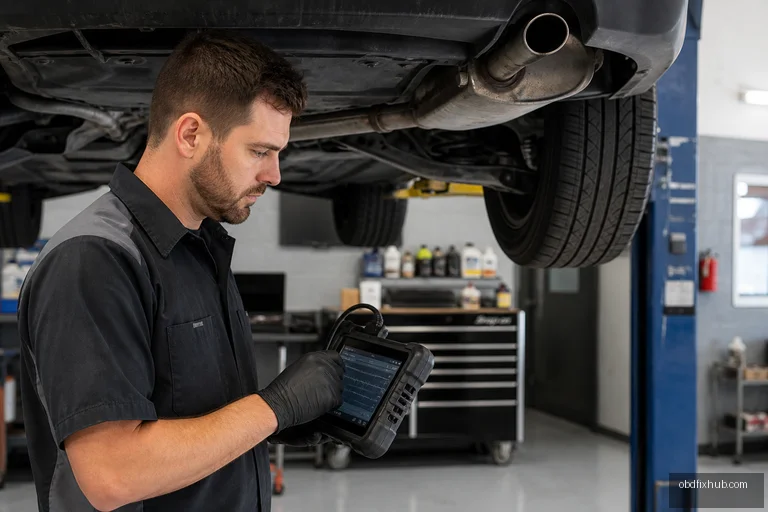
P2096 Post-Catalyst Fuel Trim System Too Lean means the engine computer has detected that Bank 1 still appears lean after the catalytic converter. The fastest way to fix it is not to replace the downstream oxygen sensor immediately: first check for an exhaust leak, intake or vacuum leak, incorrect fuel pressure, injector problems, sensor wiring faults, and misfires. A short drive is often possible if the engine runs normally, but continued driving can damage the catalytic converter or leave you stranded if the underlying fault worsens.
What Does P2096 Mean?
P2096 is a generic OBD-II powertrain code. “Post-catalyst” refers to the oxygen sensor installed after the catalytic converter, while “fuel trim system too lean” means the powertrain control module (PCM) believes there is too much oxygen in the exhaust or not enough fuel being burned on Bank 1.
On a four-cylinder or inline-six engine, Bank 1 is usually the only cylinder bank. On a V6 or V8, Bank 1 is the side containing cylinder number one. The downstream oxygen sensor is mainly used to monitor catalytic-converter performance, but the PCM also uses its signal to make limited fuel-trim corrections on many vehicles.
Importantly, P2096 does not prove that the engine is genuinely running lean. An exhaust leak near the rear oxygen sensor can draw outside air into the exhaust stream and create the same reading. This is one of the most common reasons a sensor gets replaced even though it was working correctly.
Common Symptoms of P2096
Some vehicles show only a check-engine light, while others develop noticeable drivability problems. Symptoms depend on whether the code is caused by a false oxygen reading or a real fuel-delivery issue.
- Illuminated check-engine light
- Rough idle or hesitation during acceleration
- Reduced fuel economy
- Hard starting, especially when the engine is cold
- Surging or unstable cruising
- Engine misfire codes such as P0300 or cylinder-specific misfires
- Failed emissions or inspection testing
- Loss of power under load
If the check-engine light is flashing, stop driving as soon as it is safe. A flashing light normally indicates an active misfire, which can overheat and melt the catalytic converter within minutes.
What Causes P2096 on Bank 1?
1. Exhaust leak after the catalytic converter
A cracked exhaust pipe, loose flange, failed gasket, or damaged weld near the Bank 1 downstream oxygen sensor can pull fresh air into the exhaust. The sensor interprets that oxygen as a lean condition. Inspect the exhaust when cold, then listen for a ticking sound during startup; a smoke machine or low-pressure exhaust test is more reliable than sound alone.
2. Faulty or contaminated downstream oxygen sensor
The post-catalyst O2 sensor can become slow, biased, or contaminated by coolant, oil, silicone sealant, or fuel additives. A healthy downstream sensor usually changes more slowly than the upstream sensor. A sensor stuck near a very low voltage, responding abnormally to a controlled mixture change, or showing an open heater circuit may be defective—but its wiring and power supply must be tested first.
3. Vacuum or unmetered-air leak
A split PCV hose, leaking intake boot, brake-booster hose, intake-manifold gasket, or EVAP purge valve can introduce air that the mass-airflow sensor did not measure. This commonly creates positive short-term and long-term fuel trims. Smoke testing is usually faster and more accurate than spraying flammable cleaner around the engine bay.
4. Low fuel pressure or restricted fuel delivery
A weak fuel pump, clogged filter, failing pressure regulator, restricted fuel line, or poor electrical connection at the pump can leave the engine genuinely lean. Compare measured fuel pressure with the manufacturer’s specification at idle and under load. A pressure reading that looks normal at idle but drops during acceleration is a valuable clue that a pump or restriction is being missed.
5. Dirty or failing fuel injectors
Partially restricted injectors can create a lean mixture in one or more cylinders. Injector balance testing is more useful than simply adding cleaner to the tank. If fuel trims are high on only one cylinder bank, compare injector flow, spark-plug appearance, and compression between the two banks.
6. MAF sensor, purge system, or engine-control problem
An inaccurate mass-airflow sensor can under-report incoming air, while a purge valve stuck open can act like a vacuum leak. Wiring damage, poor grounds, exhaust contamination, and rare PCM faults are also possible. These should be considered after basic mechanical and fuel tests, not before them.
How to Diagnose P2096 Correctly
A professional diagnosis starts with freeze-frame data rather than clearing the code immediately. Note engine speed, coolant temperature, load, vehicle speed, and fuel trims when P2096 was set. A code that appears only during deceleration points toward an exhaust leak or purge problem, while one that appears under heavy load makes fuel pressure more suspicious.
- Scan all stored and pending codes. Misfire, MAF, fuel-pressure, oxygen-sensor, and EVAP codes may identify the primary fault.
- Check live fuel-trim data. Compare Bank 1 with the other bank if the engine has two banks. Large positive trims at idle that improve at higher rpm suggest a vacuum leak; trims that worsen under load suggest fuel delivery.
- Inspect the Bank 1 exhaust. Look before and after the catalytic converter, especially at flanges, flex sections, welds, and sensor-thread areas.
- Test for intake and vacuum leaks. Use a smoke machine and inspect PCV and EVAP hoses carefully.
- Verify fuel pressure and volume. Follow the vehicle’s service-manual specifications rather than relying on a universal pressure number.
- Test the downstream O2 sensor circuit. Check heater resistance, reference voltage, ground, signal continuity, and connector corrosion.
- Clear the code and confirm the repair. Complete the required drive cycle and verify that fuel trims and oxygen-sensor behavior remain normal.
Do not diagnose a lean condition by unplugging sensors and guessing from voltage alone. Wideband and conventional oxygen sensors behave differently, and many scan tools display calculated fuel-trim values that are not direct measurements of air-fuel ratio.
How Can I Fix the P2096 Code?
The repair depends on the test results. A proper P2096 fix may include sealing an exhaust leak, replacing a split vacuum hose, repairing sensor wiring, replacing a defective downstream oxygen sensor, cleaning or replacing a contaminated MAF sensor, repairing the EVAP purge valve, servicing injectors, or correcting low fuel pressure.
After the repair, clear the code with a scan tool and perform a complete drive cycle. The vehicle may need several warm-up cycles before the readiness monitors run. If P2096 returns immediately, the original cause was not corrected or another fault is affecting the post-catalyst reading.
How Long Can You Drive With a P2096 Code?
If the light is steady and the vehicle starts, idles, and accelerates normally, driving a short distance to a repair shop is generally reasonable. Avoid towing, high engine loads, long trips, and aggressive acceleration until the cause is known.
Do not continue driving if the light flashes, the engine misfires, power drops sharply, the exhaust smells strongly of fuel, or the catalytic converter glows red. A real lean condition can raise combustion temperatures, while an associated misfire can send unburned fuel into the converter. Neither condition should be ignored for weeks.
How Much Does It Cost to Fix P2096?
Repair prices vary by vehicle, location, and the failed component. Typical U.S. repair ranges are approximate:
- Diagnostic testing: $80–$180
- Vacuum or EVAP hose repair: $50–$250
- Exhaust leak repair: $100–$500
- Downstream oxygen sensor replacement: $200–$600
- MAF sensor replacement: $150–$500
- Fuel pump or fuel-delivery repair: $400–$1,200
- Catalytic-converter replacement: $800–$2,500 or more
These figures are not a diagnosis or a quote. The most expensive mistake is replacing the catalytic converter or oxygen sensor before checking for a small exhaust leak and measuring fuel trims.
Bank 1 P2096: Practical Repair Strategy
For a Bank 1 fault, begin by identifying cylinder number one and tracing the correct exhaust bank. On some transverse engines, the physical layout is not obvious. Confirm the bank using the manufacturer’s service information before replacing any sensor; installing a part on Bank 2 will not solve a Bank 1 code.
A useful real-world pattern is this: if Bank 1 long-term fuel trim is high at idle, falls close to normal at 2,500 rpm, and the downstream sensor remains lean, check for an intake leak and then an exhaust leak. If trims are acceptable at idle but rise during a loaded road test, test fuel pressure and pump volume before condemning the sensor.
Frequently Asked Questions
Can a bad catalytic converter cause P2096?
It can, but it is not the first part to replace. A converter that is damaged, leaking, or unable to store oxygen may affect downstream readings, yet exhaust leaks, fuel problems, and sensor faults are more common and should be ruled out first.
Can I fix P2096 by replacing the O2 sensor?
Sometimes, but only if testing confirms that the sensor is biased, slow, electrically faulty, or contaminated. Replacing it without checking for an exhaust leak is a common and avoidable misdiagnosis.
Is P2096 the same as P0171?
No. P0171 generally describes a lean condition detected before the catalytic converter on Bank 1. P2096 specifically refers to the post-catalyst fuel-trim calculation, although both codes can be caused by the same vacuum leak, fuel-delivery problem, or unmetered air.
Will clearing P2096 make the car pass emissions testing?
Usually not immediately. Clearing the code resets readiness monitors, and the vehicle may fail an emissions test until those monitors complete. If the underlying problem remains, the code will return during the drive cycle.
What is the best first step for P2096?
Record freeze-frame and fuel-trim data, then inspect for exhaust and intake leaks before buying parts. This approach is inexpensive, evidence-based, and prevents a downstream oxygen sensor from becoming an unnecessary repair.
Bottom Line
P2096 means Bank 1 looks lean after the catalytic converter, but the code identifies a symptom rather than a single failed part. Start with scan data, an exhaust-leak inspection, fuel-trim analysis, and fuel-pressure testing. Repair the confirmed cause, verify the sensor circuit, and complete a drive cycle before considering the problem solved.




