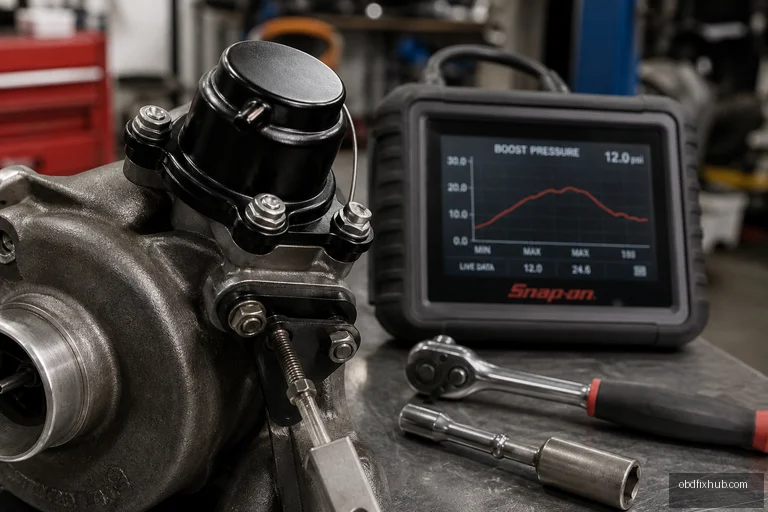
P2261 Turbocharger Bypass Valve Mechanical Fault means the engine computer has detected a mechanical problem with the turbocharger or supercharger bypass valve, commonly called a diverter valve or compressor bypass valve. It may be stuck open, stuck closed, restricted, leaking, or unable to follow the commanded position. Short, gentle driving may be possible if the engine runs normally, but continued driving is not advisable when there is severe power loss, surging, loud turbo noise, smoke, or limp mode.
This code does not automatically mean the turbocharger itself has failed. In many real-world diagnoses, the fault is caused by a split vacuum hose, damaged wiring, carbon contamination, a failed actuator, or an aftermarket bypass valve installed with the wrong spring or calibration.
What Does P2261 Mean?
P2261 is a generic OBD-II trouble code defined as Turbocharger/Supercharger Bypass Valve A Mechanical. The exact wording and monitoring strategy vary by manufacturer, but the control module is generally checking whether the bypass valve responds correctly when boost pressure is being built, reduced, or released.
The valve’s job is to manage compressed air when the throttle closes or the engine no longer needs maximum boost. On a turbocharged engine, it helps prevent compressor surge and reduces stress on the compressor wheel. On some systems, the valve is controlled by engine vacuum; on others, it uses an electronic motor or solenoid-integrated actuator.
P2261 Symptoms to Watch For
The symptoms depend on whether the valve is stuck open, stuck closed, or moving inconsistently. A valve stuck open commonly causes low boost, while a valve stuck closed may create compressor surge during throttle lift-off.
- Reduced engine power or slow acceleration
- Underboost, inconsistent boost, or an engine that enters limp mode
- Hissing, whooshing, fluttering, or chattering noises
- Surging during acceleration or hesitation after shifting
- A check engine light, sometimes accompanied by P0299 or other boost-related codes
- Poor throttle response and, in some vehicles, increased fuel consumption
- Boost pressure that rises and falls instead of following the accelerator position
A brief release of air after lifting off the throttle can be normal. Continuous hissing at idle, repeated compressor flutter, or a clear loss of boost is not. Do not diagnose the valve based on sound alone; intake leaks and intercooler hose failures can produce very similar noises.
Common Causes of the P2261 Code
- Failed bypass or diverter valve: The diaphragm may tear, the piston may bind, or the internal spring may weaken.
- Vacuum supply problem: Cracked hoses, blocked lines, a failed vacuum solenoid, or insufficient engine vacuum can prevent the valve from operating.
- Electrical fault: Corrosion, loose terminals, damaged wiring, a blown fuse, or an actuator motor failure can interrupt valve control.
- Sticking mechanism: Oil residue, dirt, carbon, or physical damage can stop the valve from reaching its commanded position.
- Incorrect aftermarket part: The wrong spring rate, connector, software calibration, or valve orientation can cause repeated P2261 faults.
- Air system fault: A split charge pipe, loose clamp, leaking intercooler, or disconnected hose may be interpreted as a valve performance problem.
- Rare control-module issue: The ECU is possible but should be considered only after the valve, wiring, vacuum system, and boost plumbing have been proven good.
How to Diagnose P2261 Correctly
Replacing the turbocharger first is an expensive and frequently unnecessary mistake. A disciplined diagnosis should separate a valve-control problem from a general boost leak.
1. Check the complete code set and freeze-frame data
Use a scan tool to record all stored and pending codes, engine speed, calculated load, throttle position, and boost pressure when P2261 was set. Codes such as P0299, P0234, or manufacturer-specific actuator codes can change the direction of the diagnosis. Clear the code only after saving this information.
2. Inspect the valve and surrounding plumbing
Look for disconnected vacuum lines, cracked charge pipes, loose clamps, damaged electrical connectors, and oil residue around a hose joint. Oil mist is common in turbocharged intake systems, but a wet, freshly coated connection can indicate a boost leak. Confirm that the valve is mounted in the correct direction and that its linkage is not obstructed.
3. Test the actuator rather than guessing
For a vacuum-operated valve, use a hand vacuum pump and verify that the actuator holds vacuum and moves smoothly. If vacuum immediately disappears, the diaphragm or hose is leaking. For an electronic valve, a scan tool with bi-directional controls can command the actuator while you observe movement, position feedback, or the sound of the motor.
Do not apply battery voltage to an electronic actuator unless the manufacturer provides the correct test procedure. Some units use position electronics that can be damaged by an improvised power test. Resistance readings can also be misleading because a motor may measure correctly while the valve is mechanically jammed.
4. Check the boost system under controlled conditions
A smoke test or pressure test can reveal leaks that are invisible during a visual inspection. Use the vehicle manufacturer’s specified pressure limit; excessive test pressure can damage seals or sensors. A road test with live data should compare requested boost, actual boost, throttle angle, and bypass-valve command.
Is It Safe to Drive With a P2261 Code?
It depends on the symptoms. If the check engine light is steady, the engine is running smoothly, and there is no smoke or abnormal noise, driving a short distance to a repair shop is usually reasonable. Keep engine speed and load low, avoid hard acceleration, towing, and sustained high-speed driving.
Stop driving and arrange a proper inspection if the light is flashing, the vehicle has severe power loss, the turbo makes a grinding or siren-like noise, the engine surges violently, oil smoke appears, or the temperature rises. A stuck bypass valve can increase compressor stress, cause unstable boost, and in extreme cases contribute to turbocharger damage. The code itself is not an emergency diagnosis, but the symptoms determine the risk.
How Much Does a Turbo Bypass Valve Replacement Cost?
In the United States, a typical bypass or diverter valve replacement costs approximately $150 to $600 including parts and labor. A simple vacuum valve on an accessible engine may cost less, while an electronically controlled valve integrated into a turbocharger assembly can cost considerably more.
- Diagnostic testing: about $80–$180
- Basic replacement valve: about $60–$250 for the part
- Electronic or OEM valve: about $200–$700 for the part
- Labor: commonly $100–$400, depending on access
- Hose, solenoid, wiring, or boost-leak repair: potentially $50–$500 extra
Dealer pricing, vehicle design, regional labor rates, and the choice between an OEM and aftermarket component make a major difference. Ask for the diagnostic result before approving a turbocharger replacement. A confirmed valve fault is not the same as a confirmed turbo failure.
Can You Run a Supercharger Without a Bypass Valve?
Some supercharger systems can physically operate without a bypass valve, but removing or permanently blocking it is generally a poor idea for a street vehicle. During closed-throttle conditions, the supercharger continues compressing air, which can create compressor surge, excess heat, harsh driveline behavior, and unnecessary belt or bearing load.
A properly sized bypass valve also improves cruising efficiency and reduces parasitic losses when boost is not required. If a supercharger kit is designed with a bypass system, use the manufacturer’s valve and control strategy. A missing valve may also cause drivability problems and trigger fault codes even if the engine still produces boost.
Practical Repair Strategy
- Save freeze-frame data and scan for related codes.
- Inspect vacuum hoses, charge pipes, wiring, connectors, and clamps.
- Test the valve with the correct vacuum or electronic procedure.
- Perform a smoke or pressure test to rule out intake leaks.
- Replace the failed valve, solenoid, hose, or wiring component.
- Clear the codes and complete a drive cycle while monitoring boost data.
After installation, confirm that the valve is sealed at idle, responds to commanded changes, and does not produce abnormal flutter when the throttle closes. If P2261 returns immediately, check connector pin fit, actuator calibration, and the software or part-number compatibility before replacing more components.
Summary
P2261 identifies a mechanical or performance problem in the turbocharger or supercharger bypass-valve system, not automatically a failed turbo. The most effective repair starts with a complete code scan, a careful leak inspection, and an actuator test. Drive only gently when symptoms are mild, and stop using the vehicle if serious noise, smoke, flashing warning lights, or major power loss appears.
Best next step: have the bypass valve and the entire boost-control system tested before authorizing expensive turbocharger work.
Frequently Asked Questions
How can I tell if a turbo bypass valve is bad?
Check for low or unstable boost, hissing, compressor flutter, and a valve that fails a vacuum-holding test or does not respond to an electronic actuator command. A boost leak can mimic the same symptoms, so inspect the hoses and intercooler plumbing as well.
Can P2261 clear itself?
The code may become pending or disappear temporarily if the valve works during a later drive cycle, but an intermittent fault usually returns. Clearing the code without finding the cause does not repair the system.
Is P2261 always caused by the bypass valve?
No. Vacuum leaks, damaged wiring, a failed control solenoid, a leaking charge pipe, incorrect aftermarket parts, and rarely an ECU problem can all produce this code.
Should I replace the turbocharger when P2261 appears?
Not without evidence. Test the bypass valve, actuator, vacuum supply, wiring, and boost plumbing first. Many P2261 repairs require only a valve, hose, solenoid, or connector repair.




