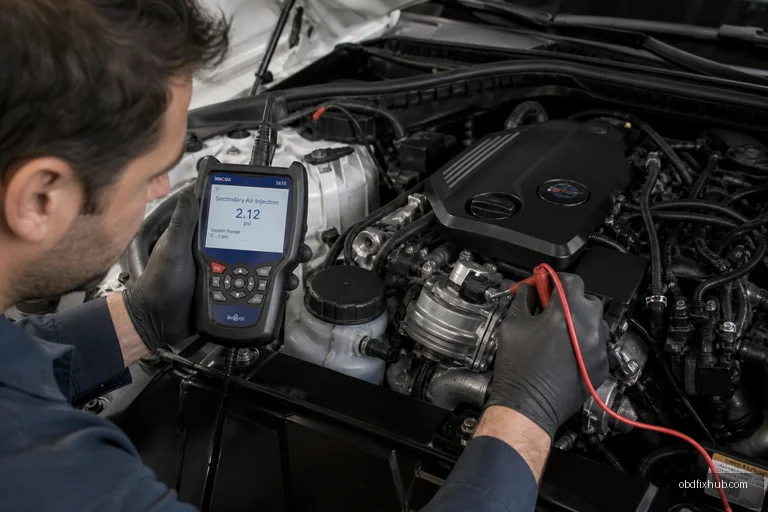
Search intent: Informational. Drivers searching for P2430 usually want to know whether the fault is serious, what caused it, and whether a sensor or the complete secondary air injection system needs replacement. The P2430 code means the engine computer has detected an electrical or plausibility problem in the secondary air injection flow and pressure sensor circuit. In many vehicles, the root cause is wiring, moisture, a failed pressure sensor, or a pump and valve problem—not necessarily the sensor itself.
What Does the P2430 Code Mean?
P2430 is a generic OBD-II trouble code defined as “Secondary Air Injection System Air Flow/Pressure Sensor Circuit.” The secondary air injection system pumps fresh air into the exhaust during a cold start. This extra oxygen helps the catalytic converter reach operating temperature quickly and reduces cold-start emissions.
A pressure or airflow sensor reports what is happening in the system to the powertrain control module (PCM). If the sensor signal is missing, electrically implausible, outside its expected range, or inconsistent with pump operation, the PCM stores P2430 and usually switches on the Check Engine light.
The exact component name and testing values vary by manufacturer. Some vehicles use a pressure sensor mounted near the air injection pump, while others integrate the sensor into a valve or use a different circuit designation. Always verify the wiring diagram and factory specifications for the specific vehicle.
P2430 Symptoms to Watch For
The secondary air injection system normally operates for only a short period after a cold start. As a result, the vehicle may drive almost normally even when P2430 is present. Typical symptoms include:
- Check Engine light illuminated
- Secondary air injection, emissions, or reduced emissions performance warning
- Electric pump noise that is unusually loud, rough, or absent during cold start
- Brief rough running or hesitation immediately after starting
- Stored or pending secondary air injection codes such as P0410, P0411, P0412, P0418, or P2431
- Failure to pass an emissions inspection
- In some vehicles, reduced power or limp mode if several related faults are detected
A useful practical clue is timing: if the Check Engine light appears shortly after a wet or freezing period, water entering the pump, sensor connector, or air passages deserves close attention.
Common Causes of P2430
- Failed secondary air injection pressure or airflow sensor
- Open, shorted, corroded, or damaged sensor wiring
- Loose, wet, or oil-contaminated electrical connector
- Blown fuse, failed relay, or poor power supply to the air injection pump
- Secondary air pump that is seized, weak, noisy, or water-damaged
- Stuck-open or stuck-closed check valve or air control valve
- Blocked air passages, carbon deposits, or a cracked air hose
- Exhaust moisture or condensation entering the pump and sensor circuit
- Incorrectly installed aftermarket parts
- Rarely, a PCM fault or a software issue
Replacing the sensor immediately is a common mistake. If the pump has filled with water or a check valve is leaking exhaust into the system, a new sensor may fail again. The complete system must be tested as a circuit and as an airflow system.
How to Diagnose P2430 Correctly
A professional diagnosis starts with the scan tool, not with parts replacement. The following sequence prevents many unnecessary repairs:
- Record all codes and freeze-frame data. Note engine coolant temperature, battery voltage, engine speed, and whether the code is current or pending. Related pump or valve codes can change the entire diagnostic direction.
- Inspect the system cold. Follow the sensor harness from the connector to the PCM or engine harness. Look for melted insulation, chafing against brackets, rodent damage, green corrosion, and water inside the connector.
- Check fuses and power supplies under load. A fuse can appear intact while a damaged relay or high-resistance connection prevents the pump from operating correctly. Voltage should be checked during commanded operation, not only with the ignition switched off.
- Test the sensor reference and ground. Many sensors use a 5-volt reference, sensor ground, and variable signal. Confirm the reference voltage, ground integrity, and signal response according to the service manual. Do not assume every vehicle uses the same pin layout.
- Command the pump and valves with a bidirectional scan tool. Listen for a smooth pump operation and verify that the sensor reading changes when airflow or pressure is commanded. A pump that runs but produces no pressure may have a blocked passage, failed valve, or internal damage.
- Compare the sensor reading with a mechanical test. Where the manufacturer allows it, use an appropriate pressure gauge or approved test procedure. Do not force shop air into a sensor unless the service information specifically permits it; excessive pressure can destroy the sensor.
- Clear the code and perform a cold-start drive cycle. The secondary air monitor may not run when the engine is warm. A successful repair must be confirmed when the system is cold and the monitor completes.
One field-tested diagnostic tip is to inspect the pump inlet and drain path before condemning the sensor. A pump that sounds like it is grinding or sloshing often has water damage, and that condition can create unstable sensor readings even when the sensor’s electrical tests initially look normal.
How to Fix the P2430 Code
The correct repair depends on the failed part. Common fixes include:
- Repairing a broken wire or replacing terminals affected by corrosion
- Cleaning and sealing a connector when permitted by the manufacturer
- Replacing the secondary air injection pressure or airflow sensor
- Replacing a failed pump, relay, fuse, or air control valve
- Replacing cracked hoses and blocked or leaking check valves
- Removing the cause of water intrusion and correcting damaged air plumbing
- Updating PCM software when a manufacturer service bulletin identifies a calibration issue
After the repair, clear the diagnostic trouble codes and verify the system during a genuine cold start. Simply turning off the Check Engine light does not prove that the problem is fixed. If the monitor does not run, the vehicle may still fail an emissions test even though the light temporarily remains off.
How Much Does It Cost to Fix a Secondary Air Injection System?
Repair costs vary widely by vehicle design and the failed component. Typical independent-shop estimates in the United States are:
- Electrical diagnosis: $100–$200
- Wiring or connector repair: $150–$500
- Pressure or airflow sensor replacement: $200–$600
- Relay, fuse, hose, or check valve repair: $100–$450
- Secondary air pump replacement: $400–$1,200
- Complex systems with difficult access or multiple failed parts: $1,000–$2,000 or more
Dealer pricing and luxury-vehicle repairs can be higher. Ask for a diagnostic test result before approving a pump or sensor replacement. A written estimate should identify the failed circuit, the part being replaced, and whether water intrusion or a blocked valve has also been addressed.
Can You Drive With a Bad Secondary Air Injection System?
In most cases, a vehicle with only P2430 can be driven for a short time because the system operates mainly during cold starts and does not control normal fuel delivery once the engine is warm. However, it is not a fault to ignore indefinitely. Emissions will increase, the vehicle may fail inspection, and a damaged pump can sometimes overheat or cause additional electrical problems.
Stop driving and arrange a prompt inspection if the engine is running badly, the Check Engine light is flashing, the vehicle enters limp mode, there is a burning electrical smell, or the pump runs continuously. Those symptoms suggest a broader problem than a simple sensor circuit fault.
How Do You Fix a Secondary Air Injection System Malfunction?
Fixing a secondary air injection malfunction means finding the reason the commanded airflow and the reported sensor signal do not agree. Start with codes and wiring, then test pump output, valves, passages, and sensor response in that order. Replacing parts based only on the code description is less reliable than confirming power, ground, signal, and actual airflow.
For example, if the pump has correct voltage but makes a harsh bearing noise and the pressure reading never changes, the pump or a blocked valve is more likely than the sensor. If the pump operates normally but the sensor signal stays fixed at 0 volts or 5 volts, focus on the sensor circuit, reference voltage, ground, and harness.
Final Takeaway
P2430 identifies a fault in the secondary air injection flow or pressure sensor circuit, but it does not automatically mean the sensor must be replaced. Diagnose the electrical circuit and the mechanical airflow path together, especially for water intrusion, failed check valves, and damaged pumps. If you have the code scanned, record all related codes and freeze-frame data before clearing anything; that information often reveals whether the problem is electrical, mechanical, or caused by moisture.
Frequently Asked Questions
Is P2430 a serious code?
Usually it is not an immediate engine-damage emergency, but it should be repaired before an emissions inspection. A noisy, continuously running, or water-damaged pump can create more expensive electrical and mechanical problems.
Can a bad secondary air injection sensor cause poor fuel economy?
It usually has little effect on warm-engine fuel economy because the system operates briefly after startup. Poor economy suggests another fault as well, although related emissions problems can affect how the vehicle performs its cold-start strategy.
Will disconnecting the battery fix P2430?
Disconnecting the battery may erase the code temporarily, but it does not repair the cause. The code will return when the PCM runs the secondary air injection monitor again.
Should I replace the pump or the sensor first?
Neither should be replaced without testing. Check power, ground, wiring, sensor signal, pump operation, valves, and air passages first. The scan tool’s actuator test and the manufacturer’s wiring diagram are especially valuable.
How long can I drive with P2430?
A short trip is often possible if the engine runs normally and the warning light is steady. Schedule diagnosis soon, and avoid driving if the light flashes, the pump runs continuously, or the vehicle has serious drivability or electrical symptoms.




