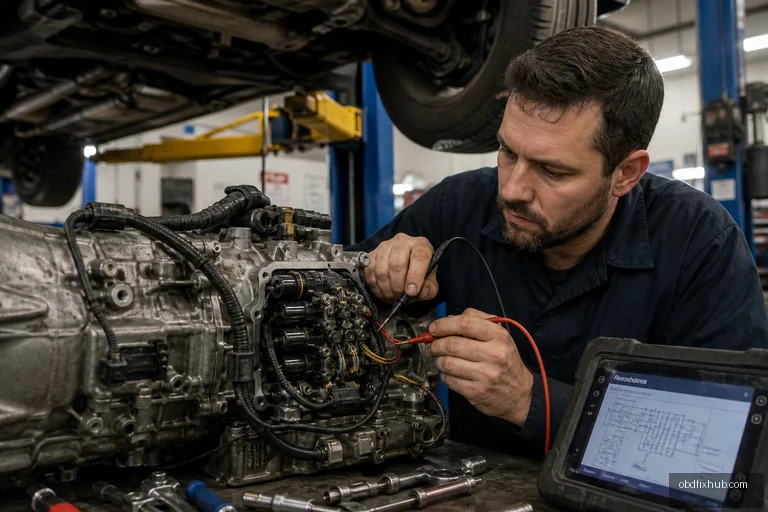
P2845 means the transmission control module has detected an incorrect neutral position from a shift fork position sensor. In practice, the transmission may be unable to confirm that a selector fork is centered, fully disengaged, or where the control unit expects it to be. The fault is most common on electronically controlled manual, automated-manual, and dual-clutch transmissions, but the exact diagnosis depends on the vehicle and gearbox design.
This is an informational search query: drivers usually want to understand whether the car is safe to drive, what caused the code, and whether the repair involves a sensor, wiring, an actuator, or internal transmission work. Do not assume the shift fork itself has failed simply because P2845 is stored.
What Does P2845 Mean?
The P2845 diagnostic trouble code is associated with a shift fork position sensor reporting an implausible or incorrect neutral position. A shift fork moves a synchronizer sleeve or clutch mechanism inside the transmission. Its position is monitored so the transmission control module, or TCM, can coordinate gear selection without forcing the actuator or engaging two gears at once.
When the TCM commands neutral, it expects a specific sensor voltage, position value, or calibrated travel range. P2845 is set when the feedback does not match that expected position. Depending on the manufacturer, the code may refer to a particular fork, gear group, selector axis, or neutral-learning value.
That manufacturer variation matters. A Volkswagen DSG, an automated manual gearbox, and another brand’s electronically shifted transmission may all use the same generic OBD description while requiring completely different parts and procedures.
P2845 Shift Fork Sensor Symptoms
The symptoms can appear suddenly, especially after a low-voltage event or actuator problem. In other cases, the vehicle drives normally for several miles before the TCM loses confidence in the position signal.
- Transmission stuck in neutral, one gear, or limp mode
- Delayed engagement when selecting Drive, Reverse, or a manual gear
- Harsh shifting, missed shifts, or a refusal to complete a gear change
- Flashing gear indicator or a transmission warning message
- Engine revs rising without normal vehicle acceleration
- Starter inhibited because the transmission cannot confirm Park or Neutral
- Clicking, buzzing, or repeated actuator operation after the ignition is switched on
- Additional clutch, gear-position, or actuator codes stored with P2845
A useful real-world clue is the difference between an intermittent and a permanent fault. If cycling the ignition temporarily restores shifting, suspect an unstable electrical signal, weak battery voltage, connector movement, or a sensor that fails when warm. If the transmission remains locked in one state, a mechanical obstruction, actuator failure, or lost adaptation is more likely.
Common Causes of Code P2845
1. Faulty shift fork position sensor
The sensor may have an internal open circuit, a dead spot in its signal, contamination, or a damaged magnetic or resistive track. Some sensors are integrated into an actuator or mechatronic assembly, so replacing the sensor separately may not be possible.
2. Damaged wiring or connector terminals
Transmission harnesses live in a hot, vibrating environment and can rub against brackets or become saturated with oil. A connector with spread terminals may pass a basic continuity test but lose contact when the harness moves. Inspect for corrosion, fluid intrusion, bent pins, and insulation that has hardened near the gearbox.
3. Low system voltage or poor grounds
A weak battery, charging fault, or poor transmission ground can distort sensor readings and interrupt actuator movement. Measure voltage during cranking and while the fault occurs; a battery that looks acceptable with the engine off can still cause control-module errors under load.
4. Shift actuator or mechatronic malfunction
The sensor may be accurately reporting that the fork is not in neutral because the actuator cannot move it. Failed actuator motors, hydraulic pressure problems, valve-body faults, and contaminated fluid can all create a position mismatch without the sensor being defective.
5. Mechanical transmission damage
A bent shift fork, damaged selector rail, worn synchronizer, broken retaining component, or debris inside the gearbox can prevent the commanded neutral position. Mechanical damage becomes more likely when P2845 follows a loud impact, severe grinding, clutch failure, or an attempted shift under heavy load.
6. Lost adaptation or incorrect service procedure
Many automated transmissions require a basic setting, clutch calibration, or gear-selector adaptation after a battery disconnect, actuator replacement, mechatronic repair, or clutch service. If calibration was interrupted or performed with the wrong conditions, the TCM may store P2845 even though the hardware is serviceable.
How to Diagnose P2845 Correctly
Professional diagnosis starts with the complete transmission scan, not with a parts order. Record every code, freeze-frame value, transmission temperature, commanded gear, actual gear, and battery voltage. A companion code for clutch travel, actuator current, or another shift fork can identify the root problem more quickly than P2845 alone.
- Check the battery and grounds. Confirm charging voltage, inspect the transmission ground strap, and verify that supply voltage remains stable during actuator operation.
- Inspect the harness and connector. Follow the wiring to the gearbox, looking for chafing, oil contamination, loose locks, pushed-back pins, and previous repair work.
- Compare commanded and actual position. Use a manufacturer-capable scan tool to view shift-fork position, neutral status, actuator current, and target position. A fixed value, implausible jump, or position that stops short is significant.
- Perform electrical tests. Check reference voltage, sensor ground, and signal voltage according to the wiring diagram. Do not apply battery power to a position-sensor circuit unless the service manual specifically permits it.
- Test actuator movement. Run the appropriate output test while monitoring position feedback. If the actuator is commanded but the fork does not move, investigate the actuator and mechanical mechanism before condemning the sensor.
- Check fluid and mechanical operation. Use the correct fluid level and inspection procedure. Grinding, binding, abnormal noise, or metal particles warrant a deeper transmission inspection.
- Complete adaptation and verify the repair. Clear the code only after the cause is addressed, perform the required basic settings, then road-test through the affected gears while monitoring live data.
One diagnostic detail is often missed: a multimeter may show a normal sensor resistance while the signal fails during movement. A scope or scan-tool graph can reveal dropouts that a static resistance test cannot. Move the harness gently during testing, but never force a selector mechanism by hand when the manufacturer requires actuator control.
How Is P2845 Fixed?
The correct repair depends on what the tests prove. Wiring faults require proper terminal repair, sealed connections, and routing that prevents renewed chafing. A failed standalone sensor can be replaced where the design allows it; on some transmissions, the sensor is part of the actuator, selector module, or mechatronic unit.
If the actuator is functional but adaptation is lost, a factory-level scan tool may solve the problem through guided calibration. Calibration will not repair a bent fork or a worn synchronizer, however. Repeating the basic setting several times can make the transmission appear better temporarily while allowing the mechanical fault to worsen.
After internal transmission work, use the specified fluid, torque values, seals, and adjustment procedure. A successful repair should include a cold and warm road test, reverse engagement, low-speed shifts, and confirmation that no pending position or clutch codes return.
Can You Drive With P2845?
Driving is risky if the transmission is stuck, slipping, grinding, refusing Reverse, or shifting unpredictably. Continued operation can damage clutch packs, synchronizers, or the actuator because the system may keep trying to reach a position it cannot achieve. If the vehicle still shifts normally and the code is intermittent, drive only far enough to reach a qualified transmission technician and avoid towing, steep hills, and stop-and-go stress.
Key Takeaway
P2845 is a position-confirmation fault, not proof that one specific sensor must be replaced. Start with voltage, grounds, wiring, live position data, actuator movement, and adaptation status. A disciplined diagnosis prevents an expensive mechatronic or transmission replacement when the real cause is a corroded connector, unstable power supply, or incomplete calibration.
Recommended next step: Have the vehicle scanned with a manufacturer-capable tool and request the complete transmission code report, including commanded versus actual shift-fork position. That information usually determines whether the repair is electrical, calibration-related, actuator-based, or mechanical.
Frequently Asked Questions
Is P2845 a serious transmission code?
It can be serious because the transmission may lose reliable gear-position control. If the vehicle is stuck in gear, slipping, grinding, or displaying a flashing gear indicator, stop driving and arrange professional diagnosis.
Can a weak battery cause P2845?
Yes. Low voltage or a poor ground can interrupt actuator operation and produce an incorrect position reading. Battery and charging-system tests should be completed before replacing transmission components.
Does P2845 always mean the shift fork sensor is bad?
No. The code can be caused by wiring, connector faults, low voltage, an actuator that cannot move the fork, lost adaptation, or internal mechanical damage. Live-data testing is needed to separate these possibilities.
Can clearing P2845 fix the problem?
Clearing the code only removes the stored fault temporarily. If the position signal or mechanical condition remains incorrect, P2845 will return, often when the transmission attempts the same shift or calibration routine.
Will a transmission fluid change fix P2845?
Only in limited cases, such as a fluid-related actuator or pressure problem where the correct service procedure is specified. Fluid replacement will not repair a failed sensor, damaged wiring, bent fork, or broken internal component.




