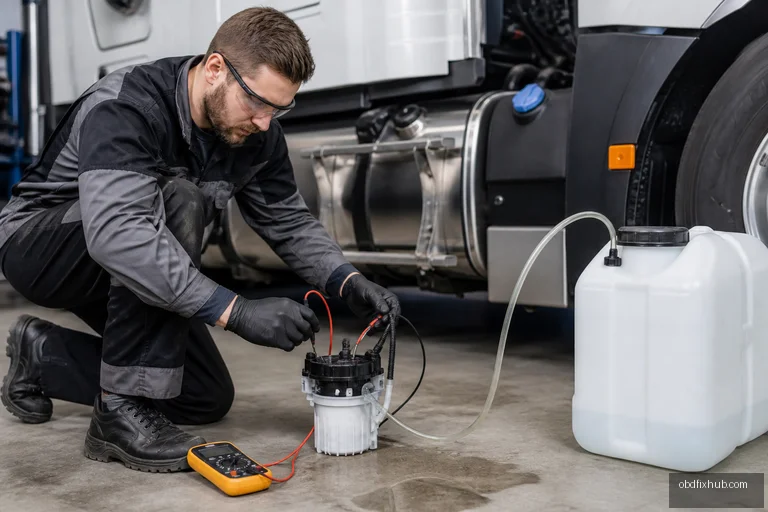
P2AD6 Reductant Pump Motor Position Sensor Circuit means the engine control system has detected an electrical or plausibility problem with the position feedback circuit inside the diesel exhaust fluid, or DEF, reductant pump assembly. The pump may still run, but the control module cannot reliably confirm its motor position, speed, or operating response. Diagnosis should begin with wiring, connector condition, power and ground checks before replacing the expensive pump.
What Does the Reductant Pump Do?
The reductant pump supplies DEF, also called AdBlue in many markets, from the vehicle’s tank to the SCR dosing system. It builds the pressure required for the injector to spray a precisely measured amount of fluid into the exhaust stream, where DEF helps convert nitrogen oxides into nitrogen and water.
Most modern systems use an electrically driven pump with an internal motor position sensor or electronic feedback circuit. That feedback allows the reductant control module or powertrain control module to determine whether the pump motor is turning correctly, stalled, running too fast, or unable to reach the commanded position. Without dependable feedback, the system may stop dosing to protect the SCR components and emissions system.
P2AD6 Meaning in Plain English
When P2AD6 is stored, the module sees a signal from the reductant pump motor position sensor that is missing, outside its expected range, electrically shorted, or inconsistent with the pump’s command. The exact circuit design varies by manufacturer. On some vehicles, the sensor is integrated into the pump; on others, the pump electronics communicate over a dedicated control circuit or network.
Although the code description is standardized, the testing procedure, connector pinout, acceptable voltage range, and replacement procedure are vehicle-specific. Always check the service information for the exact year, engine, emissions system, and pump part number before applying a resistance specification.
Common Symptoms of P2AD6
A vehicle can drive normally at first because the SCR system may continue operating with substitute values. However, ignoring the fault can eventually trigger an emissions countdown or prevent a restart, especially on heavy-duty diesel vehicles.
- Check Engine, Service Engine Soon, or emissions warning light
- AdBlue or DEF warning message on the instrument panel
- Reduced engine power or torque limitation
- A no-start countdown or limited number of remaining miles
- Reductant pump noise that is absent, unusually loud, or runs continuously
- Incorrect DEF pressure or dosing-system pressure faults
- Multiple SCR, reductant heater, injector, or communication codes
- Difficulty priming the reductant system after a repair
Most Likely Causes
1. Damaged wiring or a poor connector
Road spray, salt, DEF residue, and vibration can damage the wiring near the tank. A connector may look connected while a pushed-back terminal fails to contact its mating pin. White crystalline DEF residue around the connector or pump is an important clue, but its absence does not rule out an internal open circuit.
2. Failed reductant pump assembly
The motor position sensor is often not sold separately. A worn motor, failed Hall-effect sensor, damaged circuit board, or internal pump contamination can therefore require replacement of the complete pump module. Do not condemn the pump solely because P2AD6 is present; prove that the external circuit is sound first.
3. Low system voltage or poor ground
A weak battery, corroded ground strap, or voltage drop in the pump supply can create misleading position-sensor faults. DEF pumps draw significant current during priming and pressure generation, so a circuit that measures acceptable with no load may fail when the pump is commanded on.
4. Frozen, contaminated, or crystallized DEF
DEF normally freezes at approximately -11°C, or 12°F, and the vehicle is designed to thaw it with tank and line heaters. Incorrect fluid, diesel contamination, excessive crystallization, or a damaged pickup screen can overload the pump and make its feedback signal appear implausible.
5. Control-module or software problems
Less commonly, the reductant control module, PCM, communication network, or calibration may be responsible. A software update or manufacturer technical service bulletin may apply, particularly when P2AD6 appears with several communication codes after a low-voltage event.
How to Diagnose P2AD6 Correctly
- Record all codes and freeze-frame data. Note battery voltage, outside temperature, DEF level, vehicle speed, and whether the code is current or history. Related codes often identify the real starting point.
- Inspect the tank and pump area. Look for damaged harnesses, wet connectors, DEF crystals, broken retaining clips, rubbed insulation, and signs that the tank has been struck.
- Verify the power and ground. Use a wiring diagram and perform a voltage-drop test while the pump is commanded on. A simple static voltage reading can miss a high-resistance connection.
- Test the position-sensor circuit. Check reference voltage, signal voltage, sensor ground, continuity, and shorts to power or ground according to the manufacturer’s procedure. Do not probe sealed terminals with oversized test leads.
- Use a capable scan tool for active testing. Command the reductant pump to prime or build pressure while watching pump feedback, commanded speed, actual speed, and system pressure. The signal should respond smoothly rather than remain fixed or drop out.
- Compare the results with service specifications. Generic online resistance values can be wrong for a particular pump design. If the wiring, power supply, ground, and control signals are correct but feedback is absent, the pump module is the likely failure.
A useful workshop technique is to gently move the harness while monitoring live data during an active test. If the position signal suddenly changes or the pump stops, the fault is probably an intermittent wire or terminal rather than the pump itself. This test should be performed carefully, away from moving parts and hot exhaust components.
Repair Options and What to Expect
If the fault is caused by corrosion or a damaged wire, repair the harness using sealed automotive splices and restore the connector terminals rather than simply spraying contact cleaner and reconnecting it. If the pump is internally defective, replace the correct pump or tank module and use new seals where specified.
After replacement, many vehicles require a reductant-system prime, pressure test, quantity test, or pump-learn procedure with a factory-level scan tool. Clearing the code alone does not complete the repair. The system may also need an SCR efficiency monitor or drive cycle before the warning is fully extinguished.
Use only fresh, certified DEF from a sealed container. Never add water, fuel-system cleaner, or other additives to the tank. If contamination is suspected, the tank, lines, pump, and injector may need to be cleaned or replaced according to the manufacturer’s instructions.
Can You Keep Driving With P2AD6?
Short-term driving may be possible if the vehicle has no power reduction and the DEF level is adequate, but this is not a fault to postpone indefinitely. The control module can disable dosing and begin a restart countdown. On commercial vehicles, that can become an operational problem long before the engine develops a noticeable drivability issue.
Stop and seek immediate diagnosis if the vehicle displays a no-start countdown, severe power limitation, overheating around the pump, a burning electrical smell, or evidence of contaminated fluid. An emissions-system repair is usually less costly before the pump runs dry, the injector crystallizes, or the vehicle enters a locked restart strategy.
Frequently Asked Questions
What does the company pump do?
If you mean the reductant pump, it moves DEF or AdBlue from the storage tank to the SCR injector and creates the pressure needed for accurate exhaust dosing. It does not pump diesel fuel or directly clean the exhaust; its job is to deliver reductant for the SCR emissions process.
Is P2AD6 caused by low DEF level?
A low level normally sets a separate level or range warning, but an extremely low tank, frozen fluid, crystallization, or a restricted pickup can make the pump operate abnormally. Check the fluid level, quality, temperature, and related codes instead of assuming the level alone caused P2AD6.
Can a bad DEF pump cause a no-start condition?
Yes. Many diesel vehicles use a warning and mileage countdown when the SCR system cannot dose correctly. Once the countdown expires, the vehicle may not restart until the fault is repaired and the reductant system is successfully tested with a scan tool.
Should I replace the pump immediately?
No. Inspect the connector and harness, verify supply voltage and ground under load, and test the position-sensor signal first. A damaged wire near the tank can produce exactly the same code as a failed pump and costs far less to repair.
Will disconnecting the battery clear P2AD6?
It may erase temporary data on some vehicles, but it does not repair the underlying problem and often leaves a permanent or pending code. Use a scan tool after the repair, complete the required prime or relearn procedure, and confirm that the code does not return.
Bottom Line
P2AD6 points to unreliable feedback from the reductant pump motor position-sensor circuit, not automatically to an empty DEF tank or a failed pump. Start with a complete scan, visual inspection, voltage-drop testing, and live-data analysis. Repair the wiring when possible, replace the pump only when testing proves an internal failure, then perform the manufacturer’s priming and verification procedure before returning the vehicle to service.




