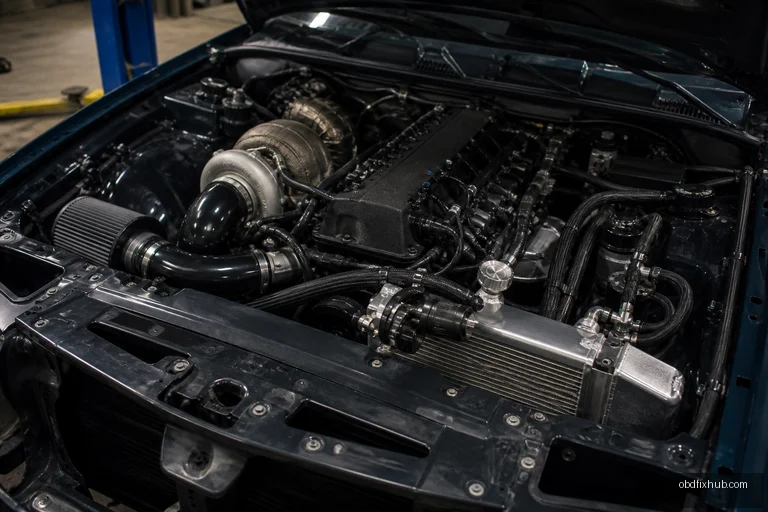
P2CB5 Charge-Air Cooler Pump Module Over Temperature: Meaning, Causes, Symptoms & Fix
P2CB5 means the vehicle has detected an excessively high temperature in the charge-air cooler pump module or its monitored circuit. In practical terms, the intercooler cooling system is not removing heat as expected, or the temperature reading is inaccurate. The result may be reduced engine power, a check-engine light, and protection mode—especially on turbocharged or supercharged engines.
This is primarily an information and diagnosis issue, not a parts-buying decision. The pump, wiring, coolant level, air trapped in the circuit, and temperature sensor all need to be tested before replacing the module.
What Does P2CB5 Mean?
P2CB5 is an OBD-II powertrain code associated with charge-air cooler pump module over temperature. The exact wording, test conditions, and repair procedure can vary by manufacturer because P2Cxx codes may use manufacturer-specific definitions. Always confirm the code with a scan tool that supports the vehicle’s OEM data, rather than relying only on a generic code website.
The charge-air cooler, often called an intercooler, lowers the temperature of compressed intake air. A dedicated electric pump circulates coolant through the cooler, heat exchanger, reservoir, and connecting hoses. If the pump stops, runs slowly, operates dry, or cannot dissipate heat, the control module may record P2CB5.
Common Causes of P2CB5
- Low charge-air cooler coolant: A leak, incorrect service procedure, or neglected maintenance can leave the pump partially or completely uncovered.
- Air trapped in the cooling circuit: An air pocket can prevent coolant flow and make a healthy pump sound as though it is running without moving fluid.
- Failed electric coolant pump: Worn bearings, an open motor winding, internal corrosion, or a seized impeller can cause overheating.
- Blocked flow: A restricted hose, clogged heat exchanger, contaminated reservoir, or damaged intercooler passage increases pump load and reduces cooling.
- Electrical supply problems: A blown fuse, weak relay, poor ground, corroded connector, or voltage drop can make the pump run intermittently or at low speed.
- Faulty temperature sensor: A biased sensor or damaged signal wire may report an over-temperature condition even when coolant temperature is normal.
- Excessive heat load: Track use, repeated high-boost acceleration, a blocked front heat exchanger, or unusually high ambient temperatures can expose a marginal system.
- Control-module or software fault: Less commonly, the pump command or temperature interpretation inside the vehicle’s control module is incorrect.
P2CB5 Symptoms to Watch For
The symptoms depend on whether the problem is a genuine overheating condition or a false temperature signal. Many vehicles reduce boost or throttle response to protect the engine, so the driver may notice a clear loss of performance before any unusual noise appears.
- Check-engine light or a manufacturer-specific warning message
- Reduced boost, slow acceleration, or limited-power mode
- Intercooler pump whine, grinding, buzzing, or complete silence when commanded on
- Rapidly warming charge-air cooler hoses or an unusually hot pump housing
- Low coolant in the auxiliary reservoir or visible coolant residue near fittings
- Repeated P2CB5 after clearing the code
- Additional pump, temperature-sensor, low-voltage, or coolant-flow codes
Do not open a hot coolant reservoir. The auxiliary circuit may be pressurized, and hot coolant can cause serious burns. Allow the vehicle to cool fully before inspecting the level or hoses.
How to Diagnose P2CB5 Correctly
1. Record freeze-frame and related codes
Before clearing anything, save the freeze-frame data: coolant temperature, intake-air temperature, vehicle speed, engine load, battery voltage, and whether the code appeared during boost. A code that sets immediately after a cold start points toward wiring, a sensor, or a pump-command problem; a code that appears after sustained boost points more strongly toward flow or heat rejection.
2. Inspect the auxiliary cooling circuit
Check the reservoir level and look for dried coolant marks around the pump, hose connections, heat exchanger, and intercooler. A pressure test is more useful than simply looking for drips because small leaks may evaporate on a hot engine. Use only the coolant specification approved for the vehicle; mixing incompatible coolant types can damage seals and restrict small passages.
3. Verify pump operation and flow
Use the scan tool’s output-control or actuator test to command the charge-air cooler pump on. Listen for a smooth electric-motor sound and observe whether coolant visibly circulates where the design permits it. A pump that runs but produces no flow may have a seized impeller, air lock, or blocked circuit. Do not assume that noise proves the pump is working.
4. Test voltage, ground, and current draw
Measure voltage at the pump connector while it is commanded on, then perform a voltage-drop test on both the power and ground sides. A pump may receive battery voltage with no load yet fail when current flows through a corroded connector or weak ground. Compare current draw with the manufacturer’s specification: unusually low current can indicate an open or worn motor, while excessive current often suggests a seized pump or restriction.
5. Check temperature-sensor plausibility
Compare the reported pump-module or coolant temperature with ambient temperature during a cold start and with another available coolant-temperature reading. A sensor reading that is implausibly high before the engine has warmed is a strong clue. Inspect the sensor connector for coolant intrusion, bent terminals, damaged insulation, and a 5-volt reference or ground fault, depending on the circuit design.
How to Fix P2CB5
The correct repair depends on the failed test result. A low reservoir should be repaired at its source, then the circuit must be filled and bled using the manufacturer’s procedure. If air remains trapped, the new pump may overheat again, so bleeding is not an optional final step.
- Repair leaks and replace damaged hoses, clamps, reservoirs, or fittings.
- Replace a pump that fails the electrical, flow, or current-draw tests.
- Clean or replace a restricted heat exchanger, filter, or contaminated circuit component.
- Repair corroded connectors, damaged wiring, fuse, relay, or ground connections.
- Replace a temperature sensor only after confirming that its wiring and reference circuits are correct.
- Refill with the specified coolant, bleed the system, clear the code, and verify pump operation under load.
After repair, confirm the fix with a road test that reproduces the original conditions. Monitor charge-air temperature, pump command, coolant temperature, and battery voltage. A code that stays away during idle but returns during a long uphill pull usually indicates that the system still has a real heat-transfer or flow limitation.
Can You Drive With P2CB5?
Short, gentle driving may be possible if the vehicle has no coolant leak, no overheating warning, and normal engine operation. Avoid heavy boost, towing, racing, and long uphill acceleration because charge-air temperatures can rise quickly when the pump is not cooling correctly. Stop driving if you smell coolant, see steam, hear a failing pump, or the vehicle enters severe reduced-power mode.
Is a Terraform Module Related to P2CB5?
No. A Terraform module is a reusable package of infrastructure configuration used to provision cloud or on-premises resources with HashiCorp Terraform. Its purpose is to organize resources, accept input variables, expose outputs, and standardize deployments. It has no connection to an automotive charge-air cooler pump or the P2CB5 diagnostic trouble code; the word “module” is simply used in two different technical contexts.
Frequently Asked Questions
What is the most common cause of P2CB5?
Low coolant, trapped air, or a failing electric charge-air cooler pump are common causes. However, a wiring fault or inaccurate temperature sensor can produce the same code, so replacing the pump without testing is risky.
Can low coolant cause the charge-air cooler pump to overheat?
Yes. Low coolant can leave the pump without adequate heat transfer and may allow it to circulate air instead of liquid. Find and repair the leak, then bleed the circuit correctly.
Will clearing P2CB5 fix the problem?
No. Clearing the code only removes the stored fault until the control module detects the condition again. If the underlying fault remains, P2CB5 will usually return during the next drive cycle or high-load event.
Should I replace the pump immediately?
Not without testing. Confirm coolant level, flow, voltage, ground, current draw, and temperature-sensor plausibility first. This prevents replacing an expensive pump when the real problem is a fuse, connector, air pocket, or restricted heat exchanger.
Bottom line: P2CB5 indicates that the charge-air cooler pump module is overheating or reporting an implausibly high temperature. Start with freeze-frame data and a visual inspection, then verify coolant flow and electrical performance before installing parts. A proper bleed and a load-based road test are essential to confirm a lasting repair.




