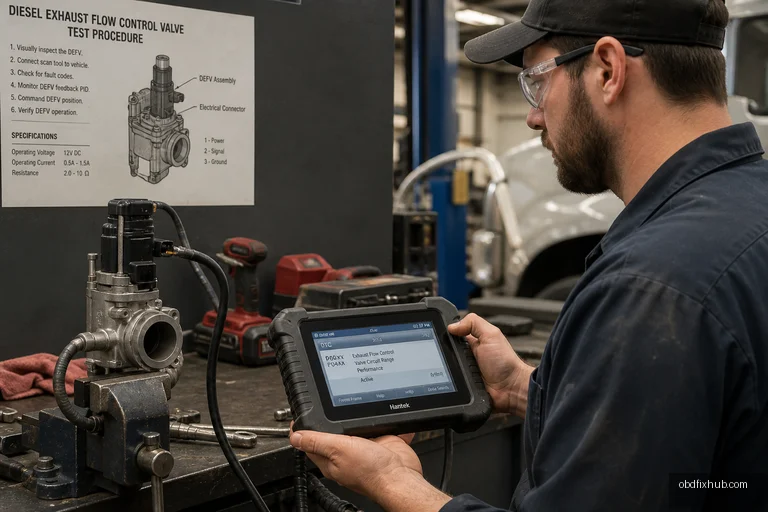
P2D11 Exhaust Flow Control Valve Position Not Learned means the engine control module could not successfully calibrate or verify the learned position of an electronically controlled exhaust flow valve. The fault is often caused by low battery voltage, a sticking valve, damaged wiring, a failed actuator, or an incomplete relearn procedure—not automatically by a defective valve.
This is primarily a diagnostic issue, not a code that should be cleared and ignored. The correct repair depends on what happens during the valve’s initialization test and whether the scan tool can see a believable position signal.
What Does P2D11 Mean?
During key-on or a commanded test, the powertrain control module moves the exhaust flow control valve through a defined range. It compares the requested position with the feedback signal from the valve’s position sensor. If the module cannot establish the valve’s minimum and maximum positions, it stores P2D11.
The exact wording can vary by manufacturer. On some diesel applications, the valve helps manage exhaust backpressure, emissions temperature, EGR flow, or diesel particulate filter regeneration. On other vehicles, it may be described as an exhaust throttle, exhaust brake valve, or exhaust flow control valve. Always verify the manufacturer-specific service information before replacing parts.
Common Symptoms of P2D11
The vehicle may still start and drive normally when this code first appears. However, the symptoms can become more noticeable when the engine needs accurate exhaust-flow control for emissions or regeneration strategies.
- Check Engine Light or service engine warning
- Reduced engine power or limp-home mode
- Delayed, failed, or interrupted DPF regeneration on diesel vehicles
- Uneven idle, hesitation, or poor throttle response
- Higher fuel consumption
- Excessive black smoke or unusual exhaust behavior
- Rattling, grinding, or clicking from the valve actuator
- Additional exhaust pressure, EGR, turbocharger, or aftertreatment codes
A valve that is physically stuck may produce a different symptom from a valve with a failed position sensor. For example, an actuator can move audibly while the scan tool reports no position change. That points more strongly toward a feedback circuit or internal sensor problem than a simple mechanical blockage.
Most Likely Causes of P2D11
1. Low or unstable battery voltage
Calibration routines are voltage-sensitive. A weak battery, poor ground, or charging-system problem can interrupt the learning process and leave P2D11 stored even when the valve itself is serviceable. This is especially common after a battery replacement, jump-start, or extended period of low battery charge.
Check battery voltage before running the relearn. A healthy, fully charged battery is usually around 12.6 volts with the engine off, while charging voltage is commonly around 13.5 to 14.8 volts. Use the vehicle’s specifications as the final reference, and inspect voltage drop under load rather than relying only on an open-circuit reading.
2. Carbon, soot, or corrosion restricting the valve
Exhaust valves operate in a hot, dirty environment. Soot can build up around the butterfly plate or spindle until the actuator cannot reach its commanded end stop. In other cases, corrosion or a damaged bushing creates excessive friction.
Do not force the valve by hand or spray an unknown solvent into an electronic actuator. Some units contain sealed gears and a position sensor that can be damaged by liquid or excessive leverage. Remove and inspect the assembly according to the service procedure, particularly if the valve does not move smoothly through its full travel.
3. Wiring or connector damage
Heat near the exhaust system can harden insulation, loosen terminals, and expose copper conductors. Oil, water intrusion, and road salt may create high resistance at the connector. A circuit can pass a basic continuity check and still fail when the actuator is loaded.
- Inspect the connector for pushed-back or spread terminals.
- Look for melted insulation near the exhaust and turbocharger.
- Check the power, ground, command, and position-feedback circuits.
- Perform a wiggle test while monitoring the scan-tool position value.
- Compare voltage drop on the power and ground sides under actuator load.
4. Failed actuator or position sensor
The valve actuator may have worn gears, an overheated motor, or an internal circuit-board failure. The position sensor can also develop dead spots, causing the reported angle to jump or stop changing at a particular point.
A useful workshop test is to command the valve with a bidirectional scan tool while graphing commanded position and actual position. A healthy system normally shows smooth, repeatable movement. Erratic feedback, a fixed value, or a large difference between commanded and actual position supports an actuator or sensor fault.
5. Incorrect relearn conditions or software issues
Some vehicles require a specific ignition sequence, engine temperature, battery voltage, or exhaust temperature before the control module will accept a new learned position. An aftermarket scan tool may display the command but fail to complete the manufacturer’s special function.
Software updates are worth checking when the hardware tests good and the code returns immediately after a correct relearn. Do not assume a failed calibration means the module needs replacement; confirm power, grounds, actuator movement, and the required procedure first.
How to Diagnose P2D11 Properly
A professional diagnosis should identify why the learning routine failed rather than simply erase the code. The following sequence avoids many unnecessary parts replacements.
- Record all codes and freeze-frame data. Look for low-voltage, communication, exhaust pressure, EGR, turbocharger, or DPF codes that may have appeared first.
- Test the battery and charging system. Correct voltage problems before attempting calibration.
- Check technical service information. Confirm the valve location, pinout, normal feedback range, relearn conditions, and whether the code is manufacturer-specific.
- Inspect the valve and harness. Pay close attention to heat damage, soot restriction, connector tension, and poor engine or chassis grounds.
- Run an active actuator test. Listen for abnormal noises and compare commanded movement with actual position data.
- Test circuits with a wiring diagram. Verify reference voltage, ground quality, actuator supply, and feedback signal at the connector—not only at the control module.
- Repair the confirmed fault and perform the relearn. Use a battery maintainer if the manufacturer permits it, then follow the exact scan-tool procedure.
- Clear the code and verify the repair. Complete the specified drive cycle and confirm that the valve position remains stable during a second commanded test.
How to Fix P2D11
The repair may be as simple as charging the battery and completing the correct initialization. If the valve is restricted, cleaning or replacing the valve assembly may be necessary. A damaged connector should be repaired with the correct terminals and heat-resistant wiring; ordinary crimp repairs placed directly beside a hot exhaust component often fail again.
Replace the actuator or complete valve assembly when the motor, gears, or integrated position sensor fails testing. Some vehicles sell the actuator separately, while others require the entire exhaust valve. Match the replacement to the vehicle identification number and calibration requirements rather than relying only on a similar-looking part.
After installation, the relearn is not optional. The module must know the valve’s closed and open reference points. If the procedure fails with a new part, recheck voltage, connector pin fit, mechanical alignment, and scan-tool compatibility before condemning the replacement.
Can You Drive With P2D11?
Short-distance driving may be possible if the vehicle has normal power, no excessive smoke, and no severe exhaust or temperature warnings. Continued driving is not advisable when the vehicle is in limp mode, a diesel particulate filter is becoming overloaded, or regeneration repeatedly fails.
Ignoring the problem can increase emissions and fuel consumption. On some diesel engines, incorrect exhaust flow can contribute to DPF loading, turbocharger control issues, or repeated regeneration attempts. Stop driving and arrange a professional inspection if the exhaust glows red, power drops sharply, or abnormal noises and smoke appear.
A Practical Diagnostic Tip
Pay attention to when P2D11 returns. If it appears immediately at key-on, suspect electrical supply, feedback, or an initialization problem. If it returns only after the engine warms up, heat-related wiring damage, mechanical binding, or an actuator that fails under thermal expansion becomes more likely.
Another valuable clue is the actual position data. A stable but incorrect reading suggests lost calibration or an offset problem, while a rapidly fluctuating reading points toward a worn sensor, poor terminal contact, or a damaged signal wire. This small distinction can save the cost of replacing a complete exhaust valve unnecessarily.
Frequently Asked Questions
Is P2D11 caused by the EGR valve?
Not usually. P2D11 refers to an exhaust flow control valve position-learning failure, although EGR and exhaust valves can interact in the same emissions strategy. Diagnose the component named by the vehicle’s service information rather than replacing the EGR valve automatically.
Does disconnecting the battery clear P2D11?
It may erase some stored information, but it does not repair the cause and may not remove a permanent or pending fault. Disconnecting the battery can also erase learned values that the vehicle needs. Use a scan tool and perform the specified relearn after the underlying repair.
Can a weak battery trigger this code?
Yes. Low or unstable voltage can interrupt the actuator’s calibration and create P2D11. Test the battery, charging output, and grounds before replacing the valve, especially if the fault appeared after a jump-start or battery service.
Will cleaning the exhaust flow valve always fix P2D11?
No. Cleaning may help when soot or carbon prevents full travel, but it will not repair a failed motor, damaged gears, faulty position sensor, or wiring problem. Confirm smooth movement and successful relearn after cleaning.
Do I need a dealer scan tool?
You need a scan tool capable of reading live actuator data and running the manufacturer’s exhaust valve initialization function. A basic code reader may display P2D11 but cannot complete the diagnosis or relearn.
Final Takeaway
P2D11 does not automatically mean the exhaust flow control valve must be replaced. Start with battery voltage, related codes, wiring, connector condition, and actual valve movement. Then perform the correct position relearn and verify the result with live data and a road test. If the code returns, a technician should test the actuator and feedback circuit under operating conditions instead of guessing at parts.




