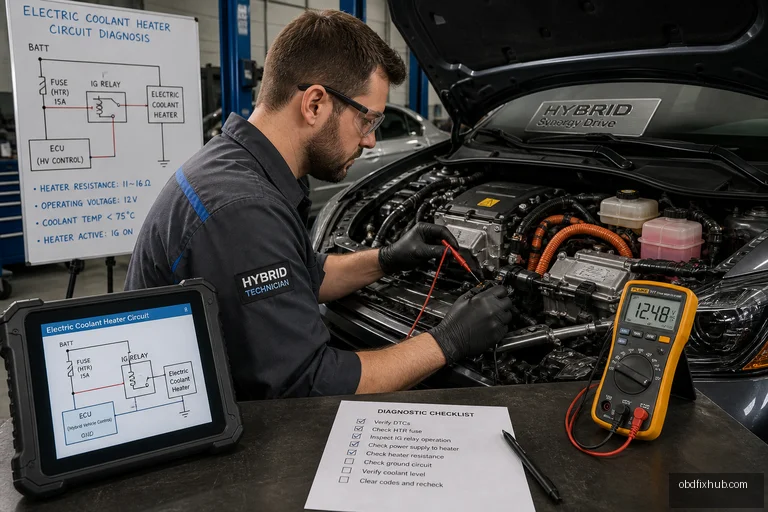
P2DA5 Coolant Heater Supply Voltage Circuit means the vehicle’s control module has detected an abnormal voltage condition in the circuit that powers the coolant heater. The problem may be caused by a blown fuse, damaged wiring, a failed relay, poor grounding, low 12-volt voltage, or a defective electric coolant heater. On hybrid and electric vehicles, the heater can also involve high-voltage components, so testing it requires more caution than a normal coolant-temperature fault.
What Does P2DA5 Mean?
P2DA5 is a powertrain diagnostic trouble code associated with the coolant heater supply voltage circuit. The coolant heater is used to warm engine coolant when the engine is cold, during cold starts, or when a hybrid or electric vehicle needs cabin heat without relying entirely on engine heat.
The exact wording and monitoring strategy can vary between manufacturers. Some vehicles monitor the heater’s supply voltage directly, while others compare commanded heater operation with current draw, feedback voltage, or communication data. For that reason, the factory service information for the specific year, make, model, and powertrain should be used before testing individual terminals.
Symptoms of P2DA5
A vehicle may continue to drive with P2DA5 stored, but the heater may be disabled as a protective measure. In a conventional vehicle, the most noticeable symptom is often poor cabin heat during cold weather. In a hybrid or EV, the effect may be more serious because the electric coolant heater can be essential for passenger comfort, battery temperature management, or efficient cold-weather operation.
- Check Engine Light or hybrid system warning illuminated
- Little or no cabin heat when the engine is cold
- Longer engine warm-up time
- Reduced electric driving or fuel economy in cold conditions
- Cooling or heating system warning messages
- Heater operation that cuts in and out intermittently
- Additional low-voltage, relay, or communication fault codes
Do not assume that a cold cabin automatically proves the heater is defective. A low coolant level, trapped air, restricted coolant flow, failed water pump, thermostat problem, or HVAC control issue can create similar symptoms. P2DA5 specifically points the diagnosis toward the heater’s electrical supply and its monitored feedback.
Most Common Causes of P2DA5
- Blown heater fuse: An internal heater short or excessive current draw may open the fuse. Replacing the fuse without finding the reason it failed often results in another failure.
- Weak 12-volt battery: A battery that drops below the required voltage during startup can cause the control module to record a supply-voltage fault, especially in cold weather.
- Damaged wiring: Harnesses routed near the radiator, exhaust, subframe, or coolant hoses can suffer from heat damage, chafing, corrosion, or water intrusion.
- Bad connector or ground: A loose terminal can look acceptable from the outside but produce a voltage drop under load. Ground-side corrosion is particularly easy to miss.
- Failed relay or power-control module: Some systems use a conventional relay; others use an electronic power module that controls heater current.
- Defective electric coolant heater: An open heating element, internal short, or failed electronics can trigger P2DA5.
- Control-module software or configuration issue: A software update may be required on some models, particularly when the code appears after a battery replacement or power interruption.
How to Diagnose the P2DA5 Coolant Heater Supply Voltage Circuit
1. Confirm the code and review related faults
Use a scan tool that can access all relevant modules, not only the generic engine computer. Record the freeze-frame data, battery voltage, coolant temperature, vehicle speed, and whether the code is current or history. Codes for low system voltage, heater communication, isolation faults, or coolant circulation can change the entire diagnostic direction.
2. Check the 12-volt system first
Measure the battery with the vehicle at rest and again while the system is being activated. A healthy fully charged battery is normally around 12.6 volts at rest, although temperature and battery type affect the reading. If voltage drops sharply during a commanded heater test, repair the battery, charging system, or power and ground connections before condemning the heater.
3. Inspect the fuse, relay, and connectors
Locate the heater fuse and relay using the vehicle’s wiring diagram rather than relying only on a fuse-box label. Inspect both sides of the fuse with the circuit energized; checking only for continuity can miss a poor fuse-box connection or an upstream supply problem. Look for discolored terminals, melted plastic, green corrosion, pushed-back pins, and coolant contamination inside the connector.
4. Perform a voltage-drop test
A voltage reading with no load is not enough. With the heater commanded on, measure voltage from the battery positive terminal to the heater’s power terminal, then from the heater ground to the battery negative terminal. Excessive voltage on either test indicates resistance in the supply or ground path. This method is more reliable than simply probing for battery voltage with the connector unplugged.
5. Test the heater according to its design
Some coolant heaters are simple resistive units, while others contain power electronics and communicate with the vehicle network. Do not apply battery voltage directly to a smart heater unless the manufacturer specifically instructs you to do so. An ohmmeter test that is appropriate for a basic heating element may damage or misdiagnose an electronically controlled unit.
6. Follow high-voltage safety procedures
Hybrid and EV coolant heaters may be connected to the high-voltage battery. Orange cables, high-voltage connectors, and heater terminals must not be handled casually. A qualified technician should disable the high-voltage system using the official service procedure, verify zero energy with approved equipment, and use the required personal protective equipment before opening the high-voltage circuit.
Effective Repairs for P2DA5
The correct repair depends on the test results. A blown fuse should be replaced only after checking for a short or excessive current draw. Corroded terminals should be repaired with the correct terminals and seals, not merely sprayed with contact cleaner. Wiring near a heat source should be secured and protected so the same fault does not return.
If the heater itself has an open circuit, internal short, failed control electronics, or an insulation fault, replacement may be necessary. Some vehicles require coolant draining, bleeding, programming, or a heater initialization procedure after installation. On hybrid and EV models, follow the manufacturer’s coolant bleeding and high-voltage commissioning instructions; trapped air can damage the heater or make a successful repair appear unsuccessful.
A Practical Diagnostic Example
Consider a hybrid that stores P2DA5 only below freezing. The heater fuse is intact, but the 12-volt battery falls to 10.8 volts during startup. Replacing the coolant heater would not solve the real problem. After the battery and charging system are repaired, the code may remain stored until it is cleared and the vehicle completes the manufacturer’s heater self-test or drive cycle.
In another common case, the heater receives correct voltage at the connector but draws no current. That result points toward an open internal element or failed heater electronics. By contrast, voltage that disappears only when the heater is commanded on usually indicates a weak relay, damaged cable, poor terminal tension, or a power source that cannot support the load.
Can You Drive With P2DA5?
Short-distance driving may be possible if the vehicle has no red warning messages, overheating, high-voltage isolation faults, or loss of propulsion. However, the vehicle may have reduced cabin heat, limited EV operation, or reduced cold-weather performance. Stop driving and seek professional help if the code is accompanied by smoke, a burning electrical smell, battery-system warnings, coolant leakage, or repeated fuse failure.
How to Prevent the Code From Returning
- Keep the 12-volt battery fully charged and replace an aging battery before winter.
- Inspect heater wiring during routine service, especially near hot or moving components.
- Use the specified coolant and maintain the correct coolant level.
- Repair water leaks that can reach electrical connectors or the heater assembly.
- After repair, clear the code and perform the required heater activation test or drive cycle.
Summary
P2DA5 identifies an abnormal supply-voltage condition in the coolant heater circuit, not automatically a failed heater. Start with a complete scan, 12-volt battery testing, fuse and relay inspection, and loaded voltage-drop measurements. If the vehicle is a hybrid or EV, treat the heater as a potential high-voltage component and use the official safety procedure. Replacing parts only after confirming power, ground, current draw, and control signals is the fastest way to achieve a lasting repair.
Frequently Asked Questions
Is P2DA5 the same on every vehicle?
No. The code is associated with the coolant heater supply-voltage circuit, but the exact circuit design, heater type, test conditions, and repair procedure vary by manufacturer and model.
Can a weak 12-volt battery cause P2DA5?
Yes. Low battery voltage or excessive voltage drop can prevent the coolant heater from operating correctly and can cause the control module to store P2DA5, especially during cold starts.
Does P2DA5 always mean the coolant heater must be replaced?
No. A fuse, relay, ground, wiring fault, connector problem, software issue, or weak battery can produce the same code. The heater should be replaced only after supply voltage, ground quality, control signals, and current draw have been verified.
Is it safe to test a hybrid coolant heater at home?
Not if the heater is connected to the high-voltage system. High-voltage isolation and discharge procedures require specialized training and equipment. Have a qualified hybrid or EV technician perform those tests.




