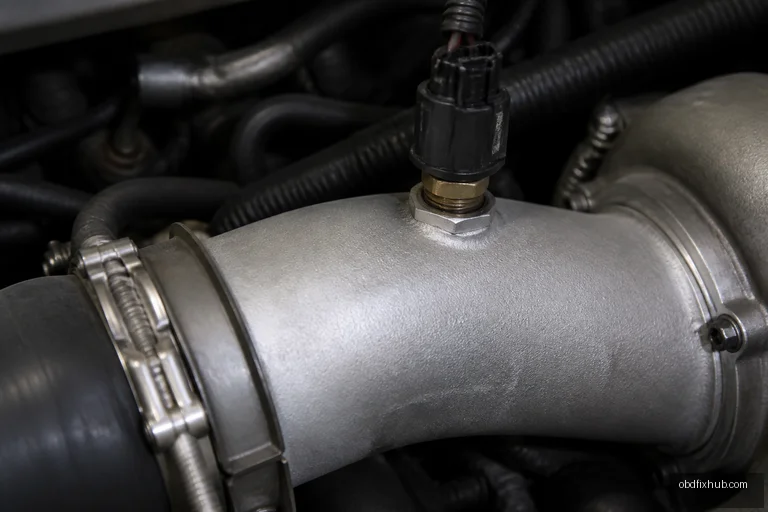
P2EA6 usually indicates a high circuit signal from the turbocharger compressor temperature sensor. However, the exact wording can vary by vehicle manufacturer and scan tool: some databases describe it as a compressor inlet temperature sensor circuit high, while others label the component differently. In most cases, the fault is electrical—such as an open circuit, damaged wiring, or a failed sensor—not proof that the turbocharger is genuinely overheating.
What Does the P2EA6 Code Mean?
The engine control module (ECM) monitors intake-air temperature around the turbocharger to calculate boost control, fuel delivery, ignition timing, and protection strategies. When the signal voltage from the compressor temperature sensor stays higher than the permitted range, the ECM stores P2EA6 and turns on the check engine light.
“Circuit failed high” is an important phrase. It normally means the computer is seeing an electrically high signal, often close to the reference voltage. On many temperature sensors, an unplugged connector or broken signal wire creates exactly this condition. It does not automatically mean the compressor outlet temperature is dangerously high.
Inlet or Outlet? Verify the Code Before Replacing Parts
P2EA6 is one of the codes whose description is not presented consistently across aftermarket scan tools. On many vehicles it refers to the turbocharger compressor inlet temperature sensor circuit high; some websites or tools associate the code with a compressor outlet temperature sensor. The repair procedure depends on the vehicle’s wiring diagram, so confirm the definition using the manufacturer-specific service information or a scan tool with OEM data.
This distinction matters because the inlet sensor is usually positioned before the compressor, while an outlet or charge-air temperature sensor is installed after the compressor and often near the intercooler pipe. Do not order a sensor based on the generic description alone.
Where Is the Turbocharger Compressor Inlet Temperature Sensor Located?
The compressor inlet temperature sensor is generally installed in the fresh-air duct between the air filter housing and the turbocharger compressor inlet. It may be threaded into the intake pipe, clipped into a plastic duct, or combined with a mass airflow (MAF) or manifold pressure assembly, depending on the engine.
On some turbocharged diesel and gasoline engines, the sensor is not visibly mounted on the turbocharger itself. Look for a small two- or three-wire sensor with a locking connector in the intake tract. The compressor outlet or charge-air temperature sensor, by contrast, is normally downstream of the turbo and may be located in the intercooler outlet pipe or intake manifold plumbing.
Common Causes of P2EA6
- Unplugged or loose connector: A connector can be left partially locked after air-filter or turbo plumbing work.
- Broken signal wire: Harnesses near the turbo are exposed to vibration, heat, and rubbing against brackets.
- Heat-damaged wiring: Exhaust and turbo heat can harden insulation and create an open circuit.
- Failed temperature sensor: The internal thermistor may be open, shorted, or outside its calibrated resistance range.
- Corroded terminals: Oil mist and moisture inside the intake area can contaminate the connector.
- Incorrect sensor installation: A sensor with the wrong resistance curve can produce an implausible reading even when it is new.
- ECM or reference-voltage fault: This is less common and should be considered only after the sensor and wiring test correctly.
Symptoms of an Air Intake Charge Temperature Sensor Problem
A defective intake or charge-air temperature sensor can affect the way the ECM manages boost and fueling. The vehicle may still drive normally at light throttle, which is why a visual inspection and live-data check are more useful than judging the fault by symptoms alone.
- Check engine light or reduced-power mode
- Sluggish acceleration and inconsistent turbo boost
- Hard starting, rough idle, or hesitation
- Increased fuel consumption
- Black smoke on a diesel engine or abnormal fueling on a gasoline engine
- Cooling-fan operation or protective boost reduction
- Additional intake, boost-pressure, or MAF-related fault codes
A sensor reading that is fixed at an extreme value can be more revealing than a noticeable drivability complaint. For example, an intake temperature of -40 degrees or an implausibly high value on a cold engine commonly indicates an open circuit, short circuit, or incorrect sensor signal.
How Hot Does a Turbo Outlet Get?
Turbocharger compressor outlet temperature varies with boost pressure, ambient temperature, engine load, compressor efficiency, and intercooler performance. During ordinary driving, the air leaving the compressor may be roughly 120–200°F (50–95°C), while sustained high boost or a hot under-hood environment can push it beyond 250°F (120°C) before the intercooler removes heat.
The turbine and exhaust side are considerably hotter than the compressor side. Never touch a turbocharger or its nearby pipes immediately after operation. A genuinely overheated charge-air system can contribute to detonation, smoke, knock control, or reduced power, but P2EA6 still requires an electrical diagnosis rather than assuming excessive heat is the cause.
How to Diagnose and Fix P2EA6
- Confirm the definition. Record all stored and pending codes, then check whether the vehicle identifies the sensor as compressor inlet, compressor outlet, or charge-air temperature.
- Inspect the intake system. Follow the duct from the airbox to the turbo and check the sensor body, connector lock, bent pins, oil contamination, and damaged seals.
- Examine the harness closely. Flex the wiring near hot components and mounting brackets. A wire that looks intact may be broken internally beneath the insulation.
- Check live data with the engine cold. The sensor should normally read close to ambient temperature and should not be fixed at an extreme value. Compare it with the outside-air or coolant-temperature reading.
- Test voltage and continuity. Using the factory wiring diagram, verify the reference voltage, ground, signal circuit, and continuity from the sensor connector to the ECM. Do not short a reference circuit to ground while testing.
- Measure sensor resistance if specified. Compare the reading with the manufacturer’s temperature/resistance chart. A generic resistance value is not safe because thermistors differ between applications.
- Repair, clear, and retest. Repair wiring with sealed automotive splices, replace a confirmed faulty sensor, clear the code, and perform a road test while monitoring live temperature and boost data.
Replacing the sensor without checking the connector is a common and avoidable mistake. If the code returns immediately after clearing, suspect an open signal circuit, missing sensor ground, or an incorrectly identified component before condemning the ECM.
Can You Drive With P2EA6?
Short, gentle driving is often possible if the engine is not overheating, smoking heavily, knocking, or entering severe reduced-power mode. Avoid towing, full-throttle acceleration, and high-boost operation until the fault is diagnosed. An incorrect intake-temperature signal can cause poor fueling and protective control, while a separate boost or wiring problem may create additional engine damage.
Final Takeaway
P2EA6 is primarily a temperature-sensor circuit-high fault, not a direct diagnosis of turbocharger failure. Verify whether your vehicle calls the component an inlet or outlet sensor, inspect the connector and heat-exposed harness, compare live data with ambient temperature, and test the circuit before buying parts. A wiring repair or sensor replacement usually resolves the problem when the ECM, turbocharger, and intercooler are mechanically healthy.
Frequently Asked Questions
What does “turbocharger compressor inlet temperature circuit failed high” mean?
It means the ECM is receiving a higher-than-expected electrical signal from the compressor inlet temperature sensor circuit. An unplugged sensor, broken signal wire, poor ground, or failed sensor is more likely than an actually overheated turbo.
Where is the turbocharger compressor inlet temperature sensor located?
It is usually in the intake duct between the air filter and the turbocharger compressor inlet. Exact placement varies, and some vehicles combine it with a MAF sensor or another intake-air sensor.
What are the symptoms of a bad air intake charge temperature sensor?
Possible symptoms include poor acceleration, inconsistent boost, hard starting, rough running, increased fuel use, smoke, reduced power, and an illuminated check engine light. Some vehicles show few symptoms apart from the stored code.
How hot does a turbo compressor outlet get?
Compressor outlet air commonly reaches about 120–200°F (50–95°C) during normal operation, but high load and boost can raise it above 250°F (120°C). The exhaust turbine side is much hotter.
Does P2EA6 mean the turbocharger must be replaced?
No. P2EA6 points to a sensor circuit problem and does not, by itself, indicate a failed turbocharger. Diagnose the sensor, wiring, connector, and live data before considering turbo replacement.




