U0100 Lost Communication With ECM/PCM: Meaning, Causes, Symptoms & Fix
U0100 Lost Communication With ECM/PCM means another control module has stopped receiving messages from the engine or powertrain control module over the vehicle’s communication network, usually the CAN bus. The code does not automatically mean the ECM/PCM has failed. In many real-world cases, a weak battery, blown power supply fuse, corroded ground, damaged wiring, or a shorted CAN circuit is the actual problem.
What Does U0100 Mean?
Diagnostic trouble code U0100 is a generic network communication code. “U” codes are set when electronic control modules lose the ability to exchange data. The ECM or PCM controls critical functions such as fuel injection, ignition, throttle operation, emissions monitoring, and transmission coordination, so communication loss can affect far more than the check engine light.
The exact wording may vary by scan tool. You may see “Lost Communication With ECM/PCM,” “No Communication With Engine Control Module,” or “CAN Communication Error With ECM.” These descriptions point to the same general fault, but the correct repair depends on which module set the code and whether the ECM is still responding to a scan tool.
Common Symptoms of U0100
Symptoms can range from a warning light with no noticeable drivability issue to a complete no-start condition. A vehicle may continue running if communication is interrupted briefly, while a longer interruption can disable fuel, spark, throttle, or transmission functions.
- Check engine light, ABS light, traction control light, or multiple warning lamps
- Engine cranks but does not start
- No-crank condition or intermittent starting problems
- Reduced power or limp mode
- Erratic transmission shifting or transmission fail-safe operation
- Inoperative electronic throttle, cruise control, or remote starting
- Scan tool cannot communicate with the ECM/PCM
- Several unrelated U-codes stored in multiple modules
One useful clue is the behavior of the scan tool. If the tool communicates with other modules but cannot access the ECM/PCM, focus on ECM power, ground, connector condition, and network wiring. If no modules communicate, suspect a broader power, ground, gateway, or CAN bus problem.
Most Common Causes of U0100
1. Low battery voltage or unstable power
A battery that drops below normal cranking voltage can make modules reset or disappear from the network. This is especially common after a vehicle has been parked for weeks, after a battery replacement, or when a starter draws excessive current. Check the battery before replacing expensive control modules; a healthy fully charged battery is typically around 12.6 volts with the engine off, while charging voltage commonly falls near 13.5 to 14.8 volts, depending on the vehicle.
2. Blown fuse or failed relay
The ECM/PCM may have separate constant-power, ignition-power, and relay-controlled circuits. A blown fuse can be caused by a shorted wire, water intrusion, an incorrectly installed accessory, or a failed component. Do not simply replace the fuse repeatedly. If it blows again, the underlying short must be found first.
3. Poor grounds
Engine control modules require clean, low-resistance grounds. Corrosion at the battery negative terminal, engine-to-body ground strap, or ECM ground eyelet can interrupt communication even when the wiring looks intact. A voltage-drop test under load is more reliable than judging a ground by visual inspection alone.
4. Damaged CAN bus wiring
The CAN network normally uses two twisted wires, often labeled CAN High and CAN Low. Common damage points include areas near the battery tray, transmission, engine harness, fuse box, and previous collision repairs. A crushed harness, water-soaked connector, loose terminal, or aftermarket remote-start installation can pull the network voltage out of range.
5. Water or corrosion at the ECM connector
Plenum drains, windshield leaks, pressure washing, and damaged seals can allow moisture into the ECM connector. Green corrosion on terminals is a strong warning sign, but corrosion may also be hidden behind the connector seal. Disconnect the battery and follow the manufacturer’s safety procedure before unplugging an ECM.
6. A failed or shorted control module
An internally failed ECM/PCM is possible, but it should be diagnosed last. A different module on the same CAN network can short the bus and make the ECM appear dead. Disconnecting modules one at a time according to the service manual can identify the module that is collapsing network communication.
How to Diagnose U0100 Correctly
Do not begin by ordering an ECM. A disciplined network diagnosis prevents unnecessary programming costs and avoids replacing a good module.
- Record every code. Use a full-system scan, not an engine-only scan. Note which modules report U0100 and whether the code is current or history.
- Check battery condition. Test resting voltage, cranking voltage, and charging output. Repair battery or starter problems before chasing communication faults.
- Inspect ECM fuses and relays. Test for power on both sides of each fuse with the ignition in the required position. A fuse can look good but lack voltage because the upstream feed is missing.
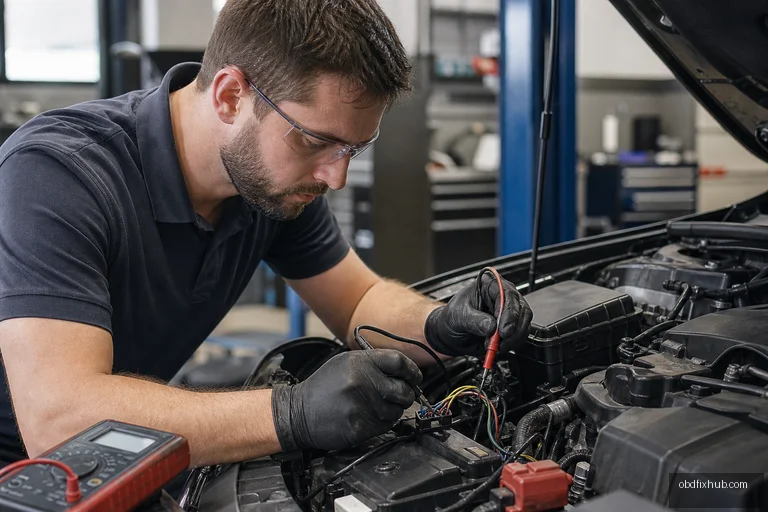
- Test ECM powers and grounds. Use a wiring diagram and a multimeter or test light. Perform voltage-drop tests while the circuit is loaded; resistance checks alone can miss a poor connection.
- Inspect the harness and connectors. Look for stretched wires, aftermarket splices, backed-out terminals, moisture, rodent damage, and harness repairs made with unsuitable crimp connectors.
- Check CAN bus resistance when appropriate. With the vehicle powered down and the correct modules isolated according to the service information, many networks measure close to 60 ohms across CAN High and CAN Low. This is a guide, not a universal rule; some vehicles use different network layouts.
- Check network voltage and signal quality. An oscilloscope can reveal a shorted, distorted, or missing CAN waveform that a basic code reader cannot identify.
- Confirm the repair with a complete scan. Clear the codes, cycle the ignition, perform a road test, and rescan all modules. Some vehicles also require module configuration, immobilizer synchronization, or software programming after ECM replacement.
U0100 Lost Communication With ECM/PCM: Practical Fixes
The repair may be as simple as charging the battery, replacing a blown fuse after correcting a short, cleaning a ground connection, or repairing two damaged CAN wires. A corroded connector should be repaired with the correct terminals and seals rather than sprayed with contact cleaner and reassembled as a temporary solution.
If the ECM/PCM itself is defective, replacement is not plug-and-play on most modern vehicles. The replacement unit may need immobilizer programming, VIN writing, calibration updates, throttle relearn, crankshaft position variation relearn, or configuration from the original module. Used modules can work on some applications, but compatibility and programming requirements must be verified by part number and software level.
Can You Drive With U0100?
Driving is not advisable if the vehicle has a no-start problem, reduced power, unstable throttle response, harsh shifting, or multiple warning lights. If the vehicle runs normally and the code is stored as history, a short trip to a repair facility may be reasonable, but the fault can return without warning. Network problems often become worse with vibration, heat, moisture, or a failing battery.
Important Diagnostic Tip
Pay attention to when the code appeared. If U0100 was logged immediately after a battery replacement, jump-start, collision repair, stereo installation, or engine work, inspect that area first. For example, a forgotten engine ground strap can allow the engine to crank while preventing stable ECM communication, producing several alarming codes at once.
Summary: The Best Next Step
U0100 identifies a communication failure, not a guaranteed bad ECM/PCM. Start with battery voltage, fuses, grounds, ECM power supplies, connectors, and CAN bus wiring before condemning a control module. If a scan tool cannot communicate with the ECM, use the vehicle’s wiring diagram and a full-system scan to isolate whether the module is unpowered, disconnected, or being blocked by another device on the network.
Action step: Record all codes, test the battery and ECM power circuits, then inspect the CAN harness before approving an ECM replacement or programming service.
Frequently Asked Questions
Can a weak battery cause U0100?
Yes. Low battery voltage during cranking can reset the ECM or interrupt network communication. Test the battery and charging system before performing advanced CAN diagnostics.
Does U0100 mean the ECM is bad?
No. Power loss, poor grounds, blown fuses, damaged CAN wiring, water intrusion, or another shorted module are more common starting points. The ECM should only be replaced after its powers, grounds, and network circuits pass testing.
Why does my car have several communication codes at once?
Multiple U-codes often indicate a shared network or power problem. A weak battery, failed gateway, open CAN wire, or one module shorting the bus can make several systems report that they cannot communicate.
Can I clear U0100 with a code reader?
You can clear the code, but it will return if the communication fault remains. Clearing codes is useful only after the cause has been repaired and the vehicle has completed the required drive cycle.
Will replacing the battery fix U0100?
It may, if low voltage caused the code. However, inspect battery terminals, ground connections, charging output, and the original battery-related event so the communication fault does not return.




