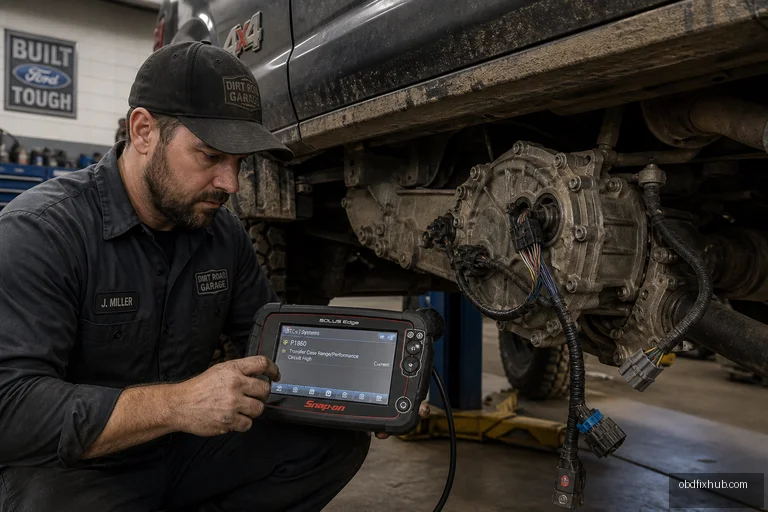
U0102 Lost Communication With Transfer Case Control Module means another control module has stopped receiving messages from the vehicle’s transfer case control module over the CAN network. The fault is usually caused by a power or ground problem, damaged wiring, corrosion, a failed CAN bus connection, or a defective transfer case control module—not automatically by a bad transfer case itself.
This is an informational diagnostic trouble code, so the correct repair depends on testing the communication circuit and module power supplies. Replacing the TCCM without checking its wiring is one of the most common and expensive mistakes technicians see with U0102.
What Does U0102 Mean?
The transfer case control module, often called the TCCM, controls the electronically operated four-wheel-drive or all-wheel-drive transfer case. It receives information from modules such as the ABS, transmission, engine, and body control modules, then commands the transfer case motor or clutch to select the requested drive mode.
These modules communicate through the Controller Area Network, or CAN bus. When a module expects regular messages from the TCCM and those messages disappear for a calibrated period, it stores U0102. The exact wording and module that records the code can vary by manufacturer, but the underlying issue is a communication failure.
Common Symptoms of U0102
Symptoms depend on the vehicle’s design and the position of the transfer case when communication was lost. A vehicle may still drive normally in two-wheel drive, while another may be left in four-wheel drive or neutral.
- Four-wheel-drive or all-wheel-drive system is unavailable
- 4WD, AWD, SERVICE 4WD, or drivetrain warning message
- Flashing or inoperative 4WD mode indicators
- Transfer case will not shift between 2HI, 4HI, 4LO, or other modes
- Vehicle remains in one drive mode after the ignition is cycled
- ABS, traction control, stability control, or transmission warning lights
- Clicking or repeated actuator noise from the transfer case area
- Additional U-codes related to lost communication with other modules
A particularly useful clue is whether the 4WD selector responds at all. If the indicator does not illuminate and a scan tool cannot communicate with the TCCM, suspect power, ground, or network wiring before suspecting a mechanical transfer case failure.
Most Common Causes of U0102
1. TCCM power or ground failure
A blown fuse, failed relay, loose ground strap, or corroded connector can shut down the transfer case control module completely. On many trucks, the TCCM has more than one power feed, including an ignition-switched supply and a constant battery supply. Testing only one fuse can therefore produce a false diagnosis.
2. Damaged CAN bus wiring
CAN High and CAN Low wires may be open, shorted together, shorted to ground, or shorted to voltage. Harness damage is common near the transfer case, frame rails, underbody connectors, and areas exposed to road salt or off-road debris. A previous exhaust, driveshaft, or suspension repair may also have pinched the harness.
3. Water or corrosion in a connector
Water intrusion around the transfer case connector, cabin kick panel, or under-seat module can create intermittent communication faults. Green or white deposits on terminals, swollen seals, and moisture inside the connector are strong evidence that the problem may return unless the source of the water is repaired.
4. Low system voltage
A weak battery, poor battery terminal, failing alternator, or voltage drop during starting can cause multiple modules to reset and log communication codes. If U0102 appeared after a dead battery or jump-start, measure battery voltage and charging voltage before condemning any electronic module.
5. A failed transfer case control module
The TCCM can fail internally because of water damage, overheating, a corrupted memory, or an electrical short. However, the module should be considered faulty only after its power, grounds, CAN circuits, and connector terminals pass testing. A new module may also require programming, configuration, or a transfer case position relearn.
6. Another module disrupting the CAN network
One shorted control module can bring down a section of the communication network and make the TCCM appear to be offline. For this reason, a scan showing several modules missing at the same time is more significant than U0102 alone. The first module to fail may not be the module named in the code.
How to Diagnose U0102 Correctly
Professional diagnosis starts with a complete network scan, not with replacing the transfer case module. The following sequence avoids most unnecessary parts replacement.
- Scan every available module. Record current, history, and pending codes. Note which modules communicate and which are missing. Save freeze-frame data and check whether the code appeared during low voltage, a shift request, or a specific drive condition.
- Check the battery and charging system. A fully charged battery should generally measure about 12.4 to 12.7 volts with the engine off. Charging voltage commonly falls near 13.5 to 14.8 volts, although the exact specification varies. Inspect both battery terminals and the main body and engine grounds.
- Verify TCCM fuses under load. Do not rely only on visual inspection. Test for voltage on both sides of each relevant fuse with the ignition in the required position. A fuse that has power on one side only is not supplying the module.
- Test module grounds with a voltage-drop test. A ground may look clean and still fail under load. With the circuit energized, measure between the TCCM ground and battery negative while operating the system. Excessive voltage drop indicates resistance in the ground path.
- Inspect the connector and harness. Look for pushed-back pins, loose terminal tension, water, rubbed insulation, aftermarket wiring, and crushed sections. Gently move the harness while monitoring communication; if the scan tool connection returns or drops, the harness requires closer examination.
- Test CAN circuit resistance correctly. With the ignition off and the battery disconnected according to the manufacturer’s procedure, resistance across CAN High and CAN Low is often approximately 60 ohms when both 120-ohm terminating resistors are present. Around 120 ohms can indicate a missing termination or open network section. Never measure resistance on a powered CAN circuit, and always confirm the vehicle’s wiring diagram before interpreting the reading.
- Check CAN voltage and waveform when necessary. A digital multimeter can identify an obvious short, but an oscilloscope is better for intermittent faults and distorted CAN signals. Compare the waveform with the manufacturer’s reference and isolate modules only according to the service procedure.
- Attempt communication with the TCCM. If the scan tool cannot access the module while its power, ground, and network circuits are correct, the module may have an internal failure. If communication is available, check for software updates, configuration errors, actuator codes, and transfer case position data.
U0102 Lost Communication With Transfer Case Control Module: Fixes
The repair should match the confirmed fault. A loose ground may require cleaning and tightening, while a damaged CAN wire may need a sealed splice or harness replacement. Do not use household wire connectors in an exposed underbody harness; moisture-resistant automotive splices and proper strain relief are essential.
- Replace a blown fuse only after finding the reason it failed.
- Repair corroded terminals and replace severely damaged connector bodies.
- Restore missing power or ground feeds and verify voltage drop afterward.
- Repair chafed, open, or shorted CAN High and CAN Low wiring.
- Replace the TCCM only after circuit testing proves the module is not responding.
- Program, configure, or relearn the replacement module when required.
- Clear all codes, perform a complete module scan, and road-test every available drive mode.
On some vehicles, installing a used TCCM is not plug-and-play. The replacement may be locked to the donor vehicle, require VIN writing, or need transfer case clutch and position calibration. Ask for the exact programming requirement before approving the repair.
Can You Drive With U0102?
Sometimes the vehicle can be driven safely if it remains in two-wheel drive and no other warning lights affect braking or stability control. However, driving on a high-traction surface with the transfer case stuck in four-wheel drive can cause driveline binding, tire scrub, or drivetrain damage.
Avoid using 4LO, towing, or driving off-road until the system has been tested. Stop driving and arrange professional inspection if the vehicle is stuck in neutral, shows transmission or ABS faults, makes grinding noises, or has severe drivability problems.
Practical Diagnostic Example
Consider a pickup that stores U0102 immediately after heavy rain. The 4WD switch is dark, the TCCM does not respond to a scan tool, and several other modules report lost communication. The fastest path is not replacing the transfer case; it is checking the TCCM fuse, ground, and connector for water intrusion.
If drying the connector temporarily restores communication, the repair is incomplete until the leak is found—often a damaged grommet, windshield leak, or poorly sealed harness entry. A repeat failure after a module replacement usually points to this overlooked root cause.
U0102 Repair Cost Considerations
Repair cost varies widely. A fuse, ground repair, or connector cleanup may be relatively inexpensive, while a damaged harness can require several hours of labor. A replacement TCCM plus programming can cost substantially more, especially on newer vehicles with security and configuration requirements.
Before authorizing a module, request three specific findings: verified power and ground, verified CAN circuit integrity, and proof that the module fails to communicate. This documentation separates a justified electronic repair from a guess based only on the trouble code.
Summary: The Right Way to Handle U0102
U0102 identifies a communication breakdown with the transfer case control module, but it does not prove that the module itself is defective. Start with a full scan, battery condition, fuses, grounds, connector inspection, and CAN bus testing. Repair the circuit first, then program or replace the TCCM only when testing supports that conclusion.
If the 4WD system is unavailable or stuck in an uncertain position, avoid forcing mode changes and have the vehicle diagnosed with a scan tool capable of accessing the TCCM. Accurate network testing is usually faster and cheaper than replacing transfer case components on speculation.
Frequently Asked Questions
Can a weak battery cause U0102?
Yes. Low voltage during starting or a poor battery connection can reset the TCCM and create a communication code. Test battery voltage, charging output, and voltage drop before replacing electronic parts.
Does U0102 mean the transfer case is bad?
No. U0102 refers to lost communication with the transfer case control module. The mechanical transfer case may be completely healthy; wiring, power, ground, corrosion, or another CAN module may be responsible.
Will clearing U0102 fix the 4WD system?
Clearing the code may turn off the warning temporarily, but it will not repair the underlying fault. If communication is still interrupted, U0102 and the 4WD warning will return.
Can I replace the TCCM myself?
You can replace it on some vehicles, but many require programming, configuration, or position calibration afterward. Verify the exact procedure for your make, model, drivetrain, and model year before buying a replacement module.




