U0113 Lost Communication With Emissions Critical Control Information: Meaning, Causes, Symptoms & Fix
U0113 means that one control module has stopped receiving emissions-related data from another module over the vehicle’s communication network, usually the CAN bus. The fault may be caused by a weak battery, damaged wiring, a poor ground, network interference, or a failed control module. Because the exact module and circuit vary by vehicle, replacing a part based only on the code is rarely the right first move.
What Does U0113 Mean?
Diagnostic trouble code U0113 is a network communication code. “Lost communication” means that a receiving module expected valid messages but did not receive them within a specified period. The phrase “emissions critical control information” refers to data used by the powertrain and emissions systems to manage functions such as fuel delivery, evaporative emissions, exhaust after-treatment, torque control, or diagnostic monitoring.
U0113 does not automatically identify a defective oxygen sensor, catalytic converter, diesel particulate filter, or emissions module. It indicates a communication problem, and the missing information may originate from a dedicated emissions controller, the engine or powertrain control module, or another related system. Manufacturer-specific service information is essential because the module assignment can differ between makes and model years.
Common Symptoms of U0113
The symptoms depend on which messages are missing and how the vehicle responds when the network becomes unreliable. Some vehicles continue to drive normally with only a warning lamp, while others enter a reduced-power strategy.
- Check Engine Light or malfunction indicator lamp
- Additional U-codes stored in several control modules
- Reduced engine power or limp-home mode
- Hard starting, extended cranking, or a no-start condition
- Unstable idle, poor throttle response, or unusual shifting
- Failed emissions readiness monitors or an unsuccessful inspection
- Cooling fan, transmission, or after-treatment functions operating abnormally
- Intermittent warning messages that disappear after cycling the ignition
A useful clue is whether several unrelated systems fail at the same time. For example, an engine warning, loss of scan-tool communication with one module, and intermittent transmission symptoms point more strongly toward a power, ground, or CAN-bus issue than toward three separate component failures.
Most Likely Causes of U0113
1. Low battery voltage or unstable power
A battery that drops below normal voltage during cranking can make a control module reboot or disappear from the network. Corroded battery terminals, a weak alternator, and loose fuse-box connections can create the same symptom. Always test voltage under load rather than relying on a battery’s resting voltage alone.
2. Damaged CAN-bus wiring
CAN-high and CAN-low circuits can be damaged by water intrusion, previous accident repairs, aftermarket equipment, rodents, or harness chafing against a bracket. A single open circuit, short to ground, short to power, or short between the two CAN wires can interrupt communication with one or multiple modules.
3. Poor grounds or blown fuses
Emissions-related modules often have separate battery feeds, ignition feeds, and ground circuits. A blown fuse may be the result of a shorted component, not the original problem. Inspect the fuse, the fuse terminals, the module connector, and the associated ground points instead of simply installing another fuse.
4. Moisture or connector corrosion
Connectors near the engine, transmission, exhaust system, wheel wells, and cowl area are exposed to heat, salt, and water. Green corrosion, pushed-out terminals, swollen seals, or moisture inside a module connector can create an intermittent U0113 that is difficult to reproduce in the workshop.
5. Failed or incorrectly programmed control module
A control module can fail internally, especially after reverse polarity, jump-start damage, water exposure, or an electrical overvoltage event. A replacement module may also require programming, configuration, or a security relearn before it can communicate correctly. Do not condemn the module until its power, ground, network circuits, and software requirements have been verified.
How to Diagnose U0113 Correctly
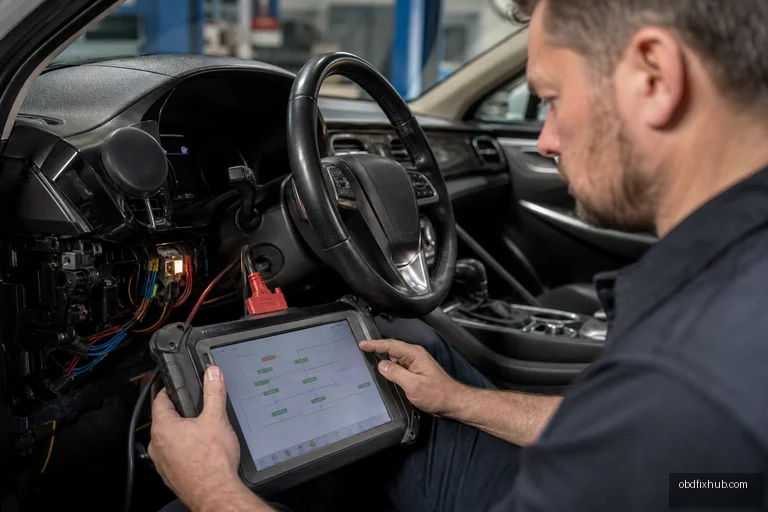
The most effective diagnosis begins with the entire vehicle network, not with the component named in a parts catalog. Follow this sequence to avoid replacing an expensive module unnecessarily.
- Scan every available module. Record all current, pending, and history codes. Note which modules report U0113 and whether there are companion codes such as low-voltage, CAN-bus, or lost-communication faults.
- Check the battery and charging system. Inspect the terminals and measure battery voltage before starting, during cranking, and with the engine running. A voltage drop during cranking can explain a code that appears only after startup.
- Confirm module power and ground. Use a wiring diagram and a load test. A digital multimeter may show 12 volts with no load even when a corroded connection cannot supply current to the module.
- Inspect the harness and connectors. Look for pulled wires, water tracks, damaged insulation, aftermarket splices, and terminals that have backed out of the connector. Gently move the harness while monitoring communication, but never force a connector or short CAN pins together.
- Test CAN-bus resistance when appropriate. With the vehicle powered down and the correct network isolated, many high-speed CAN systems measure close to 60 ohms across CAN-high and CAN-low because two 120-ohm termination resistors are in parallel. A reading near 120 ohms, very low resistance, or an open circuit can indicate a missing terminator or wiring fault. Follow the manufacturer’s shutdown procedure because some vehicles keep modules awake for several minutes.
- Use a scope for intermittent faults. A healthy CAN waveform has clean, consistent differential activity. Distorted signals, excessive noise, missing dominant bits, or voltage levels pulled out of range can reveal a fault that resistance testing misses.
- Check module communication and software. If the wiring and power supplies test correctly, determine whether the scan tool can communicate with the suspected module. Confirm technical service bulletins, software updates, configuration procedures, and module initialization requirements before replacement.
U0113 Fix: What Usually Repairs the Problem?
The repair depends on the failed part of the network. Common successful repairs include cleaning or replacing corroded terminals, repairing a CAN wire, securing a ground strap, replacing a blown fuse after correcting its cause, repairing water intrusion, or replacing and programming a failed control module.
For example, if U0113 appears after heavy rain and the affected module is mounted below the windshield, checking the cowl drains and connector seals may be more productive than testing emissions sensors. If the code appears immediately after a battery replacement, inspect the battery terminals, ground connections, and any disturbed wiring before considering a module failure.
After the repair, clear the codes and perform a complete network scan. Road-test the vehicle under the conditions shown in the freeze-frame data, then rescan it. Emissions readiness monitors may need several drive cycles before they complete, so a vehicle can be repaired correctly while still showing incomplete monitors immediately afterward.
Can You Drive With U0113?
Short-distance driving may be possible if the vehicle runs normally and no red warning lamps, overheating, braking, or steering problems are present. However, driving is not advisable when the engine is in limp mode, the vehicle stalls, shifting is erratic, or multiple control systems are offline. A communication failure can disable emissions functions and may leave the vehicle unable to restart.
Have the vehicle diagnosed promptly if U0113 returns after clearing, appears with several U-codes, or is accompanied by a no-start condition. Avoid disconnecting modules randomly, because doing so can create additional codes and make the original fault harder to identify.
Key Takeaway
U0113 is a communication fault, not a direct diagnosis of a failed emissions component. Start with a full-module scan, battery and charging checks, module powers and grounds, and a careful CAN-bus inspection. Correct testing of the network is usually faster and less expensive than replacing sensors or control modules by guesswork.
Frequently Asked Questions About U0113
Is U0113 a serious code?
It can be. Some vehicles only illuminate the Check Engine Light, while others lose essential emissions or powertrain functions. The seriousness depends on which module is offline and whether the engine, transmission, or safety systems are affected.
Can a weak battery cause U0113?
Yes. Low cranking voltage or an unstable charging system can reboot a module and interrupt CAN-bus communication. Test the battery, alternator, terminals, and grounds before condemning a control module.
Will clearing U0113 fix the problem?
Clearing the code only removes the stored fault temporarily. If the communication problem remains, U0113 will return when the vehicle repeats its network check or the missing message is detected again.
Do I need to replace the emissions control module?
Not necessarily. Wiring faults, poor grounds, blown fuses, water intrusion, and low voltage are common causes. Module replacement should follow verified power, ground, network, and programming checks.




