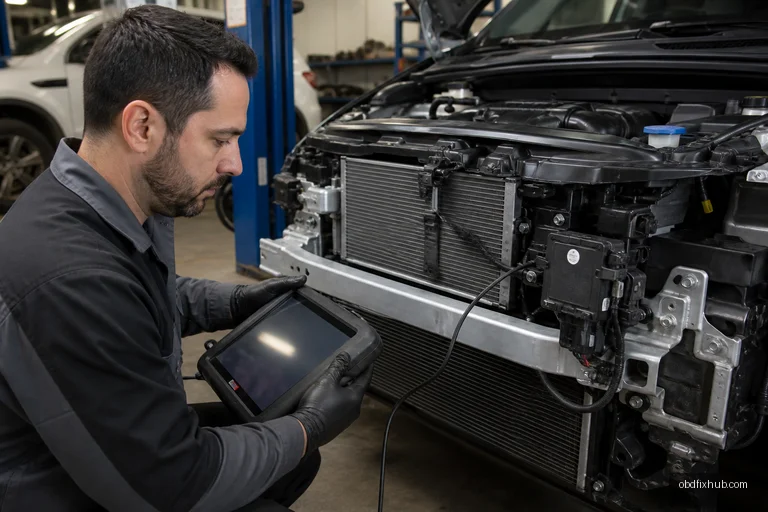
U0286 Lost Communication With Radiator Anti-Tamper Device means one or more vehicle control modules can no longer exchange messages with the radiator anti-tamper device over the vehicle network, usually the CAN bus. The fault is generally caused by low voltage, damaged wiring, corrosion, a failed device, or a network communication problem—not by a defective radiator itself.
This is an informational and diagnostic fault code, so the correct repair depends on the vehicle’s make, model, wiring architecture, and manufacturer-specific service information. Do not replace the radiator or anti-tamper module based on U0286 alone.
What Does U0286 Mean?
U0286 is a generic communication trouble code. The first character, U, identifies a network or communication fault. In this case, a control module expected to receive data from the radiator anti-tamper device but did not receive valid messages within the required time.
The radiator anti-tamper device is not necessarily part of the radiator core or cooling fan assembly. Depending on the vehicle, it may be an electronically monitored security or presence device associated with the radiator area. Some systems use it to detect tampering, unauthorized removal, disconnected components, or abnormal circuit conditions.
Because manufacturers implement this system differently, the anti-tamper device may communicate directly on the CAN network or through another control module. A factory wiring diagram is essential before testing individual wires.
Common Symptoms of U0286
The vehicle may drive normally when this code is stored, especially if the anti-tamper system is separate from engine operation. However, the fault can still cause warning messages or prevent certain security and monitoring functions from operating correctly.
- Check Engine Light or a general vehicle warning message
- Security, anti-theft, or tamper warning displayed on the instrument cluster
- U0286 stored as a current, pending, or history code
- Several communication codes appearing at the same time
- Intermittent warning messages after rain, washing, or engine-bay cleaning
- Battery drain if a module repeatedly attempts to establish communication
- In some vehicles, no noticeable drivability symptoms at all
A useful clue is the pattern of the codes. If U0286 appears alone, the radiator anti-tamper device, its connector, or its local power and ground circuits deserve close attention. If it appears alongside multiple U-codes, low system voltage or a wider CAN-bus problem is more likely.
Most Common Causes of U0286
1. Low battery voltage or unstable power supply
Modern control modules can stop communicating when voltage falls during starting or when a battery is deeply discharged. A weak battery may set U0286 even though the component itself is healthy. Check battery condition and charging voltage before replacing any module.
2. Blown fuse, missing power, or poor ground
The anti-tamper device may have a dedicated fuse, shared ignition feed, or controlled power supply. A blown fuse can be the result of a shorted device, damaged harness, or previous repair. A ground that looks tight can still fail under load because of corrosion between the terminal and the body.
3. Damaged CAN wiring
CAN wires can be damaged by front-end repairs, radiator replacement, collision damage, vibration, or contact with a fan shroud. Typical problems include an open circuit, short to ground, short to battery voltage, or CAN-high and CAN-low shorted together.
4. Water intrusion or connector corrosion
Components mounted near the radiator are exposed to water, road salt, mud, and pressure washing. Green corrosion on terminals, moisture inside a sealed connector, or a loose terminal can interrupt communication intermittently. A connector may pass a visual inspection but fail when the harness is moved.
5. Failed radiator anti-tamper device or control module
The device itself can fail internally, particularly after an impact, water intrusion, incorrect jump-start, or wiring short. Module replacement may require configuration, pairing, or a security-related initialization procedure. Installing a new part without completing that procedure may leave U0286 active.
6. Incorrect programming or vehicle configuration
After module replacement, body repairs, or software updates, a device may not be correctly configured in the vehicle network. A code that appears immediately after a replacement should prompt a programming and configuration check before another part is installed.
How to Diagnose U0286 Correctly
Use a scan tool that can communicate with all available modules, not only the engine computer. A basic code reader may display U0286 but cannot show which module reported it, whether the device is online, or whether other modules have lost communication as well.
- Record every code. Scan all modules and save freeze-frame or event data. Note whether U0286 is current, pending, or stored as history.
- Check the battery first. With the vehicle rested, a healthy 12-volt battery is typically near 12.6 volts. During cranking, voltage should not collapse abnormally. With the engine running, verify charging voltage according to the vehicle’s specifications.
- Inspect relevant fuses and grounds. Test for power on both sides of each fuse with the circuit active. Do not rely only on continuity testing; a fuse can test good while the circuit has no feed.
- Inspect the harness and connector. Look around the radiator, front bumper, cooling fan area, and any recent repair location. Check for pulled wires, crushed loom, exposed copper, moisture, and terminals pushed backward in the connector.
- Test network integrity. With the vehicle powered down and the correct modules asleep, a technician may measure CAN resistance according to the manufacturer’s procedure. Many conventional high-speed CAN systems measure approximately 60 ohms across CAN-high and CAN-low, but this is not universal. Always follow the wiring diagram and network topology.
- Perform a wiggle and voltage-drop test. Move the harness while watching live communication status or resistance. Voltage-drop testing under load is particularly useful for finding a ground that appears intact but cannot carry current.
- Verify the device before replacement. If power, ground, network wiring, and termination are correct but the device remains offline, compare the result with OEM diagnostic steps. Replacement may then be justified, followed by programming or initialization.
One practical diagnostic mistake is checking CAN resistance with the battery connected or the network awake. This can produce misleading readings and may risk damage to test equipment. The ignition state, battery connection, and sleep procedure should match the manufacturer’s instructions.
U0286 Repair: What Usually Fixes It?
The repair can be as simple as restoring a fuse or cleaning a corroded connector, but the exact fix must address the reason communication stopped. Common repairs include:
- Charging or replacing a weak battery
- Repairing a broken CAN wire with the correct twisted-pair routing
- Replacing a damaged connector terminal or water-damaged connector
- Cleaning and securing a ground connection
- Repairing harness damage caused by collision or radiator work
- Replacing the radiator anti-tamper device when testing confirms internal failure
- Programming, configuring, or pairing the replacement module
After the repair, clear all codes and perform a complete network scan again. The vehicle may need to enter sleep mode before a communication fault can be verified as resolved. A road test, ignition cycle, and recheck are preferable to clearing the code and assuming the repair worked.
Can You Drive With U0286?
Usually, a vehicle with only U0286 and no overheating, starting, or security symptoms can be driven cautiously to a repair facility. However, do not ignore the code if the scan also shows cooling fan, engine temperature, immobilizer, or multiple network faults.
Keep clear of the radiator fan during diagnosis. Electric cooling fans can start unexpectedly even with the engine off. Before working near the fan, follow the manufacturer’s safety procedure and disconnect power only when the service information permits it.
Frequently Asked Questions
Is U0286 caused by a bad radiator?
Usually not. U0286 identifies lost communication with a radiator anti-tamper device, not a coolant leak or blocked radiator. Wiring, voltage, connectors, and module configuration should be tested first.
Will disconnecting the battery clear U0286?
It may erase temporary memory in some vehicles, but it does not repair the underlying fault. If the communication problem remains, U0286 will return after the next self-test.
Can a low battery cause U0286?
Yes. Low cranking voltage or an unstable power supply can make a networked device go offline. Battery and charging-system tests are among the first checks to perform.
Does replacing the anti-tamper device require programming?
It may. Some vehicles require configuration, security pairing, or a module initialization routine after replacement. Confirm this in the manufacturer’s service information before installing a part.
What is the fastest way to fix U0286?
The fastest reliable approach is a full-module scan followed by checks of battery voltage, fuses, grounds, connector condition, and CAN wiring. Replacing the device without those tests often wastes time and money.
U0286: Key Takeaway
U0286 means the vehicle has lost network communication with its radiator anti-tamper device. Start with low voltage, fuses, grounds, water intrusion, and damaged CAN wiring; only then consider device failure or programming. If multiple modules report communication faults, diagnose the network as a system rather than replacing the radiator-related component immediately.




