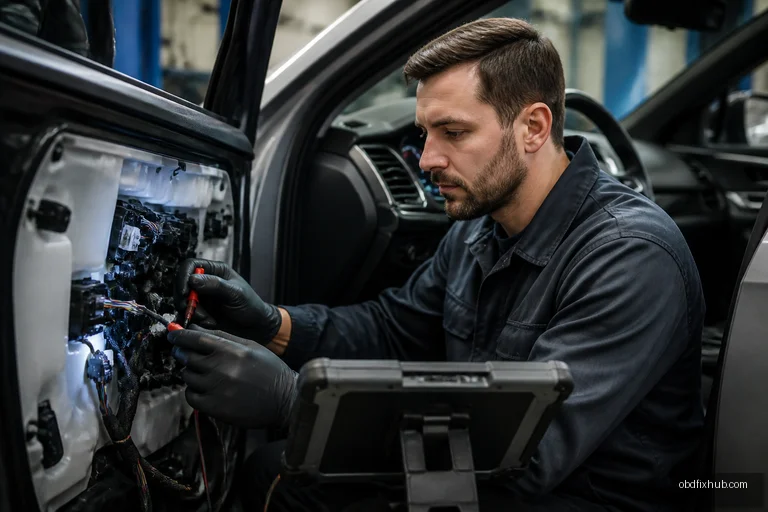
U02A7 lost communication means another control module cannot exchange data with the Engine Sound Control module, often called Engine Sound Control 1. The fault is usually caused by a power supply, ground, CAN-bus wiring, connector, or module problem—not by the engine itself. Before replacing anything, confirm the code with a full-module scan and check the vehicle manufacturer’s wiring diagram.
What Does U02A7 Mean?
Diagnostic trouble code U02A7 is a network communication code. It indicates that a vehicle control module has stopped receiving expected messages from the Engine Sound Control module over the vehicle communication network, typically the Controller Area Network (CAN bus).
The Engine Sound Control module manages artificial or enhanced engine sound played through the cabin speakers or an external sound actuator. It may be fitted to performance vehicles, hybrid vehicles, and models that use synthesized engine noise to improve the driving experience. The exact module name and location vary by manufacturer.
The “1” or equivalent designation in the description identifies one of potentially several engine sound control modules. It does not automatically identify the failed component. A low battery, water intrusion, or a damaged CAN wire can set the same code.
Common Causes of U02A7 Lost Communication
- Weak battery voltage or a recent battery replacement
- Blown fuse supplying the Engine Sound Control module
- Loose, corroded, or water-damaged module connector
- Open, shorted, or poorly repaired CAN High or CAN Low wiring
- Faulty ground connection near the module
- Engine Sound Control module software failure or internal damage
- Aftermarket audio, alarm, remote-start, or performance equipment interfering with the network
- Incorrect coding after module replacement
In workshop diagnosis, undervoltage is easy to overlook. A vehicle may start normally while a control module fails its network initialization because voltage briefly drops below the module’s operating threshold during cranking. If U02A7 appeared after a flat battery or jump-start, test the battery and charging system before condemning the module.
Symptoms You May Notice
Some vehicles show only a stored warning code with no noticeable drivability problem. The engine sound feature may be disabled, unusually quiet, or stuck at one volume level. Other symptoms can include an infotainment warning, multiple communication codes, intermittent warning lights, or a message stating that a driving sound or vehicle sound system is unavailable.
U02A7 normally does not cause a no-start condition by itself because the Engine Sound Control module is usually not responsible for fuel injection or ignition. However, if the same network fault affects several modules, the vehicle may display unrelated warnings or enter a limited-function mode. Treat a cluster of U-codes as a network problem rather than repairing each code separately.
How to Diagnose U02A7 Correctly
1. Perform a complete vehicle scan
Use a scan tool that can communicate with every available module, not only the generic OBD-II engine menu. Record all codes, their status, and freeze-frame information before clearing anything. Pay particular attention to codes that identify lost communication with several modules or low system voltage.
2. Check battery voltage and grounds
With the vehicle switched off, a healthy fully charged battery is commonly close to 12.6 volts. During cranking, voltage should not collapse excessively, and with the engine running the charging voltage should be checked against the manufacturer’s specification. Inspect the battery terminals, body grounds, and engine-to-body ground strap for looseness, oxidation, or heat damage.
3. Verify fuses and module power
Locate the Engine Sound Control module fuse using the vehicle-specific fuse chart. Test both sides of the fuse with a meter or test light; a visual inspection can miss a poor fuse connection. If power is absent, trace the supply circuit rather than installing a larger fuse, which can create a serious wiring hazard.
4. Inspect the connector and CAN wiring
Find the module and look for water tracks, green corrosion, pushed-back terminals, broken locking tabs, and wiring pinched under trim. Pay special attention to areas beneath seats, in the trunk, behind rear quarter panels, or near speakers, where sound-control modules are often mounted. Do not probe sealed terminals with oversized test leads.
With the ignition off and the network asleep, a professional may measure CAN bus resistance according to the manufacturer’s procedure. A reading near 60 ohms is common on many properly terminated networks, but this is not universal and must not be treated as a universal pass/fail rule. Incorrect test conditions can wake the network and produce misleading results.
5. Confirm communication before replacing the module
Try to enter the Engine Sound Control module with the scan tool. If the tool cannot access it while other modules communicate normally, verify power, ground, and CAN signal integrity directly at the module connector. If these circuits are correct, the module may require software programming or replacement.
A replacement module may need configuration, vehicle identification, calibration, or security authorization. Installing a used unit without checking compatibility can leave the original communication fault in place. Follow the factory service procedure and use a stable battery support unit during programming.
How to Fix Lost Communication With ECM/PCM A
If the scan tool specifically reports “lost communication with ECM/PCM A,” that is usually a different code family, such as U0100 or a manufacturer-specific variation. U02A7 concerns the Engine Sound Control module, not normally ECM/PCM A. Start by confirming the exact code number, module description, and vehicle year, make, model, and engine.
For a genuine ECM/PCM communication fault, inspect ECM and PCM power feeds, grounds, ignition circuits, CAN wiring, and related fuses. Check whether the ECM can be accessed with the scan tool and compare its communication status with other modules. Do not replace the PCM until the power, ground, network wiring, and software requirements have been verified; a wiring fault can make a good PCM appear defective.
Can You Drive With U02A7?
If U02A7 is the only code and the vehicle runs normally, short-distance driving is often possible because the engine sound module is generally a comfort or sound-enhancement system. Drive cautiously if several warning lights appear, the transmission behaves abnormally, steering assistance changes, or the vehicle enters reduced-power mode. Those symptoms suggest a wider network or power-supply problem that needs prompt diagnosis.
Repair Mistakes to Avoid
- Clearing the code without recording the other network faults
- Replacing the sound module before testing its fuse, ground, and CAN circuits
- Using a generic wiring diagram for a different model year
- Disconnecting modules with the ignition on
- Ignoring water leaks in the trunk, cabin, or under-seat areas
- Fitting a replacement module without programming or configuration
Summary
U02A7 indicates a communication failure involving the Engine Sound Control module. The most effective repair path is to scan every module, check battery health, verify fuses and grounds, inspect for moisture and connector damage, test CAN circuits, and only then consider software programming or module replacement. If your scan tool says ECM/PCM A instead, confirm the code because that is a separate diagnostic direction.
Best next step: record every stored and pending code, then obtain the manufacturer-specific wiring diagram before testing the module. A proper network diagnosis is usually faster and less expensive than replacing parts by guesswork.
Frequently Asked Questions
Is U02A7 a serious engine problem?
Usually not by itself. U02A7 commonly affects the artificial engine sound system, but multiple communication codes or drivability symptoms may indicate a larger power or CAN-network fault.
Can a weak battery cause U02A7?
Yes. Low voltage during starting can prevent the Engine Sound Control module from initializing or communicating. Test the battery, charging system, terminals, and grounds before replacing the module.
Will disconnecting the battery fix U02A7?
It may temporarily clear a software-related event, but it will not repair damaged wiring, corrosion, a blown fuse, or a defective module. Scan and test the vehicle before and after any battery disconnect.
Does U02A7 mean the ECM must be replaced?
No. U02A7 normally identifies communication with the Engine Sound Control module. An ECM or PCM should only be considered after its own power, ground, network circuits, and programming have been proven correct.
Can an aftermarket stereo set U02A7?
Yes. Incorrectly connected audio equipment, amplifiers, alarms, or remote-start systems can disturb power or network wiring. Temporarily isolating recent aftermarket installations can help identify the source.




