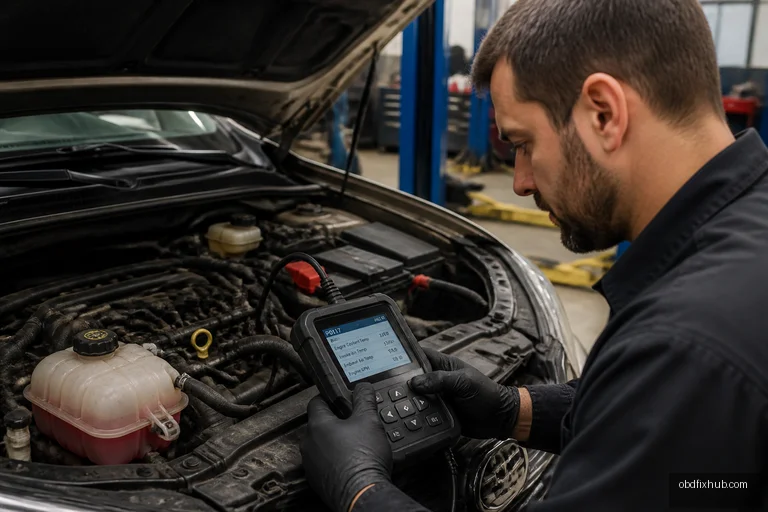
P00B1 means the vehicle has detected a range or performance problem in the radiator coolant temperature sensor circuit. In practical terms, the signal from the radiator-side coolant temperature sensor does not agree with what the engine computer expects. The fault may be a failed sensor, damaged wiring, poor connector contact, low coolant, or a cooling-system problem that makes the sensor reading look implausible.
This is an informational and diagnostic fault code, not a part-number diagnosis. Some vehicles use a separate radiator coolant temperature sensor, while others integrate it into a radiator outlet, hose assembly, or cooling module. Always confirm the exact definition and testing values in the service information for your make and model.
What Does P00B1 Mean?
P00B1 is an OBD-II trouble code for Radiator Coolant Temperature Sensor Circuit Range/Performance. The powertrain control module, or PCM, compares the radiator coolant sensor signal with other inputs such as engine coolant temperature, intake air temperature, vehicle speed, coolant pump operation, and cooling fan commands.
A cold engine should generally show coolant and ambient temperatures that are reasonably close. After warm-up, the radiator outlet temperature should change in a believable pattern as the thermostat opens. If the sensor reports an impossible value, changes too quickly, stays fixed, or disagrees with the rest of the cooling-system data, the PCM can store P00B1.
Common Symptoms of a Faulty Radiator Coolant Temperature Sensor
The symptoms depend on whether the sensor signal is too high, too low, intermittent, or simply inaccurate. A sensor that fails intermittently may only set the code during highway driving, after rain, or when the wiring moves with engine vibration.
- Check Engine Light or service-engine warning
- Cooling fans running continuously or not switching on correctly
- Engine temperature readings that jump, freeze, or do not match actual conditions
- Reduced air-conditioning performance when fan control enters a protective mode
- Poor fuel economy or altered engine operation
- Cooling fan operation after the ignition is switched off
- Overheating, especially if the sensor or wiring prevents proper fan control
- Stored companion codes for engine coolant temperature, cooling fan, thermostat, or coolant pump operation
Do not assume that a normal dashboard gauge clears the sensor. Many dashboards are heavily damped and may remain near the middle even when the computer is receiving an inaccurate signal.
What Causes P00B1?
The most common cause is an electrically faulty radiator coolant temperature sensor, but replacing it immediately is not always the best first move. I have seen P00B1 caused by a connector that looked clean externally but had coolant contamination inside the terminals. A partially backed-out terminal can pass a quick visual inspection and fail only when the vehicle is hot.
- Open, shorted, or chafed sensor wiring
- Corroded, loose, or coolant-contaminated connector terminals
- Failed thermistor inside the radiator coolant temperature sensor
- Low coolant level or air trapped in the cooling system
- Damaged radiator, hose, thermostat, electric water pump, or cooling fan
- Incorrect aftermarket sensor with the wrong resistance curve
- Rarely, a PCM driver, ground, or reference-voltage fault
A useful diagnostic clue is the freeze-frame data. If P00B1 was stored with the engine cold and the radiator sensor reported an extreme temperature, suspect the electrical circuit. If it appeared after a long drive with abnormal engine temperature, investigate coolant flow and fan operation before condemning the sensor.
How to Diagnose P00B1 Properly
Work carefully around the cooling system. Never remove a radiator cap or pressurized reservoir cap on a hot engine. Hot coolant can cause serious burns, and a fan may start unexpectedly even with the engine off.
- Scan all modules and record freeze-frame data. Note coolant temperature, radiator temperature, engine speed, vehicle speed, and fan command. Do not erase the code before saving this information.
- Check coolant level and visible leaks. Inspect the radiator, reservoir, hose connections, water pump area, and sensor mounting point. A low coolant level can expose the sensor to air and produce misleading readings.
- Compare live data on a cold engine. After the vehicle has sat overnight, radiator coolant temperature should usually be close to ambient temperature and engine coolant temperature. A reading such as -40 degrees or an implausibly high value strongly suggests an open or shorted circuit.
- Inspect the connector and harness. Look for green corrosion, bent pins, coolant inside the plug, broken locking tabs, rodent damage, and wiring rubbing against the radiator, fan shroud, or engine.
- Perform an electrical test. Using the manufacturer’s wiring diagram, verify the reference voltage, sensor ground, signal wire, and continuity back to the PCM. A digital multimeter and a back-probe adapter are safer than forcing test leads into connector terminals.
- Test sensor resistance only against the correct specification. Most coolant sensors are thermistors whose resistance changes with temperature, but the resistance curve differs by application. Never install a random resistor to imitate a sensor; the PCM also evaluates signal plausibility over time.
- Check cooling-system operation. Confirm thermostat operation, fan activation, coolant circulation, and radiator temperature changes. A sensor can be electrically sound while a stuck thermostat or failed fan creates a genuinely abnormal temperature pattern.
An especially effective test is a controlled wiggle test. With the scan tool displaying radiator temperature, gently move the harness and connector while the engine is cold and again after warm-up. If the reading suddenly jumps, the problem is likely an intermittent connection rather than the sensor element itself.
How Is P00B1 Fixed?
The repair depends on the failed component. A technician may replace the radiator coolant temperature sensor, repair a terminal, replace a damaged connector, restore a broken reference or ground circuit, bleed trapped air, or repair the cooling fan and thermostat system. Some vehicles require coolant draining and a new O-ring; reusing a flattened seal can create a small leak that returns the problem later.
After the repair, refill the system with the correct coolant mixture and bleed it according to the manufacturer’s procedure. Air pockets are particularly common after sensor replacement on systems with a high-mounted radiator hose or electric coolant pump.
Can You Still Drive With a Bad Coolant Temperature Sensor?
Only for a short distance if the engine temperature is stable and the cooling fan is operating correctly. P00B1 can cause the fan to run continuously, but on some vehicles it can also prevent accurate fan control. If the temperature warning light is on, the gauge is rising, steam is visible, coolant is leaking, or the fan does not operate, stop driving and arrange a tow.
Do not rely solely on the dashboard gauge. Monitor the temperature with a scan tool if possible, avoid heavy traffic and towing, and stop immediately if you smell boiling coolant. Continuing to drive an overheating engine can turn a relatively inexpensive sensor or wiring repair into a head-gasket, cylinder-head, or engine replacement bill.
How Do You Reset the P00B1 Code?
You do not reset a temperature sensor itself. You repair the underlying fault, then clear the diagnostic trouble code with an OBD-II scan tool. Disconnecting the battery may erase some codes on older vehicles, but it can also reset radio settings, idle adaptations, window calibration, and emissions readiness monitors, so it is not the preferred method.
After clearing P00B1, start the engine from cold and watch the radiator temperature data while the vehicle warms up. Complete the manufacturer-specific drive cycle and rescan for pending or confirmed codes. If P00B1 returns quickly, the circuit still has a fault; if it returns only after warm-up, focus on heat-related wiring damage, coolant flow, thermostat operation, and fan control.
Is It Expensive to Fix P00B1?
In many vehicles, a straightforward sensor replacement costs approximately $100 to $350, including parts and labor. A sensor that is easy to reach may cost less, while a sensor integrated into a radiator hose, outlet housing, or cooling module can increase parts and labor costs.
Electrical diagnosis commonly adds around $80 to $180, depending on shop rates and the time required to trace the circuit. Wiring repairs, connector replacement, coolant bleeding, or a failed fan module can raise the total significantly. Ask the repair shop whether the estimate includes diagnosis, coolant, O-rings, bleeding, and a post-repair scan.
Final Takeaway
P00B1 identifies a problem with the radiator coolant temperature sensor circuit, but it does not automatically mean the sensor is bad. Start with freeze-frame data, cold-engine live-data comparisons, coolant level, connector condition, and circuit testing. Fix the cause before clearing the code, then verify that the temperature signal changes smoothly and agrees with actual cooling-system operation.
Frequently Asked Questions
What are the most common symptoms of a faulty coolant temperature sensor?
Typical symptoms include a Check Engine Light, incorrect or unstable temperature data, abnormal cooling-fan operation, reduced air-conditioning performance, poor fuel economy, and possible overheating. Symptoms vary by vehicle and by the type of sensor failure.
Can low coolant cause P00B1?
Yes. Low coolant or air trapped near the sensor can produce an implausible radiator temperature reading. However, low coolant is usually a symptom of a leak, so inspect the system instead of simply topping it up and clearing the code.
Will replacing the sensor automatically clear P00B1?
No. The code may remain stored until it is cleared with a scan tool, although the Check Engine Light can eventually turn off after successful drive cycles. Always verify the repair by checking live data and rescanning for pending codes.
Can I diagnose P00B1 without replacing parts?
Yes. A scan tool, wiring diagram, digital multimeter, and careful visual inspection can often identify whether the fault is in the sensor, power supply, ground, signal wire, or cooling system. Testing before replacing parts prevents unnecessary sensor swaps.




